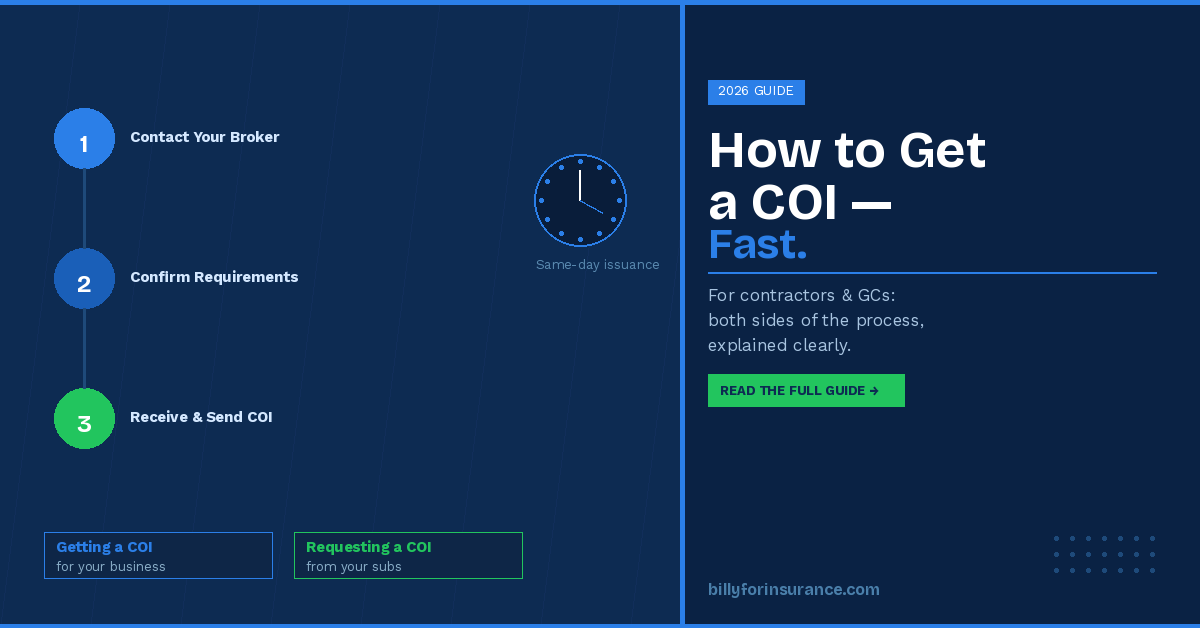
To get a certificate of insurance, ask your insurance broker or agent for one. Most brokers issue a standard COI within a few hours, and many insurers let you download one instantly from their online portal. It’s free. If you need to collect a COI from a subcontractor or vendor, jump to Part 2.
People search “how do I get a certificate of insurance” for two very different reasons, and the answer depends on which side you’re on.
How to Get a Certificate of Insurance for Your Own Business
-
Contact your insurance broker or agent
Your broker is the person or agency that manages your policy, and they’re the ones who issue the COI, not the insurance company. If you’re not sure who your broker is, check your policy documents, renewal notices or the invoices you pay for coverage.
Email or call and ask for a certificate of insurance. Have this ready:
- The name and address of the certificate holder, meaning the company asking for the COI
- Whether anyone must be added as an additional insured, and on which forms (CG 20 10 for ongoing operations, CG 20 37 for completed operations)
- The project name or description for the Description of Operations box
- Any coverage limits your contract requires
- Whether you need a waiver of subrogation or primary and non-contributory wording
The more you give your broker up front, the faster they can issue it and the less likely it is to come back rejected.
-
Check whether you can download it instantly
Many carriers have self-service portals where you can download a standard COI right away. Log in and look for a “Documents,” “Certificates” or “Proof of Insurance” section.
Portals usually only produce standard certificates. If your client needs additional insured status, specific endorsement wording or custom certificate holder details, you’ll still need your broker.
-
Review it before you send it
Take 60 seconds to check:
- The insured name matches your legal business name exactly
- The certificate holder name and address are correct
- Coverage isn’t expired, based on the effective and expiration dates
- Limits meet what your contract says
- Any required additional insured or endorsement wording appears in the Description of Operations
A COI with errors just gets rejected and the process starts over.
How long does it take to get a COI?
For a standard certificate with no endorsement changes, most brokers can issue a COI within a few hours, often faster. If your policy needs changes, such as adding an additional insured or raising limits to meet a contract, allow 24 to 48 hours for the broker to work it through with the carrier.
The fastest way to get a COI is to give your broker complete information on the first request. If you’re asked for COIs often, ask your broker about self-service options or a standing arrangement for future requests.
How much does a COI cost?
A standard certificate of insurance is free, because it simply documents a policy you already pay for. Your broker should issue it at no charge. Adding endorsements such as additional insured status can carry a small charge from the carrier, depending on your policy, but on standard construction contracts it’s often included.
What Contractors and Subcontractors Need on a COI
If you’re a contractor or subcontractor, the GC or owner will tell you what they need. Most construction contracts ask for some version of this:
| Coverage | Common minimum | Often required with it |
|---|---|---|
| General liability | $1M per occurrence / $2M aggregate | Additional insured (CG 20 10 and CG 20 37), primary and non-contributory, waiver of subrogation |
| Commercial auto | $1M combined single limit | Additional insured, waiver of subrogation (CA 04 44) |
| Workers compensation | Statutory limits | Waiver of subrogation (WC 00 03 13) |
| Employer’s liability | $1M each accident | Usually listed on the workers comp line |
| Umbrella / excess | $1M to $5M+, depending on project size | Follow-form over GL, auto and employer’s liability |
These are typical figures, not rules. Your contract’s insurance exhibit is what counts, so send it to your broker with your request.
For subcontractors: the most common reason a COI is rejected is missing endorsements, not low limits. Ask your broker to attach the endorsement pages, not just mention them on the certificate. Here’s why that matters.
Part 2
How to Request a COI From a Subcontractor or Vendor
If you’re a GC, property manager or owner, “getting a COI” means collecting proof of insurance from the vendors and subs working for you. This is where most of the compliance work lives.
-
Know what you need before you ask
Before you send a request, know exactly what your contract requires. The most common items:
- Coverage types: general liability, auto, workers comp, umbrella, and sometimes professional liability or builder’s risk
- Minimum limits, such as $1M per occurrence and $2M aggregate for GL
- Additional insured status: CG 20 10, CG 20 37, or both. See our guide to CG 20 10 and CG 20 37 endorsements.
- Waiver of subrogation, so the sub’s insurer can’t come after you if it pays a claim. See CG 24 04.
- Primary and non-contributory wording, so the sub’s policy pays before yours
- Certificate holder details: your exact company name and address
A vague request gets you vague COIs. The more specific you are, the less back and forth.
-
Send a written COI request
Put your requirements in writing before work starts, ideally in the subcontract itself. Use our sample letter to request COIs from subcontractors as a starting point, or our COI request script and email template.
Ask the sub to forward your requirements to their broker, since the broker issues the certificate. Subs often don’t know the details, so a clear written summary prevents errors.
-
Review the COI when it arrives
Don’t just file it. Check it against your contract. The most common problems:
- Limits below your contract minimums
- Missing or wrongly worded additional insured endorsements
- Insured name doesn’t match the entity under contract
- Policies that expire mid-project with no renewal plan
- No waiver of subrogation or primary and non-contributory wording
For the full process, see how to review a certificate of insurance. The difference between being listed and being covered trips up a lot of teams, so read certificate holder vs. additional insured too.
-
Track expirations and renewals
Collecting a COI once isn’t enough. Policies usually renew every year, so a certificate that was valid at kickoff may be expired months later when you need it. You need a way to track every expiration date and request renewals before a gap opens.
Many teams start with a free COI tracking spreadsheet. As subs and projects grow, manual tracking gets risky: certificates slip through, follow-up emails pile up, and pre-kickoff reviews turn into fire drills.
How to Manage COI Collection at Scale
When you’re managing dozens or hundreds of subs and vendors, the real question isn’t how to get one COI. It’s how to stay compliant across every project, all the time.
COI tracking software handles this by:
- Sending COI requests to vendors and their brokers automatically
- Reading certificates and endorsements with AI, with no manual data entry
- Flagging non-compliant or expired certificates right away
- Sending renewal reminders before policies lapse
- Keeping a complete audit trail for each vendor and project
- Connecting to Procore, Sage, Autodesk and your other systems
Billy is built for construction teams doing exactly this. It cuts out the manual chasing and gives your compliance team one place to see every vendor’s status on every project. You can also pair COI collection with subcontractor prequalification to check insurance, licensing and safety records before a vendor is approved.
Managing COIs across multiple projects?
Billy automates COI requests, AI review and expiration tracking for every vendor, so your team stops chasing and stays ahead.
Request a demoFrequently Asked Questions
Who issues a certificate of insurance?
The insured’s insurance broker or agent issues it, not the insurance company directly. The broker prepares the certificate for their client and sends it to whoever asked for it.
Can I make my own certificate of insurance?
No. A COI has to come from your licensed broker, agent or carrier. Creating or editing one yourself can be treated as insurance fraud, and GCs and owners can verify certificates with the issuing agency.
Can I request a COI from any insurer?
Only for a policy you hold or that names you. If you need a COI from someone else, such as a subcontractor, you ask them, and they ask their broker.
What if a subcontractor won’t provide a COI?
That’s a red flag. Most construction contracts make proof of insurance a condition of starting work. A sub who can’t or won’t provide one may have a lapsed policy, too little coverage or no insurance at all. Don’t let work start until you have a valid, compliant certificate. Our guide to common COI compliance misconceptions covers what to watch for.
How long is a COI good for?
As long as the policies listed on it are active. Most commercial policies renew every year, so most COIs effectively expire within 12 months. Check the expiration date of every policy on the certificate.
Can I get a COI if I don’t have insurance?
No. A COI can only be issued for an active policy. If you don’t have the required coverage, you’ll need to buy a policy first. Share your contract requirements with your broker before you buy, so the policy is set up correctly from the start.
What’s the difference between a COI and an insurance policy?
A COI is a one-page summary that shows a policy exists. It doesn’t contain the policy’s full terms, conditions or exclusions. Only the policy itself defines what’s covered. See what a COI is and how to read one.
Summary
Getting a certificate of insurance comes down to two situations. If you need one for your own business, give your broker the full details: certificate holder, additional insured requirements, limits and project description. Most can turn it around the same day.
If you need COIs from subs and vendors, send a clear written request with your exact requirements, review every certificate you receive, and track renewals so nothing expires mid-project. Spreadsheets work up to a point. Past that, the risk of something slipping through gets too high.