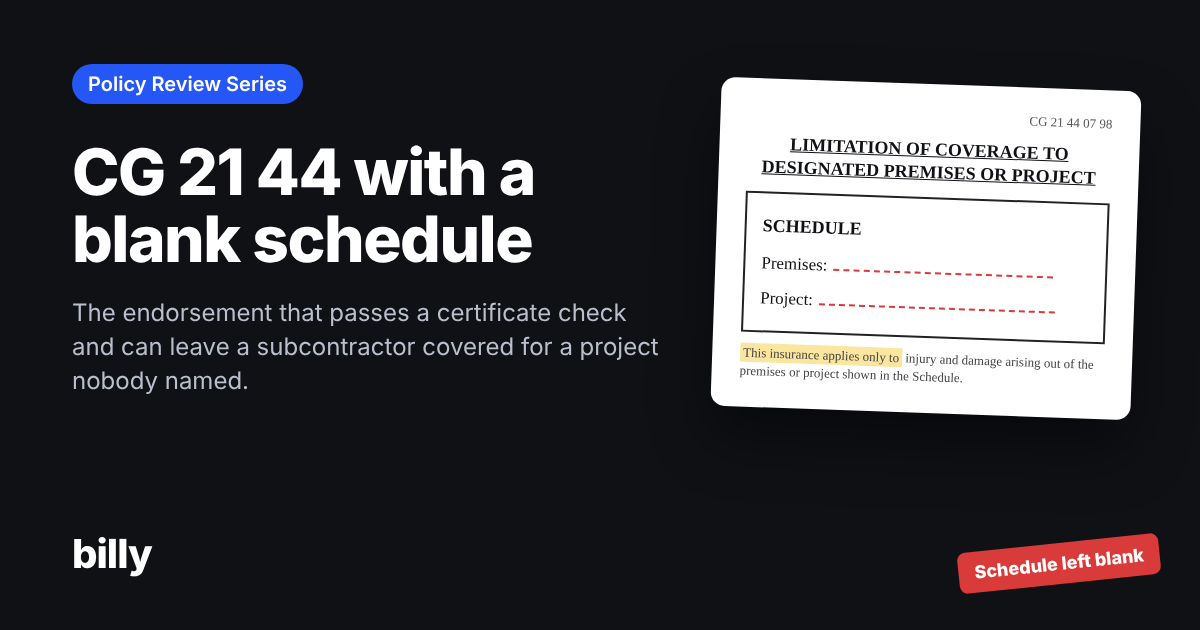
- CG 21 44, “Limitation of Coverage to Designated Premises or Project,” is an ISO endorsement that limits a general liability policy to the premises or project listed in its schedule.
- Policy reviewers at RiskRemedy report seeing it this year on nearly one hundred New York City steel erectors’ policies with the schedule left blank.
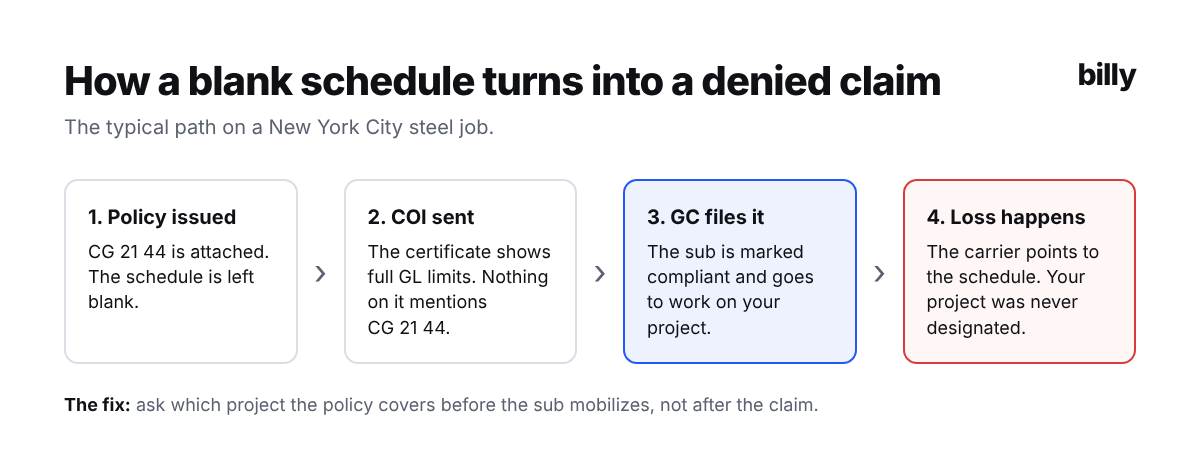
- A certificate of insurance will not show it. The ACORD 25 lists full limits, the GC files it, and nobody asks which project the policy actually covers.
- If the schedule is blank, the form points to the Declarations. If your project is not named there, you may be relying on coverage that does not apply to your job.
The basicsWhat is the CG 21 44 endorsement?
The 07 98 edition is titled “Limitation of Coverage to Designated Premises or Project.” The current 04 17 edition adds “or Operation” to the title and narrows the premises wording further. The operative language is short:
Premises:
Project:
This insurance applies only to “bodily injury,” “property damage,” “personal and advertising injury” and medical expenses arising out of:
- The ownership, maintenance or use of the premises shown in the Schedule and operations necessary or incidental to those premises; or
- The project shown in the Schedule.
That wording reaches all three coverage parts of a standard CGL policy:
There are legitimate reasons to use this form. Carriers attach it to policies written for a single building, a vacant lot, or one specialty project that does not fit an insured’s main program. For a contractor who moves from job to job all year, it is a very different story.
The trendWhy a blank schedule is the real problem
The CG 21 44 schedule has two lines: Premises and Project. Directly under it, the form says that if no entry appears, the information will be shown in the Declarations.
So a blank schedule is not the end of the review. It is a pointer. The first place to look is the Declarations page. In the pattern RiskRemedy describes, the project was not listed there either. The policy is limited to a project that was never named.
That leaves the GC with three uncomfortable possibilities:
The Declarations name a different project. The policy covers that job, not yours.
The Declarations name nothing. The carrier may argue the policy covers no project at all. Whether a court agrees depends on the wording, the facts and the jurisdiction, and nobody wants to find out during a claim.
Someone intends to fill it in later. An endorsement that can be completed after the fact is not one you can verify when you approve the sub.
Which raises the obvious question: why attach the endorsement at all? Sometimes it is a pricing tool. Sometimes it is a leftover from a program built for a different insured. Either way, it is the GC’s risk to catch.
Who it hitsWhy steel erectors in New York City are the pattern
Yehuda Daniel Katz, cofounder and CEO of RiskRemedy, is sharing six endorsements his team keeps finding on contractors’ general liability policies. Almost none of them say “Exclusion” in the title, and every one of them passes a certificate check. CG 21 44 is the first.
A steel erector works project to project. The certificate shows full limits, and then the GC files it. Nobody really asks which project the policy actually covers.
Steel erection is one of the highest severity trades on a site. Falls, dropped loads and crane incidents produce the kind of bodily injury claims that test every word of a policy, and New York’s Labor Law sections 240 and 241 already put GCs and owners in a tough spot on gravity related injuries. A policy limited to one designated project, with the schedule left blank, does not fit how a steel erector actually operates.
If you approve steel, concrete, demolition, roofing or any other high hazard trade, this is the first endorsement to search for.
Approving steel subs in New York? See how Billy flags endorsements like this before a sub reaches your site.
Book a demoThe blind spotWhy your COI review will not catch CG 21 44
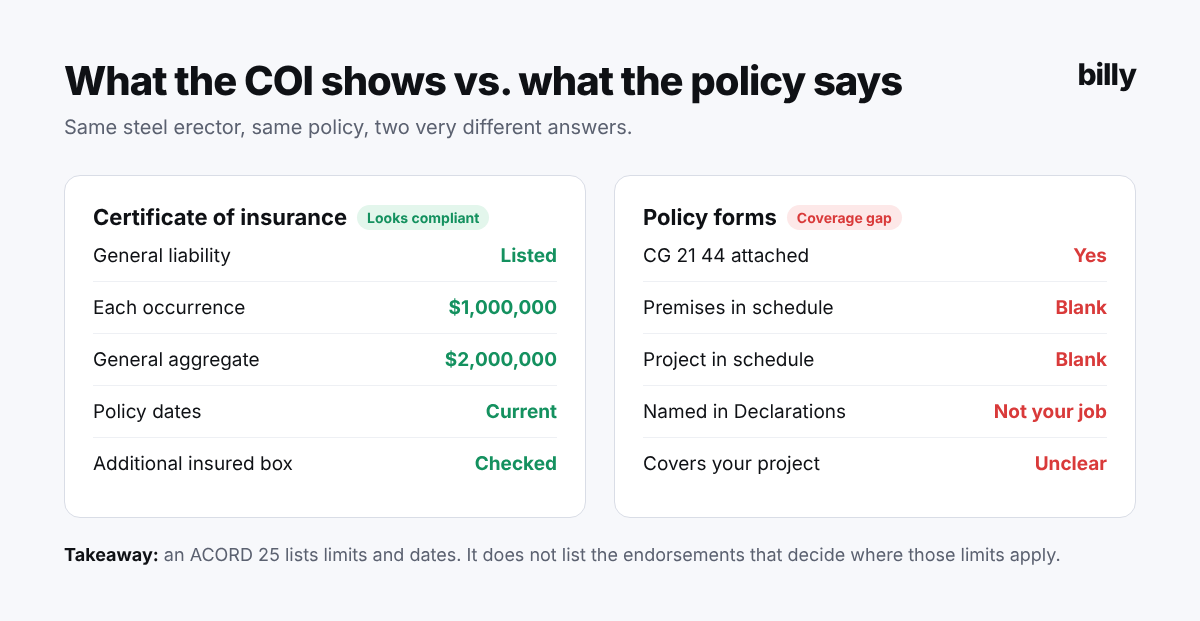
A certificate of insurance is a summary. The ACORD 25 shows policy types, numbers, dates and limits. It has no field for limiting endorsements, and it states that it confers no rights and does not amend the policy.
That is how a steel erector with CG 21 44 and a blank schedule can show $1,000,000 per occurrence, current dates and a checked additional insured box. On paper, the sub is compliant. In the policy, your project may not be covered.
| What you check | Shows CG 21 44? | What it tells you |
|---|---|---|
| Certificate of insurance (ACORD 25) | No | Limits, dates, carriers, policy numbers |
| Additional insured endorsement (CG 20 10, CG 20 37) | No | Who is covered as an additional insured, not where the policy applies |
| Schedule of forms | Yes | Whether CG 21 44 or a carrier version is attached |
| CG 21 44 schedule and Declarations | Yes | Which premises or project the policy actually covers |
This also matters for your additional insured status. Being named on a CG 20 10, CG 20 37 or primary and noncontributory endorsement only helps if the underlying policy applies to the work in the first place. If CG 21 44 limits the policy to another project, your AI status on your project can be worth very little.
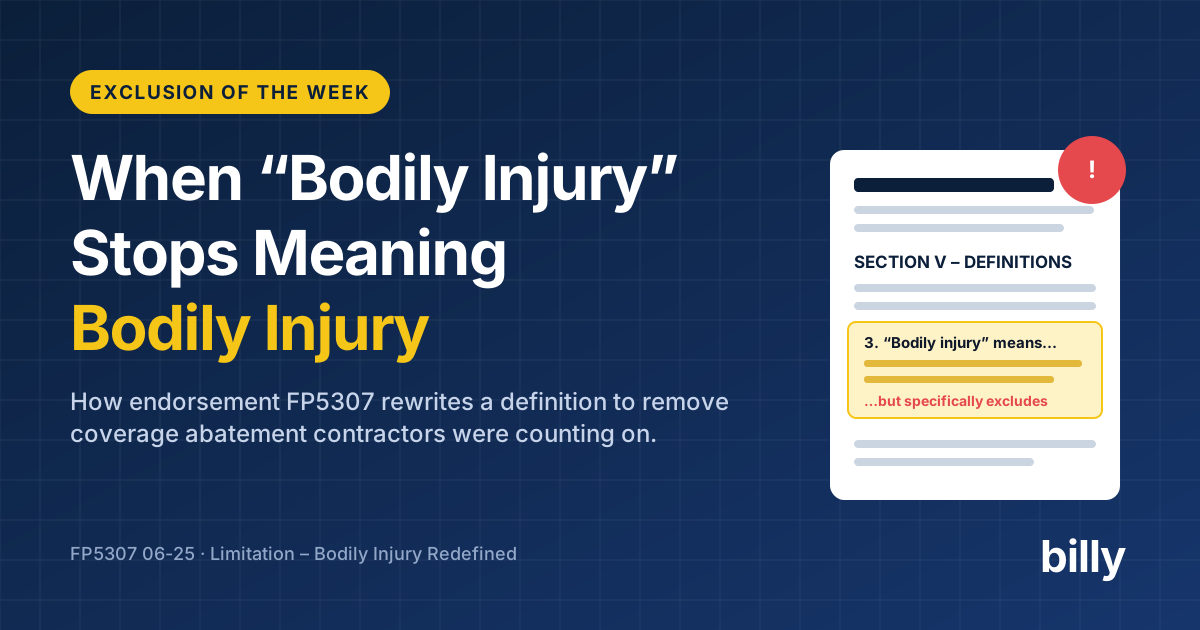
We have seen the same pattern with definitions. Last week’s post on the Bodily Injury Redefined endorsement showed how a form can remove coverage without the word “exclusion” anywhere in its title. CG 21 44 does the same thing with geography.
The checklistHow to review a subcontractor policy for CG 21 44
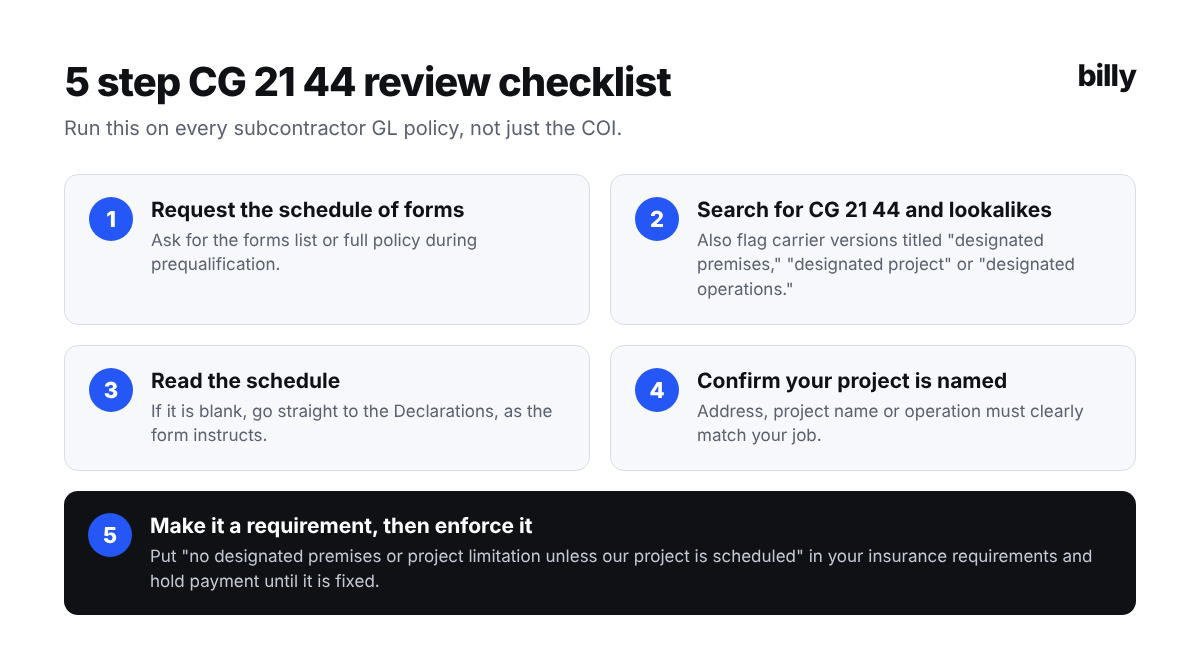
- Request the schedule of forms.Ask for the forms list or full policy during subcontractor prequalification, before the subcontract is signed. That is when you have leverage.
- Search for CG 21 44 and lookalikes.Carriers and E&S markets often use their own form numbers. Flag any title with “designated premises,” “designated project,” “designated operations” or “limitation of coverage to.”
- Read the schedule.If it is blank, go to the Declarations, exactly as the form instructs.
- Confirm your project is named.The address, project name or described operation should clearly match your job. “Various” or nothing at all is not a match.
- Make it a requirement, then enforce it.Add a line to your insurance requirements: no designated premises or project limitation unless our project is scheduled. Then hold onboarding or payment until it is fixed, the same discipline you already apply to waiver of subrogation and AI endorsements.
For a step by step walkthrough of the rest of the review, see how to review a certificate of insurance.
The platformHow Billy helps GCs catch limiting endorsements
Manual endorsement review does not scale when you have hundreds of subs and thousands of policy pages. Billy is built to take that work off your team.
Subs and brokers upload COIs, endorsements and policy forms with no login. Automated follow ups chase what is missing. See how to request COIs from subs.
The AI Review Assistant reads COIs and endorsements line by line, so limiting forms surface for your team instead of hiding on page 40.
Syncs projects and vendors from Procore and connects to Sage 300 and Viewpoint Vista to hold payment on noncompliant subs.
With Billy Managed Services, our team handles collection, review and follow up end to end.
For producersWhat this means for brokers
Katz makes a point worth repeating for the broker side. Plenty of insureds are happy with their premium, so price alone will not win the account. Asking the owner to show you which project the policy covers will.
A blank CG 21 44 schedule is a concrete, documented gap a producer can bring to a contractor and fix. If you are a broker or carrier working with construction clients, see how Billy works with brokers and carriers.
On the roadMeet the team behind the reviews
Billy is built in Brooklyn by people who have spent years inside construction compliance. You will find us at the events where GCs, CFOs and risk managers compare notes. Learn more about Billy.
Stop finding coverage gaps after the claim
Billy collects and reviews subcontractor insurance against your requirements, syncs vendors from Procore, and keeps every project audit ready.
Or grab our free COI tracking template.
FAQFrequently asked questions
What is the CG 21 44 endorsement?
CG 21 44 is an ISO endorsement titled “Limitation of Coverage to Designated Premises or Project” (07 98) or “Limitation of Coverage to Designated Premises, Project or Operation” (04 17). It limits a commercial general liability policy to injury, damage and medical expenses arising out of the premises, project or operation shown in its schedule.
What happens if the CG 21 44 schedule is blank?
The form says that if no entry appears in the schedule, the required information will be shown in the Declarations. Check the Declarations first. If your project is not named there either, the policy may not cover work on your project, even though the certificate of insurance shows full limits.
Does a certificate of insurance show CG 21 44?
No. An ACORD 25 certificate shows policy types, numbers, dates and limits. It does not list limiting endorsements. To find CG 21 44 you need the schedule of forms or the full policy.
Is CG 21 44 an exclusion?
It does not say “exclusion” in its title, but it works like one. By limiting coverage to designated premises or projects, it removes coverage for everything else. That is why it passes a quick COI review.
Why would a contractor’s policy include CG 21 44?
The form is designed for policies written for a single location or project. On a contractor who works project to project, it may be a pricing tool, a leftover from another program, or a schedule that was never completed. In each case the GC should confirm the project is named before approving the sub.
How is CG 21 44 different from a wrap up exclusion?
A wrap up exclusion such as CG 21 54 removes coverage for a project insured under an OCIP or CCIP. CG 21 44 limits coverage to the designated project and removes coverage everywhere else.
How can general contractors catch CG 21 44 at scale?
Require the schedule of forms during prequalification, add a “no designated premises or project limitation” line to your insurance requirements, and use compliance software like Billy to review endorsements against those requirements and hold noncompliant subs before payment.
- ISO CG 21 44 04 17 form (IIAT)
- IA Magazine: What Is the Limitation to Designated Premises Endorsement?
- RiskRemedy policy review series by Yehuda Daniel Katz
This article is for general educational purposes and is not legal or insurance advice. How any endorsement applies depends on the full policy, the facts of a claim and the governing jurisdiction. Talk to your broker or coverage counsel about your specific program.