A certificate of insurance tells you a subcontractor is covered if someone gets hurt or something gets damaged. It doesn’t tell you whether they can finish the job. Subcontractor bonding capacity does.
That question belongs to the surety. When a surety sets a subcontractor’s bond limits, it’s putting a dollar figure on how much work that company can carry. The aggregate bonding limit reflects the underwriter’s view of whether the subcontractor has the financial and operational capacity to run multiple projects at the same time. It’s one of the most useful signals a general contractor can get, and most compliance software stores it as a PDF and never looks at it again.
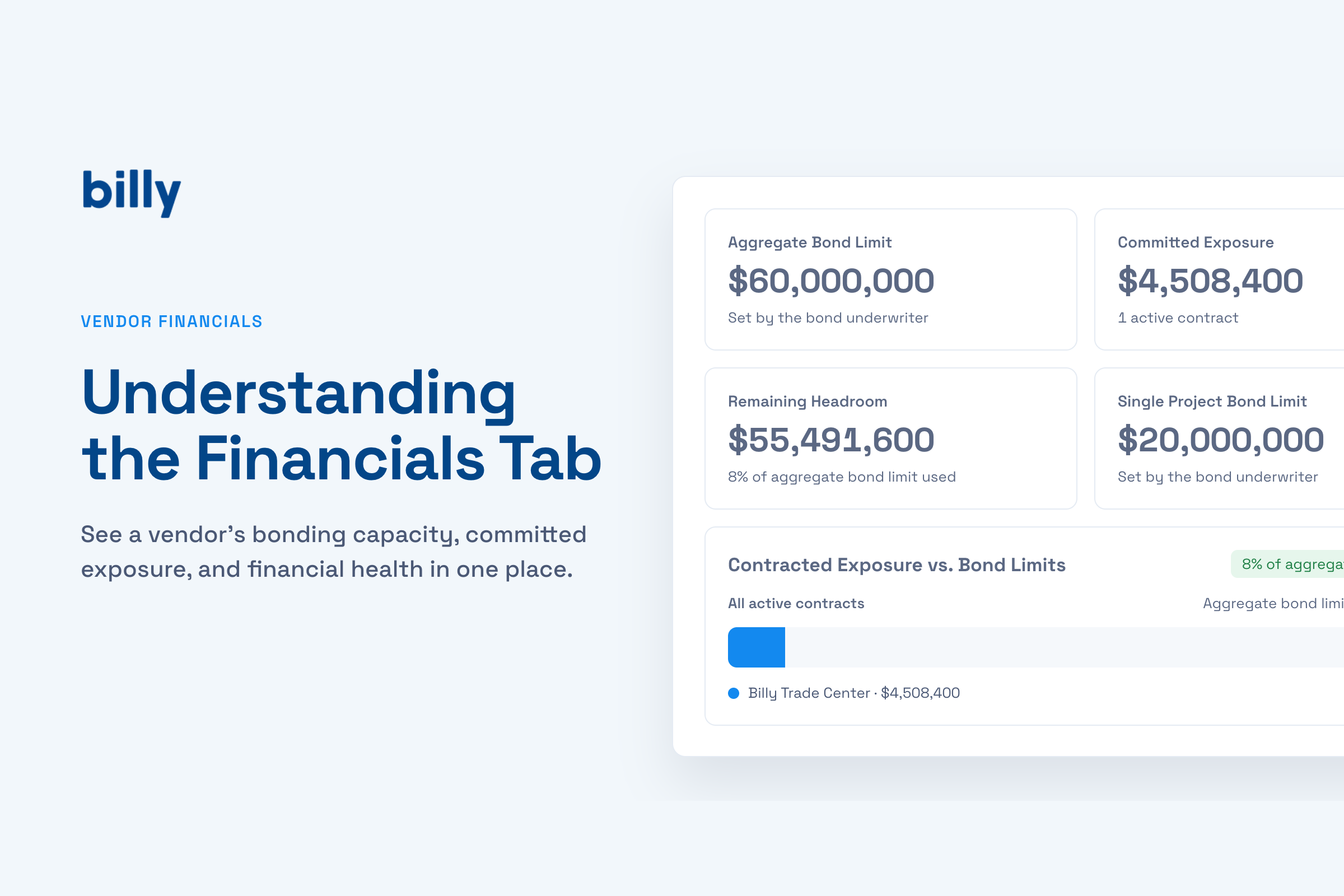
Billy’s Financials tab changes that. It compares each subcontractor’s bond limits to the contracts you’ve awarded them, so you can see exactly how much of their capacity you’re using before you award the next job.
Where subcontractor bonding capacity gets lost in prequalification
Most GCs collect bonding information at prequalification. A thorough subcontractor prequalification form asks for bonding capacity for both single projects and in aggregate, documented with a letter from the surety or agent. Then the letter gets filed, and the number never gets compared to anything.
That’s a problem, because bond limits only mean something in relation to workload. A subcontractor with a $20M single project limit is a safe choice for a $4M scope and a risky one for a $19M scope. A $60M aggregate limit looks generous until you learn the sub already has $50M of signed work with other GCs.
The limit is fixed. What changes is how much of it has already been spoken for.
Prequal experts say to check this directly: call the bonding agent to confirm the stated aggregate limit and remaining capacity, and ask whether the surety is worried about the sub’s workload. That’s good advice, and almost nobody has time to do it for every sub on every award.
How Billy’s Financials tab works
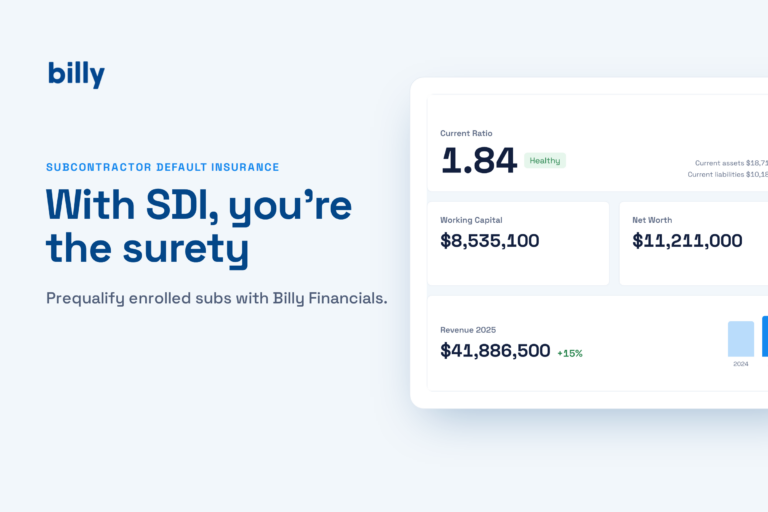
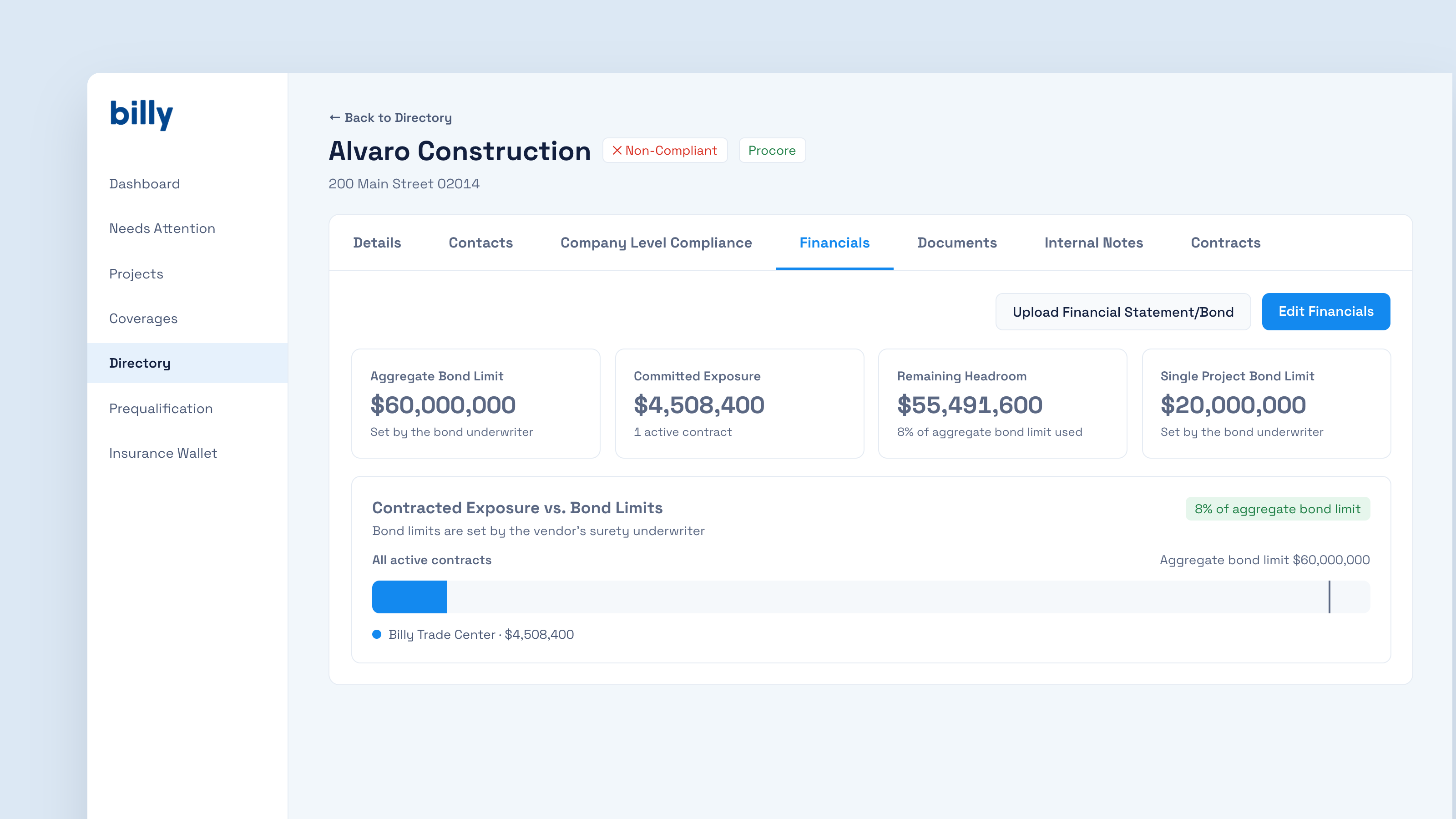
The Financials tab sits on every vendor profile in Billy’s Directory. It turns bonding letters and financial statements into a live view of subcontractor bonding capacity.
- Upload once, Billy extracts the figuresUpload a surety letter or financial statement as a PDF, and Billy reads it and fills in the bond limits and financial metrics. When the surety issues a new letter, upload it and the numbers update.
- Committed exposure calculates itselfBilly adds up the contract amounts on every active contract you have with that vendor, across all projects that aren’t frozen. Contract amounts sync from your project records, so there’s nothing to type in twice.
- Remaining headroom is always currentBilly subtracts committed exposure from the aggregate bond limit and shows how much more bonded work the vendor can take on, plus the percentage of their limit you’re already using.
- Single-project limits get checked tooA separate bar compares the vendor’s largest contract with you against their single project bond limit and shows how far under (or over) the limit it is.
- Financial health sits alongside bondingThe same tab shows current ratio (flagged as healthy at 1.50 or above, worth watching between 1.20 and 1.50, and a concern below 1.20), working capital, net worth, line of credit, current backlog, and revenue history from the prequal form.
What this looks like on a real vendor
Take a mechanical subcontractor whose surety letter shows a $60M aggregate limit and a $20M single project limit. You’ve awarded them one $4.5M contract.
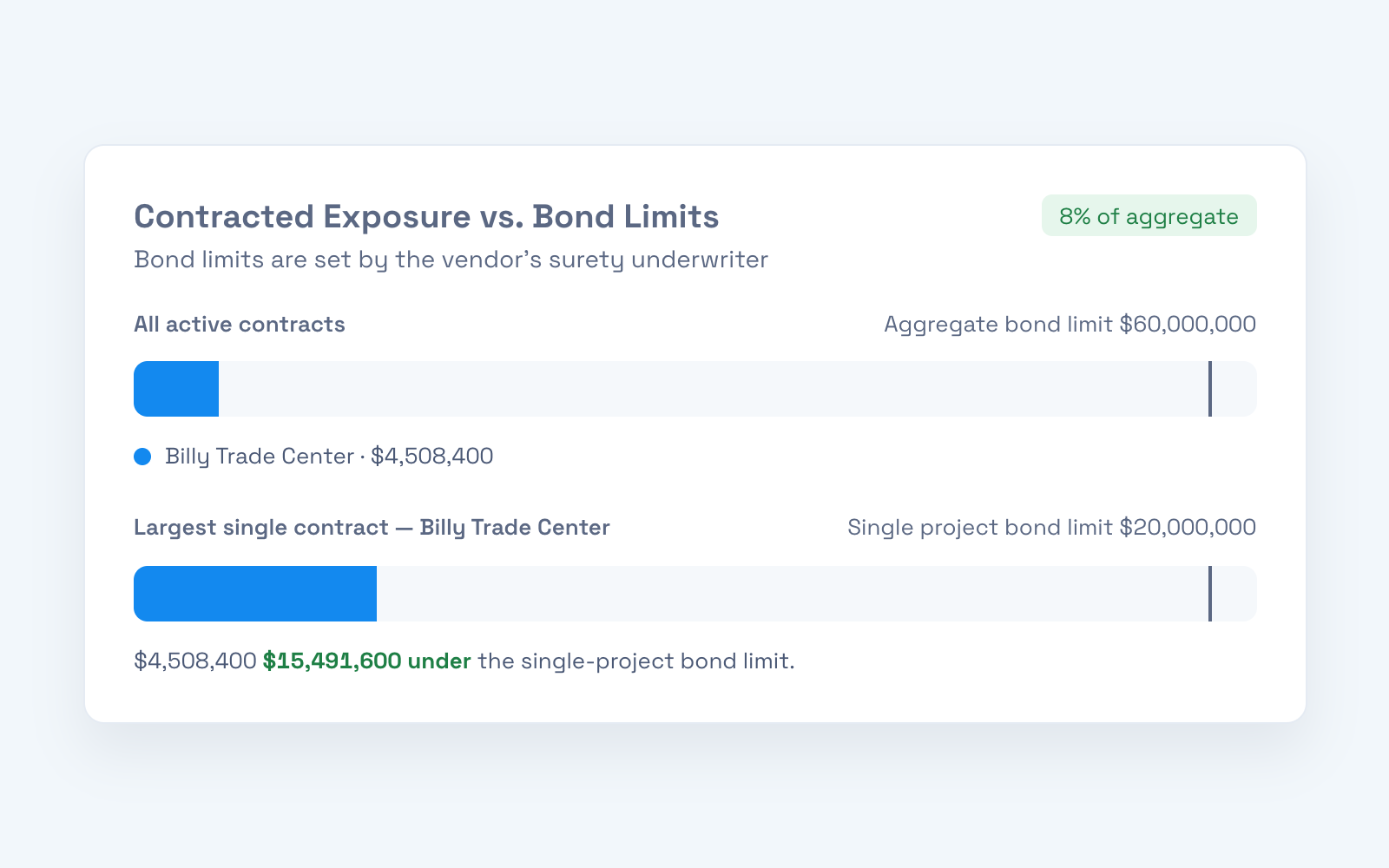
That looks comfortable. Then you check the Financial Capacity section: the sub reports $22.3M in backlog across all their customers, a backlog-to-aggregate ratio of 0.37×. That’s still reasonable, but now you know the full picture. If the next bid is a $25M package, you’ll see immediately that it’s over their single project limit before anyone signs anything.
Two ratios most GCs never calculate
Backlog ÷ aggregate bond limit
Backlog vs. aggregate bond limit
Everything the sub has signed, for every customer, divided by what their surety will back. As this ratio approaches 1.0, the sub has less room to absorb a problem job.
Your exposure ÷ annual revenue
Committed vs. latest revenue
Your exposure as a share of the sub’s annual revenue. If you make up most of a sub’s book, a slowdown on your projects hits their cash flow hard, and a problem on their side hits your schedule just as hard.
Both ratios need data from more than one source: bond letters, your contracts, and the vendor’s own reported figures. That’s why they rarely get calculated by hand, and why keeping them in one place matters.
If you run a subcontractor default insurance program, these ratios carry even more weight, because you carry the deductible when a sub fails. See how SDI contractors use Billy Financials.
How Billy compares to other COI platforms
Most compliance platforms are built around the certificate of insurance. That’s valuable, but it’s a different job from tracking subcontractor bonding capacity against awarded work.
Jones collects COIs and policy documents, checks coverage against your requirements, handles vendor email follow-up, and tracks compliance status. For deeper prequalification, Jones partnered with Bespoke Metrics’ COMPASS rather than building it into its own product.
TrustLayer positions itself around automating verification of insurance, licenses, and compliance documents for vendors, subcontractors, tenants, and other business partners.
myCOI offers COI tracking and storage for teams that want straightforward dashboards and reporting. See our Billy vs. myCOI comparison.
HoundDog automates COI collection and verification and can also gather documents like contractor agreements, MSAs, and W-9s. See our Billy vs. HoundDog comparison.
BCS goes furthest on financials among these, offering creditworthiness assessments built on Experian commercial bureau data. A credit score measures general financial risk. It doesn’t tell you how much bonded work a sub’s surety will back, or how much of that you’ve already used.
None of these platforms publicly document tracking a subcontractor’s surety bond limits against the contracts you’ve awarded. Billy does that on every vendor profile, next to COIs, W-9s, licenses, and prequalification.
| Platform | Tracks COIs | Surety bond limits as data | Committed exposure from your contracts | Remaining bonding headroom |
|---|---|---|---|---|
| Billy | Yes | Yes | Yes | Yes |
| Jones | Yes | Not documented | Not documented | Not documented |
| TrustLayer | Yes | Not documented | Not documented | Not documented |
| myCOI | Yes | Not documented | Not documented | Not documented |
| HoundDog | Yes | Not documented | Not documented | Not documented |
| BCS | Yes | Not documented (offers credit screening) | Not documented | Not documented |
Based on each vendor’s publicly available materials as of September 2026. For a wider look at the category, see the best vendor prequalification software for construction.
Frequently asked questions
What is subcontractor bonding capacity?
Bonding capacity is the amount of bonded work a surety will guarantee for a subcontractor. It’s usually expressed as a single project limit (the largest single contract the surety will bond) and an aggregate limit (the total bonded work the sub can carry at one time).
Why should a GC track subcontractor bonding capacity after prequalification?
Bond limits are fixed, but a subcontractor’s workload changes with every award. Tracking committed exposure against the limit tells you whether a sub can realistically take on the next job.
Does Billy verify the vendor’s financial figures?
Bond limits come from the surety’s letter. Figures such as current ratio, working capital, net worth, and backlog are self-reported by the vendor, and Billy labels them that way so your team knows what’s been verified and what hasn’t.
Where does committed exposure come from?
Billy adds up the contract amounts on the vendor’s active contracts across all non-frozen projects. Contract amounts sync from your project records.
See your subcontractors’ real capacityA COI shows that a subcontractor is insured. Billy shows whether they can carry the work you’re about to give them.
Book a demo