
Free tool · IRS Form W-9 (Rev. March 2024)
Fill out Form W-9 online in a few minutes, then download it or email it to the business that asked for it. It’s free, and you don’t need an account.
Fill out your W-9 now Uses the current IRS revision · No account · Free
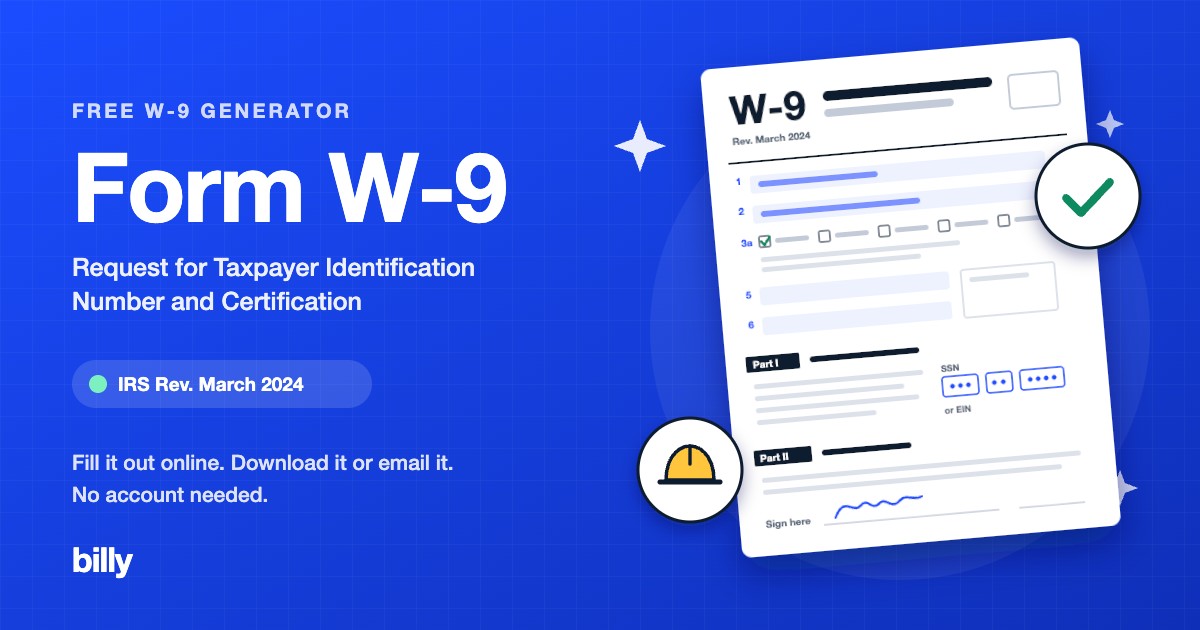
Form W-9 is the IRS form you use to give your legal name, tax classification and taxpayer identification number (SSN or EIN) to a business that’s going to pay you. The business uses it to file information returns such as Form 1099-NEC. You give the W-9 to the business that asked for it. You don’t send it to the IRS.
How the W-9 generator works
Enter your details
Name, business name, address, tax classification and your SSN or EIN. Each field explains what goes there.
Review and certify
Check everything, then sign the certification in Part II, the same as you would on paper.
Download or email
Save a PDF of your completed W-9 or email it straight to the business that requested it.
How to fill out Form W-9, line by line
The current form is the March 2024 revision. It keeps the same layout as the 2018 version, with one addition: line 3b, for partnerships, trusts and estates with foreign owners.
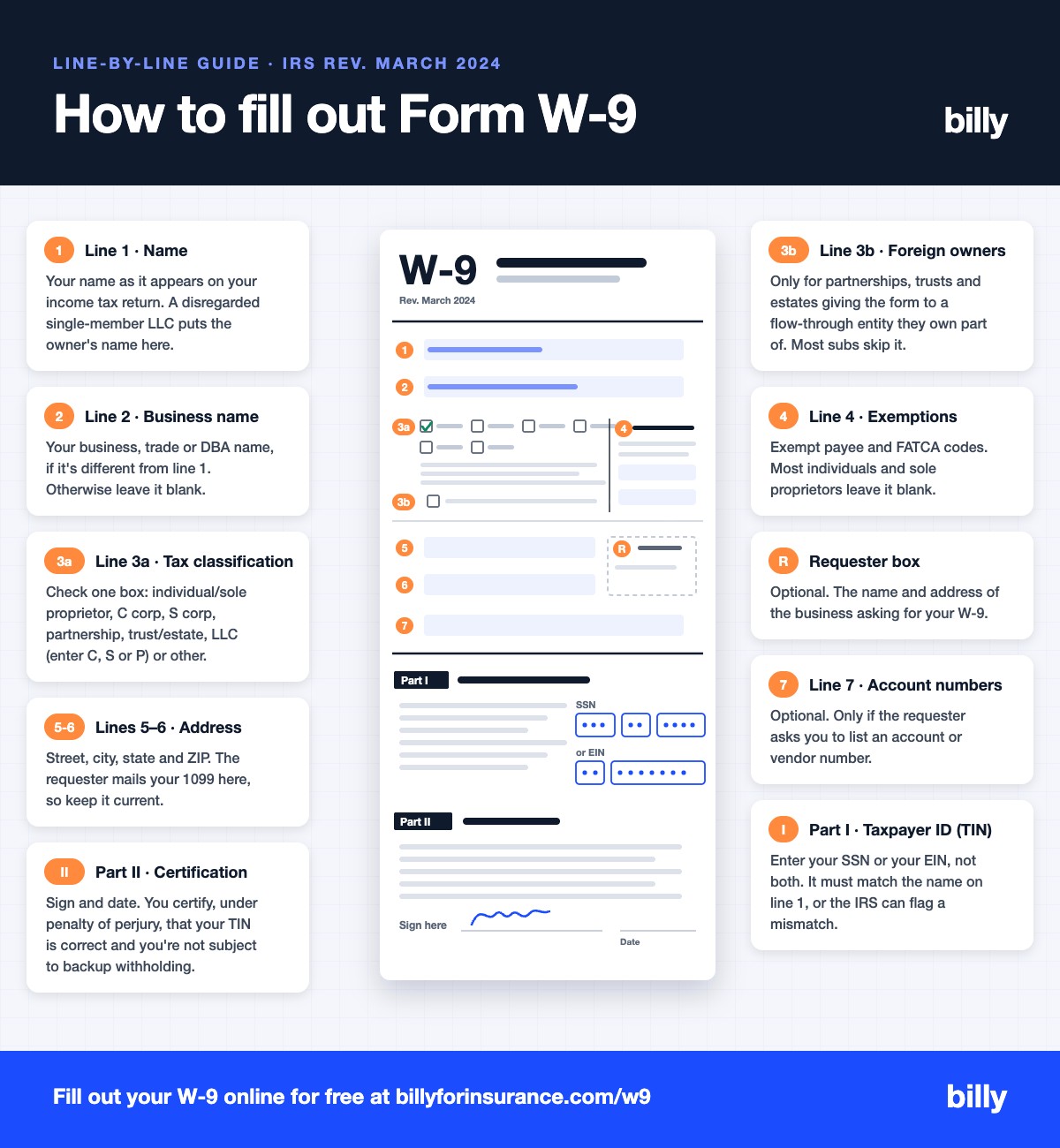
| Line | What goes there | Watch out for |
|---|---|---|
| 1 · Name | Your name as shown on your income tax return. | A single-member LLC that’s disregarded for tax purposes enters the owner’s name here, not the LLC’s. |
| 2 · Business name | Your business, trade or DBA name, or the disregarded entity’s name, if different from line 1. | Leave it blank if it’s the same as line 1. |
| 3a · Tax classification | Check one box: individual/sole proprietor, C corporation, S corporation, partnership, trust/estate, LLC or other. | If you check LLC, enter C, S or P for how the LLC is taxed. |
| 3b · Foreign owners | A checkbox for flow-through entities with direct or indirect foreign partners, owners or beneficiaries. | It only applies when a partnership, trust or estate gives the form to another flow-through entity it owns part of. A sub giving a W-9 to a GC usually leaves it blank. |
| 4 · Exemptions | Exempt payee code and FATCA exemption code. | Most individuals and sole proprietors leave both blank. Check the IRS instructions before entering a code. |
| 5–6 · Address | Street address, city, state and ZIP. | Your 1099 is mailed here, so use an address you’ll still have in January. |
| 7 · Account numbers | Optional account or vendor numbers. | Only fill it in if the requester asks. |
| Part I · TIN | Your SSN or your EIN. | Use the number that matches the name on line 1. A name and TIN that don’t match is the most common W-9 problem. |
| Part II · Certification | Your signature and the date. | You’re certifying under penalty of perjury that the TIN is correct and that you’re not subject to backup withholding. If the IRS has told you that you are, cross out item 2. |
Who needs to fill out a W-9?
A business asks you for a W-9 when it’s going to pay you and may need to report the payment to the IRS. In construction that usually means:
- Subcontractors and trade partners before their first payment from a general contractor.
- Independent contractors and sole proprietors working on a 1099 basis.
- Suppliers, equipment rental companies and consultants when a GC or owner sets them up as a vendor.
Form W-9 is for US persons, including resident aliens. Foreign individuals and entities use a Form W-8 instead.
Common W-9 mistakes that hold up payment
The name and TIN don’t match
An LLC owner puts the LLC’s name on line 1 and their own SSN in Part I, or the reverse. When the IRS can’t match the name to the number, the payer gets a notice and may have to start backup withholding.
The wrong box on line 3a
LLCs are the usual problem. Check the LLC box and enter C, S or P. A single-member LLC that’s disregarded checks the box for its owner instead.
No signature
An unsigned W-9 doesn’t certify anything. Sign and date Part II before you send it.
An old revision
W-9s you’ve already given don’t expire, but new requests should use the March 2024 revision. The generator on this page uses it.
W-9 and COI: why contractors are asked for both
When a general contractor, property manager or client onboards a new subcontractor or vendor, they usually ask for two documents at the same time: a W-9 and a COI (certificate of insurance). They answer different questions. The W-9 tells the payer who you are for tax purposes. The COI shows that you carry the insurance the contract requires.
| W-9 | COI | |
|---|---|---|
| What it is | IRS form with your legal name, tax classification, address and taxpayer identification number (TIN) | A one-page summary of your insurance policies, usually on the ACORD 25 form |
| Who fills it out | You, the payee | Your insurance broker, agent or insurer |
| What it proves | Your TIN, so the payer can file a 1099 and avoid backup withholding | That you carry the required coverage and limits as of the date it was issued |
| When it’s needed | Before the first payment | Before you start work, and again when a policy renews |
| Does it expire? | No. Fill out a new one when your name, entity, TIN or address changes | It lists each policy’s expiration date; a new one is needed after renewal |
| Who keeps it | The payer’s accounts payable team. It isn’t filed with the IRS | The GC’s compliance or project team |
Why both? A GC that pays a sub without a W-9 can face backup withholding obligations and 1099 problems at year end. A GC that lets a sub work without a current COI can end up paying for a loss the sub’s insurance was supposed to cover. Collecting both at onboarding closes both gaps before money or work changes hands.
For GCs, Billy handles both during vendor onboarding, then keeps certificates current with automated COI tracking. See how it works for subcontractors.
For general contractors: collecting W-9s from subs
A missing or wrong W-9 usually turns up in January, when you’re filing 1099s. These habits catch it earlier:
- Make a W-9 part of onboarding. Ask for it with the certificate of insurance (COI) and the signed subcontract, before the first pay application is approved.
- Check the name against the TIN. Authorized payers can use the IRS’s online TIN Matching program to check name and TIN combinations before they file 1099s.
- Know when backup withholding applies. If a payee doesn’t give you a TIN, you’re generally required to withhold 24% of reportable payments.
- Store W-9s securely. They hold SSNs and EINs. Don’t leave them in shared inboxes or spreadsheets.
- Ask for a new W-9 when something changes. A new entity, name or address means a new form.
Frequently asked questions
Is the W-9 generator free?
Yes. Filling out, downloading and emailing your W-9 is free.
What does W-9 and COI mean?
A W-9 is the IRS form a contractor or vendor fills out to give a payer their legal name and taxpayer identification number. A COI, or certificate of insurance, is a document from the contractor’s insurance broker or insurer that summarizes their coverage. Businesses usually request both before hiring or paying a contractor.
Why do general contractors ask for a W-9 and a COI?
The W-9 lets them report what they pay you on Form 1099 and avoid backup withholding. The COI shows you carry the insurance your contract requires, so a loss on the job doesn’t fall on the general contractor.
Do I need to create an account?
No. Enter your details, review and sign, then download or email the form.
Do I send my W-9 to the IRS?
No. Give it to the business that asked for it. They keep it on file and use it to prepare information returns such as Form 1099-NEC.
What’s the difference between a W-9 and a 1099?
You fill out the W-9 and give it to the payer. The payer then uses that information to file a 1099 that reports what they paid you during the year.
What’s the difference between a W-9 and a W-4?
A W-4 is for employees and sets how much federal income tax their employer withholds. A W-9 is for independent contractors and businesses, and gives the payer your TIN.
Is it safe to email a W-9?
Your W-9 contains your SSN or EIN, so send it only to a business you know requested it, and use a secure method when you can. If you get an unexpected W-9 request, confirm it with the business before you reply.
How often do I need to fill out a new W-9?
A W-9 doesn’t expire. Fill out a new one when your name, business entity, tax classification, TIN or address changes, or when a payer asks for one.
Collect W-9s and COIs from every sub in one place
Billy gathers W-9s, certificates of insurance and endorsements during subcontractor onboarding and tracks them through the project. Free for your subs.
Book a demoSources: IRS, About Form W-9 · Form W-9 (Rev. March 2024) · IRS Topic 307, Backup withholding. This page is general information, not tax advice.