Prior Work Exclusions: Why a Clean Sub COI Can Still Leave You Uncovered
Your waterproofing sub’s certificate checked every box at closeout: $1M per occurrence, $2M aggregate, additional insured for ongoing and completed operations, waiver of subrogation. Three years later, water is coming through the podium deck of the Brooklyn condo you built. The board sues you. You tender to the sub’s carrier as an additional insured, and the carrier says the work isn’t covered.
Nothing on the certificate warned you. The reason sits in an endorsement certificates never list: the prior work exclusion.
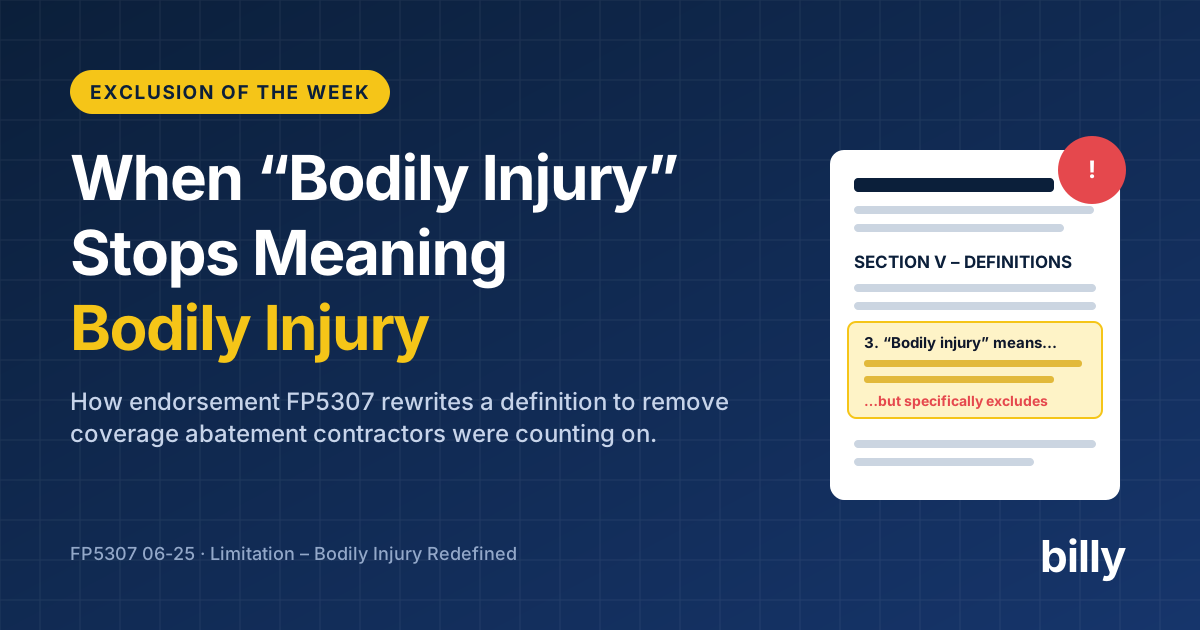
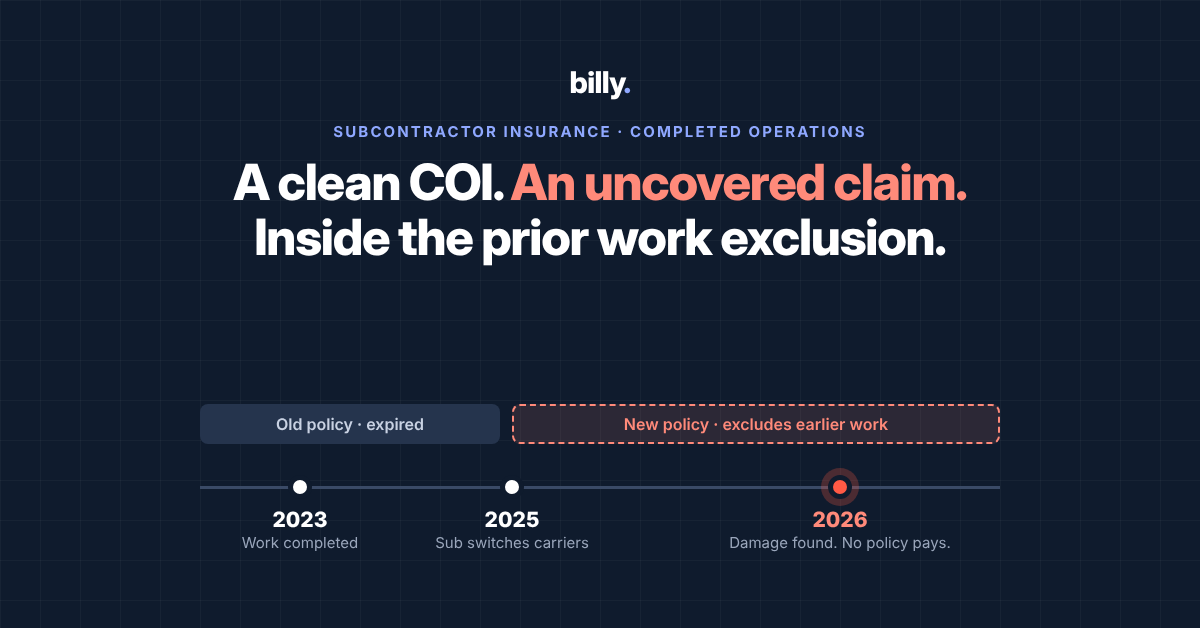
A prior work exclusion is an endorsement on a contractor’s general liability policy that removes coverage for damage from work completed before a set date, usually the day the policy starts. Certificates of insurance don’t list it, so a sub can hand you a compliant COI while carrying one.
How completed operations coverage is supposed to work
Most contractor general liability policies are written on an occurrence basis. The policy that pays is the one in force when the damage happens, not the one in force when the work was done.
That means a sub’s 2026 policy should respond to damage from a job finished in 2023. For that to hold, every renewal has to keep covering every job the sub has ever completed.
Your protection as a GC rides on the same chain. Additional insured status for completed operations (typically ISO CG 20 37, paired with CG 20 10 for ongoing work) is an endorsement on the sub’s policy. If that policy excludes the old work, your coverage for that work goes with it. We cover the pairing in CG 20 37: Why Completed Operations Coverage Is the Endorsement GCs Forget.
Why the COI won’t show you the gap
An ACORD 25 certificate is a summary of a policy, not the policy. Its own disclaimer says it confers no rights on the holder and doesn’t change the coverage it describes.
What a COI shows
- Carrier, policy number, dates
- Limits by coverage line
- Additional insured and waiver checkboxes
- A description field, sometimes with form numbers
What a COI doesn’t show
- Exclusionary endorsements
- Prior work dates
- Whether listed forms are actually attached
- What changed at the last renewal
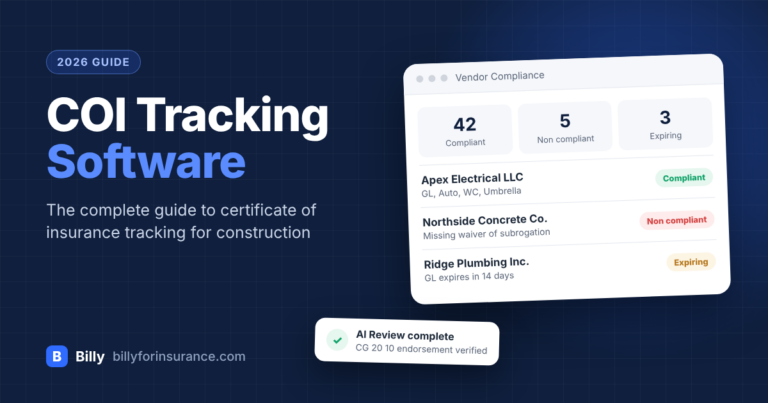
A COI-only review answers “does this sub have the right limits today?” It can’t answer “will that policy pay for the work they did on my project?”
The three endorsements that erase completed operations coverage
Each can appear as a single line on the schedule of forms, with no visible change to limits on the certificate.
| Endorsement | What it removes | Why the GC should care |
|---|---|---|
| Prior work exclusion (carrier form, or ISO CG 21 34 with a date) |
Damage from work completed before a stated date | Every job finished for you before that date loses coverage, including your additional insured status |
| Continuous or progressive injury exclusion | Damage that began, or is alleged to have begun, before the policy started, even if nobody knew | Water intrusion, settlement and mold almost always start before anyone finds them |
| Designated work exclusion (ISO CG 21 34) |
Named projects, locations or types of work | The schedule can name your project, or the exact trade you hired the sub for |
Prior work exclusion
IRMI defines it as an endorsement that eliminates coverage for injury or damage from work completed before a stated date. Many versions are carrier-written rather than ISO forms, so wording varies. ISO’s CG 21 34 Exclusion – Designated Work can work the same way when its schedule reads “all work completed before” a date.
Continuous or progressive injury exclusion
ISO’s standard known-injury wording only bars damage the insured knew about before the policy began. Carrier-specific continuous or progressive injury exclusions go further: they can bar damage that started before inception even when the policyholder had no idea. Some versions treat any damage from work done before inception as having started before inception.
Designated work exclusion
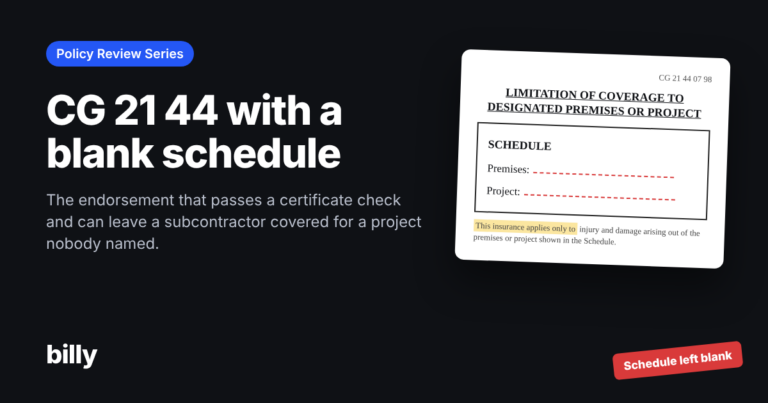
CG 21 34 removes completed operations coverage for whatever its schedule lists. Typical scheduled work includes residential, condominium, EIFS, roofing and foundation work. For a related problem on the additional insured side, see CG 21 44: Blank Schedules and Your COI.
What a court did with one in 2026
Nautilus Insurance Co. v. Bee Quality Inc. (7th Cir., July 9, 2026)
A roofing contractor repaired a storm-damaged Chicago building in 2020. In April 2022, a facade collapsed and killed two men, and their estates sued the roofer. The roofer’s policy had started in February 2022 and included a prior work exclusion. The Seventh Circuit affirmed that the carrier owed no defense and no indemnity. It also rejected the argument that the coverage was illusory, because the policy still covered newer work.
Takeaway for GCs: a well-drafted prior work exclusion holds up even after a fatal loss. Anyone relying on that roofer’s policy as an additional insured had nothing to tender to.
Where GCs get caught
The exclusion lives on the sub’s policy, but these are the situations where it lands on you.
Multi-tier subcontracting
Your first-tier sub may carry clean forms while its sub-subs don’t. A sub-sub’s prior work exclusion can leave your sub without coverage, and then you. Requirements that stop at tier one leave the rest of the chain unchecked.
The end of a wrap-up
On OCIP and CCIP projects, enrolled subs usually carry an exclusion for the wrapped project on their own policies. ISO CG 21 54 excludes operations on a designated wrap-up project; CG 21 53 is sometimes used instead to exclude only ongoing operations, which keeps completed operations on the sub’s own policy. If the wrap’s completed operations term runs out first and the sub’s form excludes both, nobody covers the project after that. Know which form your subs carry and how long the wrap’s completed operations extension lasts.
Closed projects nobody watches
Most compliance programs stop collecting certificates at closeout. That’s when the risk starts: the sub’s next renewal, carrier switch or closure happens with nobody looking.
Projects in New York
New York has no statute of repose for construction claims, so third-party defect claims against contractors have no hard outer time limit. AIA Vermont notes that New York and Vermont are the only two states without one. In those states, a sub’s completed operations coverage needs to hold for as long as the building stands.
What to require from your subs
- Write it into the subcontract. Your COI review can only enforce what the contract asks for.
- Ask for the schedule of forms, not just the certificate. For high-risk trades and large contracts, ask for the endorsements themselves.
- Hold every tier to the same terms. Flow the requirement down to sub-subs in writing.
- Keep monitoring after closeout. Request renewal documents for as long as your contract requires completed operations coverage, and review the forms on any carrier change.
- If you find an exclusion, act before you pay or sign. Ask the sub’s broker to remove it or move the date back, require project-specific completed operations coverage, or price the risk into bid leveling and prequalification.
Sample subcontract language
Have your attorney and broker adapt this to your insurance exhibit.
Subcontractor’s commercial general liability policy shall not contain any prior work, continuous or progressive injury, or designated work exclusion applicable to work performed for Contractor. Additional insured coverage shall apply to ongoing and completed operations (ISO CG 20 10 and CG 20 37 or equivalent). Subcontractor shall maintain such coverage for [X] years after final completion, shall provide written notice before any change of insurer, and shall require the same of its lower-tier subcontractors.
Email template: requesting a sub’s schedule of forms
How Billy helps
Checking endorsements by hand across dozens of subs and hundreds of renewals is where compliance programs break down. Billy makes the review routine.
AI review on upload
The Billy AI Review Assistant checks coverage, limits and endorsements like CG 20 10 and CG 20 37 against your requirements, and tells the sub exactly what to fix.
Automated collection
Billy requests and tracks COIs and other compliance documents, so expirations and renewals don’t depend on someone’s inbox.
Prequalification
Make insurance quality part of who you bid with, using the Billy prequalification tool.
Works where you work
Sync vendors and projects from Procore and other platforms. Or let Billy’s Managed Services team run it for you.
See your subs’ coverage the way a claims adjuster will
Watch Billy review a COI and its endorsements against your requirements in real time.
Book a demoFrequently asked questions
What is a prior work exclusion?
An endorsement on a contractor’s general liability policy that removes coverage for injury or damage arising from work completed before a date shown on the endorsement, usually the policy’s start date.
Does a prior work exclusion affect my additional insured coverage?
Yes. Additional insured status under CG 20 37 comes from the subcontractor’s policy. If that policy excludes work completed before a certain date, the GC’s or owner’s completed operations coverage for that work is excluded too.
How is a prior work exclusion different from a continuous or progressive injury exclusion?
A prior work exclusion looks at when the work was completed. A continuous or progressive injury exclusion looks at when the damage began, so it can bar a claim even for work done during the policy period if the damage is alleged to have started earlier.
Does an OCIP or CCIP cover completed operations after the wrap-up ends?
Only for the completed operations term the wrap-up provides, which varies by program. After that, coverage depends on the subs’ own policies, and many carry a wrap-up exclusion for that project. Check both the wrap’s extension term and the exclusion form on each sub’s policy.
How do I find out whether a sub has a prior work exclusion?
Ask the sub’s broker for the general liability schedule of forms and the endorsements themselves, plus written confirmation that no prior work, continuous injury or designated work exclusion applies to your work. A certificate of insurance alone won’t show it.
Can a prior work exclusion be removed?
Sometimes. The sub’s broker can ask the carrier to remove the endorsement or move the date back, which may come with added premium. It’s easiest to negotiate before the policy binds.
This article is general information, not legal or insurance advice. Policy wording varies by carrier and state. Review actual policy forms with your broker and counsel.
- Prior work exclusion bars roofer’s coverage after fatal collapse, Insurance Business, July 10, 2026
- Prior work exclusion, IRMI
- Exclusion – Designated Work (CG 21 34), Insurance XDate
- Exclusion – Designated Ongoing Operations, Insurance XDate
- The continuous or progressive injury or damage exclusion, Butler
- Statute of Repose Bill Introduced in VT, AIA Vermont