Key takeaways
- A waiver of subrogation prevents an insurer from seeking repayment from a protected project party after the insurer pays a covered claim.
- General liability policies commonly use CG 24 04, and workers’ compensation policies commonly use WC 00 03 13. Other policy types need their own waiver language.
- Owners and GCs require waivers to reduce recovery lawsuits among project participants and keep insured losses with the insurer that paid them.
- A COI may indicate that a waiver applies, but the certificate only summarizes coverage. Verify the actual endorsement, its effective dates, and any named party or project.
- Contract language creates the subcontractor’s obligation. The issued endorsement confirms the insurer accepted it.
What a waiver of subrogation is
A waiver of subrogation prevents an insurer from seeking reimbursement from a specified party after paying a covered claim. Without a waiver, the insurer can “step into the insured’s shoes” and use the insured’s legal rights to pursue whoever caused the loss. Subrogation transfers that recovery right to the insurer to the extent of its payment.
For example, a property insurer may pay an owner for damage caused by a subcontractor. After paying, the insurer can pursue the subcontractor to recover that money. A valid waiver removes the insurer’s right to pursue the protected subcontractor for losses within the waiver’s scope.
Construction contracts often require parties to waive recovery rights before work begins. The relevant policy must permit the waiver, usually through policy language or an endorsement. A contractual promise alone may put the contractor in breach if its insurer never accepted the waiver. In some cases, waiving recovery rights without the insurer’s consent can also compromise coverage.
Standard construction documents already use this form of risk allocation. The AIA A201 General Conditions include waiver language covering rights of recovery among project participants for certain insured losses. The exact protection still depends on the contract wording, the policy, and the endorsement.
How subrogation plays out in a real construction claim
Suppose a subcontractor’s employee negligently starts a fire that destroys an unfinished building. The owner files a $5 million builder’s risk claim, and the insurer pays.
Without a waiver, the insurer takes over the owner’s legal rights and pursues the parties responsible. It may sue the subcontractor and potentially the GC. Any recovery reimburses the insurer.
With valid waivers, the claim follows a different path. If the owner’s contract with the GC and the GC’s subcontract both waive recovery rights for insured property damage, and the builder’s risk policy permits a written waiver made before the loss, the insurer pays the claim and cannot sue the protected GC or subcontractor.
Commercial auto claims work the same way on a smaller scale. If a subcontractor’s van hits the GC’s truck, the GC’s auto insurer may pay for repairs and seek reimbursement from the subcontractor. A valid waiver prevents that recovery action.
Why GCs and owners require it from subcontractors
Waivers stop several project participants from insuring the same loss and then shifting its cost among themselves. The contract assigns a covered loss to a designated policy rather than relying on overlapping policies and litigation to decide who ultimately pays.
Waivers also limit litigation after a claim. Without one, the insurer can pursue a subcontractor that allegedly caused the damage, and that subcontractor may bring claims against others. A waiver keeps the covered loss with the insurer and the project moving.
Subcontractors should still review each waiver with their broker before signing. The insurer keeps more of the loss, so it may charge an added premium, restrict the waiver, or refuse it for certain risks. Insurer responses vary, so confirm the required waiver is available under each affected policy.
Which policies a waiver of subrogation applies to
Each policy requires its own waiver provision or endorsement. A waiver on one policy does not change another.
- General liability. Prevents the liability insurer from seeking recovery from a protected party after paying a covered claim. Subcontracts commonly require this in favor of the owner, GC, and other named parties.
- Workers’ compensation. Restricts the carrier from pursuing a third party after paying benefits for an employee injury. State law can limit whether and how this waiver is available.
- Commercial auto. Applies to covered vehicle losses. A general liability waiver does not satisfy an auto requirement.
- Umbrella or excess. Some policies follow the underlying coverage, and others need their own endorsement. Do not assume an underlying waiver extends through every layer.
- Builder’s risk and property. Often waive recovery rights for insured project damage, protecting owners, contractors, and subcontractors after a fire or other covered loss.
A contract that requires only “a waiver of subrogation” leaves the required coverage unclear. Identify each policy, the protected parties, the project, and the period of work.
Blanket vs. scheduled endorsements: CG 24 04 and WC 00 03 13
CG 24 04 is a commonly used commercial general liability endorsement that waives the insurer’s right to recover against the person or organization identified in its schedule.
WC 00 03 13 serves the same purpose for workers’ compensation. State rules and carrier requirements affect whether the form is available and how it operates.
A scheduled waiver protects named parties or projects. A subcontractor working for a different contractor or on another project would need a separate endorsement.
A blanket waiver covers a broader group defined by written contract. Typical wording applies when the insured agreed in a written contract, signed before a loss, to waive recovery rights. Blanket waivers reduce paperwork, but the wording may impose conditions.
The form number alone does not tell you whether a waiver is blanket or scheduled. Read the schedule and the operative language.
A subcontractor’s promise to obtain a waiver does not change the insurer’s recovery rights. Until you receive the endorsement, you have an obligation on paper, not proof the policy includes it.
How to verify a waiver of subrogation on a COI
- Confirm the insured and project details. The subcontractor’s legal name should match the contract. Review the producer, insurers, policy numbers, and dates.
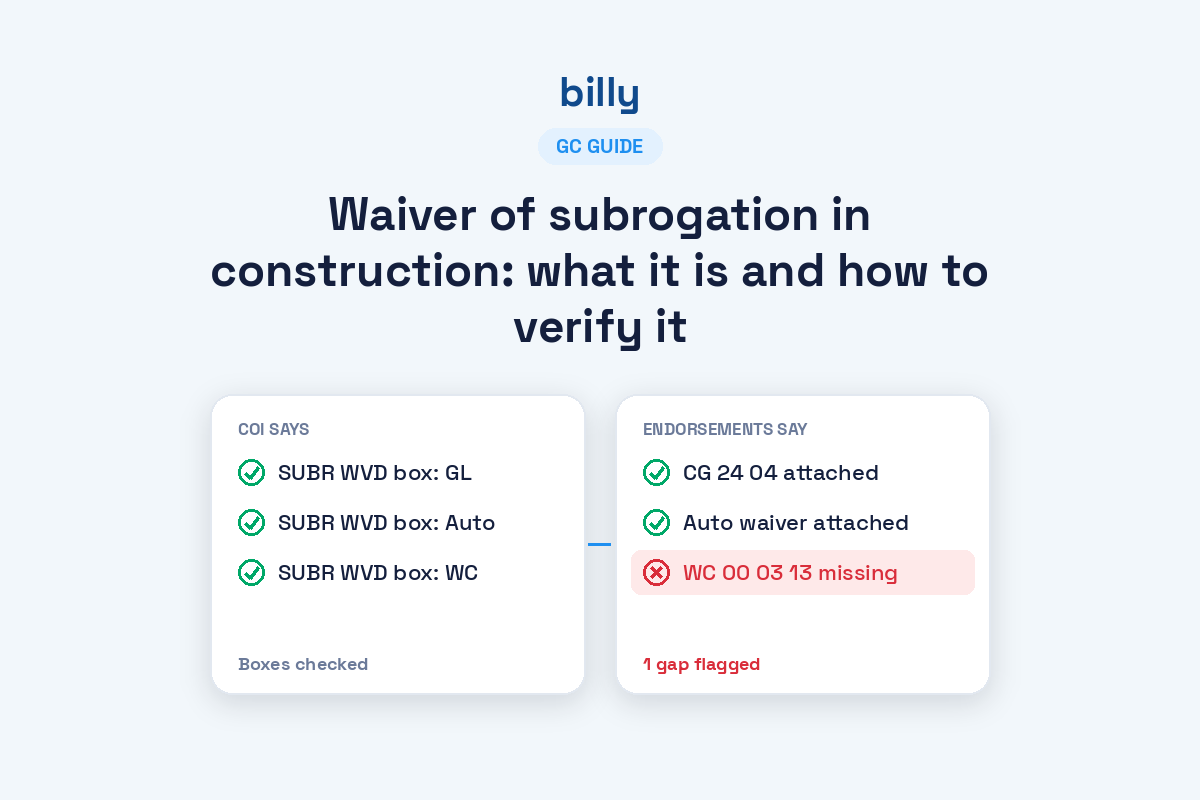
- Check every required policy. Review the SUBR WVD box for general liability, auto, umbrella, and workers’ compensation. A mark under one policy does not confirm a waiver under another.
- Read the description of operations. Wording such as “waiver applies when required by written contract” suggests a blanket endorsement, but the certificate cannot prove the policy contains it.
- Verify additional insured status separately. Additional insured status extends coverage to another party. A waiver limits the insurer’s right to recover from that party. One does not satisfy the other.
- Request the endorsement pages. Confirm they apply to the required policies, project, parties, and work period.
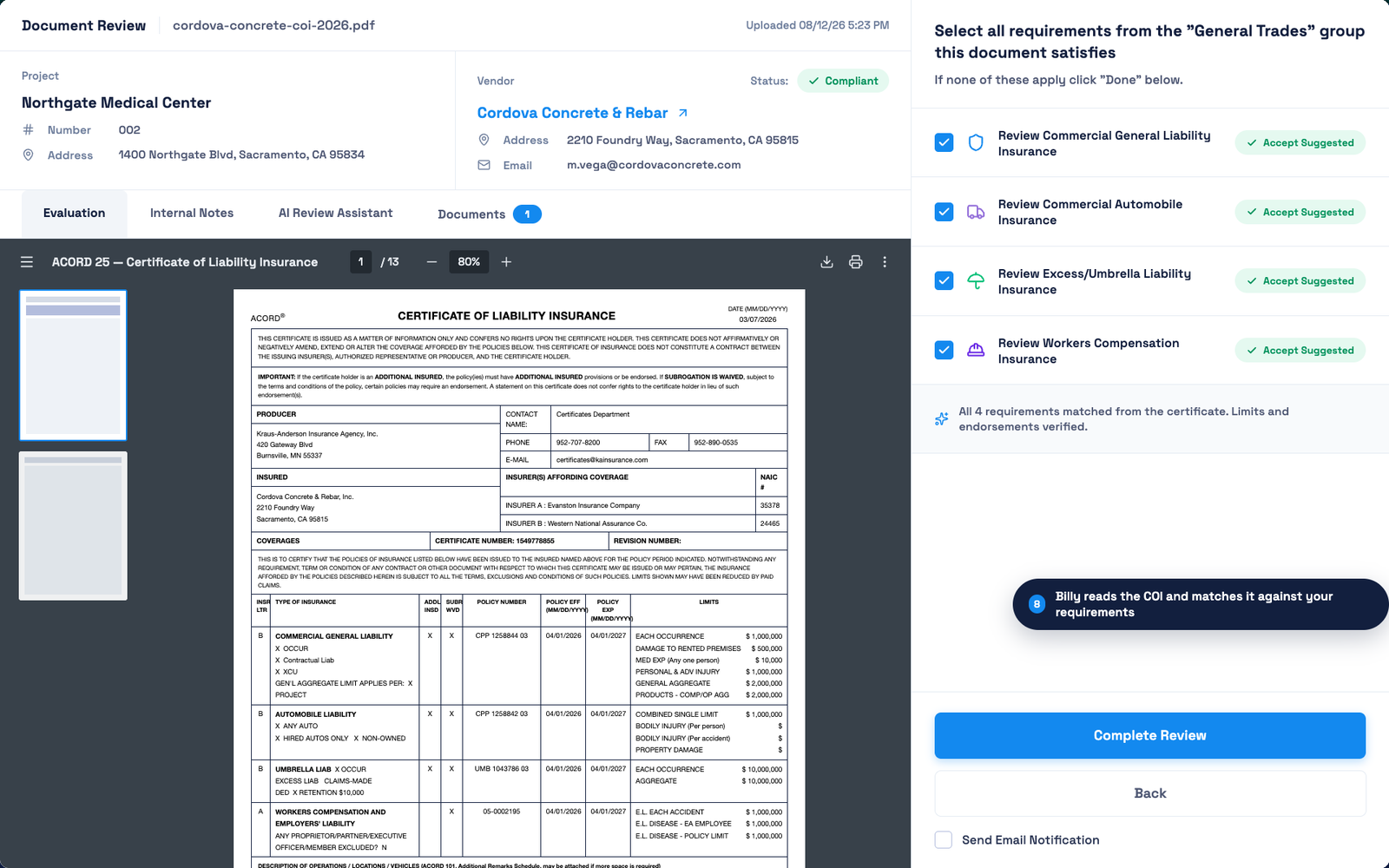
A checked SUBR WVD box shows what the producer reported. Only the issued endorsement confirms the policy change. For the full form walkthrough, see our ACORD 25 guide.
How to verify the endorsement itself
Confirm that the endorsement lists the correct insured, insurer, policy number, coverage type, and form edition. An endorsement on the general liability policy does not satisfy a contract that also requires waivers on workers’ compensation, auto, or umbrella.
For a scheduled waiver, compare the protected party’s legal name with the contract. Trade names, related entities, and abbreviated project names create uncertainty, so request a corrected endorsement when the wording does not clearly match.
For a blanket waiver, read the eligibility language. Confirm the subcontract was executed before the work or loss and that the protected party falls within the endorsement’s terms.
Check dates against the full work period. Pay particular attention to renewals, because a waiver attached to an expired policy does not prove the replacement policy includes the same endorsement.
State workers’ comp nuances to watch for
Workers’ compensation waiver rules vary by state. Some jurisdictions restrict pre-loss waivers or limit their legal effect, and carriers may face state-specific rules on whether they can issue a waiver and what language it must use. Do not assume a WC 00 03 13 endorsement provides identical protection everywhere.
Before accepting the endorsement, ask the subcontractor’s broker to confirm the waiver is permitted and effective in the state where the work occurs. Have legal counsel review the requirement when state law limits waivers or the contract covers work in multiple states.
Sample contract language for requiring a waiver of subrogation
Precise language identifies who grants the waiver, who receives protection, which policies must carry endorsements, and what losses are covered. Adapt the following with counsel.
To the fullest extent permitted by law, Subcontractor waives all rights of recovery against [Owner], [Contractor], and any other parties identified in Exhibit [X] for loss or damage arising from the Work. Subcontractor shall require its insurers to waive subrogation against those parties under its commercial general liability, workers’ compensation, commercial auto, and umbrella or excess policies. The waiver applies only to amounts actually paid by insurance. The waiver does not apply to deductibles, self-insured retentions, or uninsured amounts paid by Subcontractor. Before starting work and upon each policy renewal, Subcontractor shall provide copies of the applicable waiver endorsements.
Naming the protected parties and the direction of the waiver prevents disputes about who may pursue whom. Ambiguous clauses have left subcontractors exposed to claims they believed were waived. Local counsel should adapt the clause for project-specific requirements and state restrictions, especially for workers’ compensation.
Common mistakes that void or weaken a waiver
- Accepting contract language without the issued endorsement.
- Relying on a checked COI box as proof.
- Confusing additional insured status with a waiver. Each needs its own endorsement, as does primary and non-contributory wording.
- Naming the wrong owner, GC, or project on a scheduled waiver.
- Submitting an endorsement tied to an expired or future policy period.
- Providing a waiver on general liability alone when the contract also requires workers’ compensation, auto, or umbrella.
- Assuming a blanket waiver covers parties outside a written contract executed before the loss.
- Ignoring state workers’ compensation rules.
- Failing to collect current endorsements at every renewal.
Frequently asked questions
Does a waiver of subrogation cost extra?
Sometimes. Some insurers include waivers automatically, and others charge an additional premium or decline certain risks. Confirm the cost with your broker.
Does a waiver affect my own coverage if I am at fault?
A properly approved waiver generally should not reduce your liability coverage. Signing a waiver that conflicts with your policy could compromise coverage, so get insurer approval before signing the contract.
Is a waiver the same as being an additional insured?
No. An additional insured endorsement extends coverage to another party. A waiver prevents the insurer from pursuing that party after paying a covered claim.
Can an owner require a waiver after a loss?
An owner can ask, but a post-loss waiver generally cannot erase recovery rights that already exist without the insurer’s consent. Secure the endorsement before work begins.
How Billy catches missing waivers before they become claims
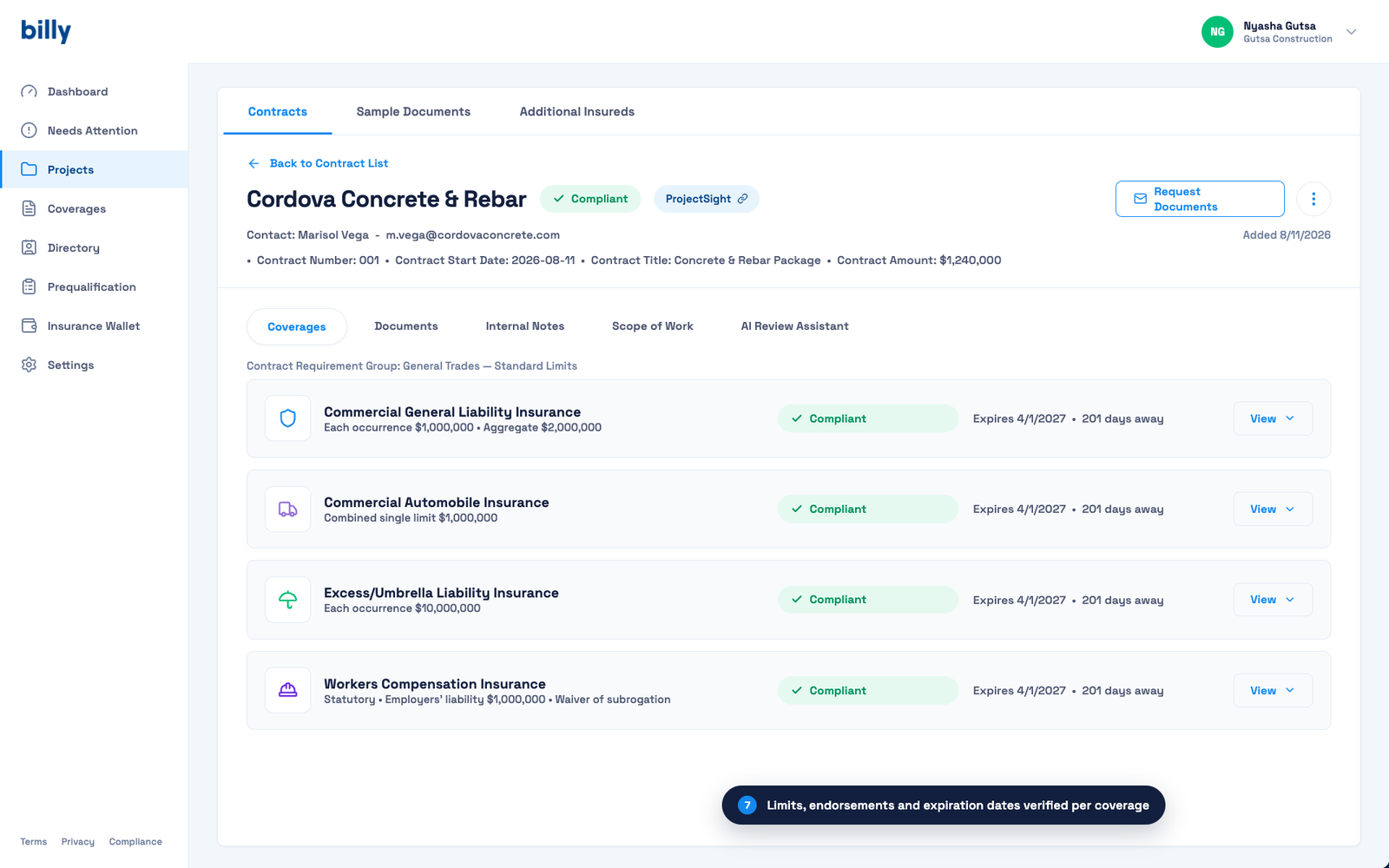
Billy’s AI Review Assistant checks COIs and endorsement pages against each subcontractor’s insurance requirements. It flags a missing waiver endorsement, an incorrectly scheduled owner or GC, and mismatched project details or coverage dates. You review the exceptions instead of manually comparing every document with the subcontract, and Billy requests current endorsements at every renewal.
If your projects run in Trimble ProjectSight, Billy’s ProjectSight integration imports projects, contracts, and vendors so waiver requirements are applied from day one.
Request a Billy demo to see automated waiver verification on your own documents.
See it on your own vendors and projects.
Request a demo