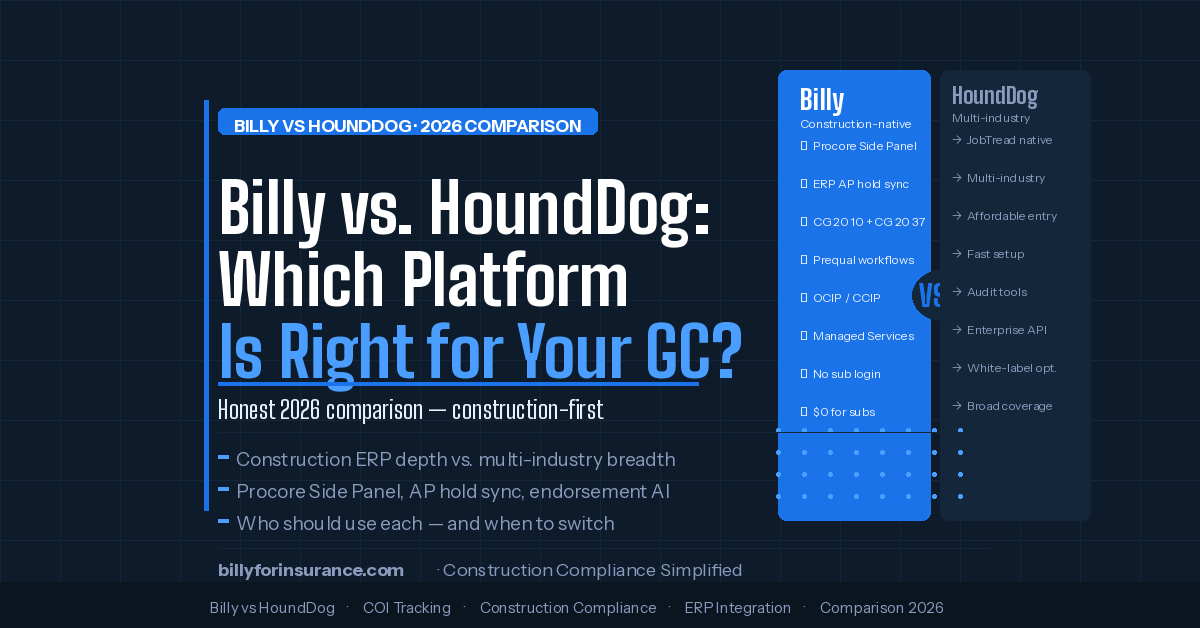
HoundDog is a well-built, affordable COI tracking platform with a real customer base. Billy is a construction-native compliance platform built specifically for general contractors. This comparison will help you understand which is the right fit for your operation — honestly.
- Quick summary: who each platform is built for
- Where HoundDog is genuinely strong
- Side-by-side feature comparison
- ERP and project management integrations
- AI review and endorsement verification
- Vendor and subcontractor experience
- Managed services and expert review
- Construction-specific workflows
- Who should choose which platform
- Frequently asked questions
The One-Paragraph Summary of Each Platform
HoundDog in one paragraph
HoundDog is a COI tracking and business insurance verification platform that serves a wide range of industries — contractors, property managers, trucking companies, higher education institutions, municipalities, and franchises. HoundDog uses AI to automatically extract, interpret, and centralize compliance information, automating COI collection, verification, and renewal across vendor bases of any size. It’s positioned on accessibility and price, with a stated goal of making insurance tracking available to any business regardless of budget. HoundDog’s co-founders describe their core customers as those in construction and property management, but note the platform extends to virtually any business needing to validate business insurance.
Billy in one paragraph
Billy is a construction-native compliance platform built specifically for general contractors and their subcontractor compliance workflows. Beyond COI tracking, Billy manages subcontractor prequalification, W9s, business licenses, lien waivers, MSAs, warranty letters, and OCIP/CCIP compliance — all connected natively to Procore, Autodesk, Viewpoint Vista, JD Edwards, CMiC, Sage 300, Sage Intacct, Acumatica, and other construction ERPs. Billy’s AI Review Assistant verifies endorsement-level compliance (CG 20 10, CG 20 37, PNC, Waiver of Subrogation) against specific contract requirements, and Managed Services puts licensed insurance professionals on your compliance operation alongside the software.
Where HoundDog Is Genuinely Strong
A credible comparison has to acknowledge what HoundDog does well. There are meaningful reasons GCs and other organizations choose it.
Price accessibility
HoundDog is explicitly positioned as affordable for any size business. Their stated goal is to make insurance tracking available to businesses who previously considered it too expensive. For smaller contractors or organizations tracking a limited vendor base, this matters.
Multi-industry flexibility
If your compliance needs span construction and other industries — property management, equipment rental, or franchise operations — HoundDog handles all of them in one platform. Customers like EquipmentShare track thousands of COIs for vendors and service providers across the country using HoundDog.
Fast setup
HoundDog typically builds and configures accounts within a day or two, with the option to import existing COIs or expiration dates. For smaller teams who need to be up and running quickly without a complex implementation, this is a genuine advantage.
JobTread integration
HoundDog has a native integration with JobTread, the construction management platform popular with residential and smaller commercial builders, with exclusive pricing for JobTread customers. If your operation runs on JobTread, HoundDog is the natural compliance pairing.
Audit tools
HoundDog includes an audit tool that reduces audit preparation time by 80%+, with one-click download of all COIs for a given audit period. For organizations that face regular compliance audits, this is a practical feature.
White-label enterprise option
HoundDog’s Enterprise plan includes custom or white-labeled dashboards — useful for brokers, risk management firms, or organizations that need to present compliance data under their own brand.
Full Feature Comparison: Billy vs. HoundDog
| Feature / Capability | HoundDog | Billy |
|---|---|---|
| Primary industry focus | ⚠ Multi-industry (construction + property mgmt, trucking, higher ed, franchises, municipalities) | ✓ Construction-native — built exclusively for GCs and construction compliance |
| COI collection and tracking | ✓ AI-powered collection and renewal automation | ✓ AI-powered collection and renewal automation |
| AI endorsement verification | ⚠ “Recognition of special endorsements and language” — not publicly specific | ✓ Explicit: CG 20 10, CG 20 37, PNC, Waiver of Subrogation verified against contract requirements |
| W9, MSA, lien waiver tracking | ✓ W9s, MSAs, subcontractor agreements, lien waivers | ✓ Full document set including warranty letters and business licenses |
| Subcontractor prequalification | ✗ Not mentioned in public product documentation | ✓ Full prequalification workflow with custom forms and annual renewal |
| Procore integration | ⚠ “Top construction project management systems” — not specifically confirmed | ✓ Native Procore integration with embedded Side Panel inside Procore |
| Autodesk Construction Cloud | ⚠ Not publicly confirmed | ✓ Native Autodesk Construction Cloud integration |
| Viewpoint Vista | ✗ Not mentioned | ✓ Deep Vista integration with AP hold sync and compliance codes |
| JD Edwards | ✗ Not mentioned | ✓ JDE vendor master sync and AP hold automation |
| CMiC | ✗ Not mentioned | ✓ CMiC vendor and project data sync |
| Sage 300 / Sage Intacct | ✗ Not mentioned | ✓ Both Sage 300 CRE and Sage Intacct Construction |
| Acumatica | ✗ Not mentioned | ✓ Acumatica integration |
| JobTread | ✓ Native integration with exclusive partner pricing | ✗ Not listed |
| AP hold enforcement | ⚠ Compliance status dashboard — AP sync depends on ERP integration availability | ✓ Direct AP hold sync to Vista, JDE, CMiC, Sage — blocks payment on lapsed coverage |
| OCIP / CCIP compliance | ✗ Not mentioned | ✓ Wrap program compliance with dual-track requirements |
| Warranty-period tracking | ✗ Not mentioned | ✓ Post-closeout warranty compliance mode |
| Managed services / expert review | ⚠ Enterprise plan includes “dedicated insurance and certificate management team” | ✓ Managed Services with licensed insurance professionals |
| Vendor login required | ⚠ Not specified — vendors submit via automated outreach | ✓ No vendor login — one-click upload via Insurance Wallet |
| Cost to subcontractors | ✓ Free for vendors submitting documents | ✓ Free — always |
| White-label dashboards | ✓ Enterprise plan | ⚠ Available for brokers and partner programs — contact Billy |
| Multi-industry support | ✓ Core strength — 6+ industry verticals | ⚠ Construction-focused; manufacturers supported but not primary |
| Audit tools | ✓ One-click audit download, 80%+ time reduction | ✓ Audit-ready compliance dashboard with historical record |
| API access | ⚠ Enterprise plan only | ⚠ Available — contact Billy for API documentation |
Table based on publicly available information as of May 2026. HoundDog items marked ⚠ reflect that the capability is not confirmed or detailed in HoundDog’s public documentation — it may exist but is not marketed. Always verify directly with each vendor.
ERP and Project Management Integrations: The Biggest Practical Difference
For commercial general contractors, the integration question is often the deciding factor. Your vendors, subcontractors, and compliance requirements don’t exist in a vacuum — they live inside Procore projects, Vista AP queues, JDE vendor masters, and CMiC subcontract modules. A compliance platform that doesn’t connect to those systems creates the same problem you already have: duplicate data entry, delayed status updates, and compliance coordinators copy-pasting between systems.
HoundDog’s integration approach
HoundDog’s contractor page states it integrates with “top construction project management systems”, but their publicly listed named integration is JobTread. Their Enterprise plan offers API integrations and “custom solutions engineered for complex tracking needs” — meaning deeper ERP connections are available but require a custom engagement rather than a native, pre-built connector.
For a smaller GC on JobTread or for an organization managing compliance without a deep ERP environment, this is fine. For a commercial GC on Procore, Vista, or JDE, “contact us for custom API integration” is a meaningful friction point.
Billy’s integration approach
Billy has named, pre-built, two-way integrations with the primary construction tech stack:
- Procore — with a native embedded Side Panel so compliance status is visible without leaving a Procore project
- Autodesk Construction Cloud — vendor and project data sync
- Viewpoint Vista — AP hold sync, compliance codes, BILLY code integration
- Oracle JD Edwards EnterpriseOne — vendor master sync and AP hold automation
- CMiC — subcontract and vendor data sync
- Sage 300 CRE and Sage Intacct Construction
- Acumatica Construction
If your ERP fires an AP hold after a policy lapses, you’ve already lost. Pre-built, two-way ERP sync is what prevents the lapse — not what responds to it. Custom API integrations require ongoing maintenance, IT resources, and time to implement. Named connectors ship ready.
Billy Integration TeamThe Procore Side Panel difference
Billy’s Procore integration includes a native embedded Side Panel — compliance status is visible directly inside the Procore interface without switching applications. Project managers, superintendents, and operations teams can check subcontractor compliance without leaving their Procore workflow. No tab-switching, no separate login, no “go check the compliance platform.”
AI Review and Endorsement Verification: Where Depth Matters Most
Both platforms use AI to extract and verify COI data. The question that matters for commercial GCs is: what does the AI actually verify?
Most construction insurance claims that hurt general contractors don’t come from expired policies — they come from missing or incorrect endorsements. A COI can show $2M general liability and still fail to provide the Additional Insured coverage your contract requires, because the endorsement language is absent, incorrect, or insufficiently specific.
HoundDog’s stated AI capability
HoundDog’s Pro plan includes “recognition of special endorsements and language.” Their platform uses AI to extract, interpret, and verify COIs against custom requirements. What’s not publicly detailed is the specific endorsement types their AI checks, the depth of endorsement language review, or how it handles the distinction between CG 20 10 and CG 20 37 endorsement editions.
Billy’s AI Review Assistant capability
Billy’s AI Review Assistant explicitly checks:
- CG 20 10 (ongoing operations Additional Insured) — form number, edition date, blanket vs. scheduled status
- CG 20 37 (completed operations Additional Insured) — separately from CG 20 10, which covers a different time period
- Primary and Non-Contributory language — confirming the sub’s policy pays before yours
- Waiver of Subrogation status
- Coverage limits against your specific contract requirements (not just generic minimums)
- Carrier AM Best rating thresholds
- Named insured accuracy against the legal entity on file
For GCs managing commercial projects with complex endorsement stacks, endorsement-level AI verification is a meaningful capability difference. For smaller contractors tracking basic residential subs, it may not matter as much.
Vendor and Subcontractor Experience: Friction Is a Compliance Risk
The compliance platform your GC team uses matters. But so does the experience your subcontractors have when submitting documents. High vendor friction = low submission rates = more manual follow-up = higher compliance gaps.
HoundDog’s vendor experience
HoundDog automates COI collection from vendors or their agents. Their platform sends outreach and vendors respond with documents. The specific mechanism for vendor submission (portal login vs. email upload link vs. broker direct upload) is not detailed in their public documentation.
Billy’s Insurance Wallet
Billy’s Insurance Wallet is a subcontractor-facing tool that requires zero login, zero portal account creation, and zero cost to the subcontractor. They receive a branded email, click a one-link upload, and submit. Their broker can upload directly as well.
For subcontractors working with multiple GCs who use Billy, the Insurance Wallet stores their compliance documents once and shares them with any requesting GC — eliminating the friction of re-submitting the same COI for every project.
Managed Services: When Software Alone Isn’t Enough
AI review handles the standard cases well. But construction compliance has edge cases: manuscript policy language, state-specific regulatory nuances, coverage adequacy assessment beyond limit verification, and situations that require insurance judgment rather than document pattern matching. Both platforms offer some form of human expert oversight — but they’re structured differently.
HoundDog’s approach
HoundDog’s Pro plan includes a “dedicated account manager with manual reviews on complicated COIs.” Their Enterprise plan provides a “dedicated insurance and certificate management team.” HoundDog’s team includes Brian, who leads their Agency Partner Team and brings over twenty years of insurance industry experience.
Billy Managed Services
Billy’s Managed Services plan assigns licensed insurance professionals to your compliance operation. This matters for commercial GCs in specific ways:
- Licensed professionals can provide coverage opinions — not just data extraction
- Edge cases (manuscript policies, wrap exclusion endorsements, state-specific restrictions) are handled by people who understand construction insurance law
- Your team gets expert accountability, not just software automation
- For high-volume operations, Managed Services effectively adds compliance capacity without headcount
If your operation requires licensed insurance expertise on complex commercial projects — OCIP programs, large subcontract values, multi-state operations — the distinction between an account manager and a licensed professional matters.
Construction-Specific Workflows Billy Has That HoundDog Doesn’t
Because HoundDog serves multiple industries, its product scope is horizontal — applicable across any compliance tracking use case. Because Billy is construction-only, its product scope is vertical — built around the specific workflows that commercial GCs actually run.
Subcontractor prequalification
Billy includes a full subcontractor prequalification workflow — custom forms, digital submission, COI collection at prequal, annual renewal, and approved vendor list management. Prequalification is the beginning of the compliance relationship, not a separate process. HoundDog does not publicly document a prequalification product.
AP hold enforcement via ERP sync
Billy writes verified compliance status back to your ERP’s AP module — so payment holds in Vista, JDE, CMiC, or Sage reflect Billy’s live compliance data, not manually entered dates. JD Edwards, Viewpoint Vista, CMiC — each has a dedicated, maintained integration. HoundDog’s AP hold capability depends on whether a custom API integration has been built for your ERP.
OCIP and CCIP compliance
Wrap-up insurance programs add complexity that standard COI tracking platforms don’t support. On OCIP and CCIP projects, enrolled subs need wrap exclusion endorsements on their own policies for non-enrolled scope, and compliance tracking needs to run on two parallel tracks (enrolled vs. non-enrolled). Billy supports dual compliance tracking for wrap programs. HoundDog does not mention OCIP/CCIP support.
Warranty-period compliance tracking
Most compliance platforms stop at project closeout. Warranty obligations run 5–10 years after completion — and every subcontractor’s insurance needs to remain active and compliant throughout that window. Billy’s warranty mode tracks post-closeout compliance separately from construction-phase compliance. HoundDog does not document this capability.
Who Should Choose Each Platform
HoundDog is a better fit if…
You’re a smaller contractor or residential builder using JobTread. Your compliance needs span multiple industries (construction + property management, equipment rental, etc.). You want affordable, fast-to-deploy COI automation without deep ERP integration. Your construction compliance requirements are straightforward (basic limits, no complex endorsement stacks). Or you need a white-labeled compliance platform for a broker or multi-tenant use case.
Billy is a better fit if…
You’re a commercial GC running Procore, Autodesk, Vista, JDE, CMiC, or Sage. You need compliance status to sync directly to AP holds without manual data entry. You require endorsement-level AI verification (CG 20 10, CG 20 37, PNC). You manage subcontractor prequalification alongside COI tracking. You run OCIP/CCIP projects or need warranty-period compliance. Or you want licensed insurance professionals on your compliance operation.
The core positioning difference in plain language
HoundDog is a horizontal COI tracking platform — it solves the general problem of vendor insurance verification for any business in any industry. Billy is a vertical construction compliance platform — it solves the specific compliance workflows that commercial general contractors run, with the depth and integration required for that context.
For a GC whose primary tool set is Procore + Vista (or any combination of construction-specific tech), Billy’s native connectors mean compliance data flows without manual intervention. For a company that manages compliance across multiple industry types, HoundDog’s broad-industry approach may be more practical.
See How Billy Works for Commercial GCs
We’ll walk through the Procore Side Panel, ERP sync, endorsement AI review, and what your compliance workflow looks like post-implementation.
Book a Free Demo →Frequently Asked Questions
Can HoundDog integrate with Procore or Autodesk Construction Cloud?
HoundDog’s contractor page mentions integration with “top construction project management systems” without naming specific platforms. Their Enterprise plan offers API integrations, which could include Procore or Autodesk through custom development. For confirmed native integrations, contact HoundDog directly. Billy has named, pre-built, two-way integrations with both Procore (including a native Side Panel) and Autodesk Construction Cloud.
Does HoundDog offer subcontractor prequalification?
Subcontractor prequalification is not described in HoundDog’s public product documentation. Their platform focuses on COI collection, verification, and renewal. Billy’s prequalification workflow includes custom forms, digital submission, COI collection at prequal, and annual renewal — all in the same platform as ongoing compliance tracking.
Which platform is better for OCIP and CCIP projects?
Billy supports OCIP/CCIP compliance with dual-track requirements — separate compliance status for enrolled and non-enrolled scopes, wrap exclusion endorsement tracking, and project-specific insurance requirements. HoundDog does not publicly document wrap program support. For commercial GCs running large projects with wrap insurance programs, Billy is the more appropriate choice.
Is HoundDog really less expensive than Billy?
Both platforms require a demo/quote for pricing — neither publishes per-seat or per-vendor rates publicly. HoundDog explicitly positions on price accessibility and targets organizations that previously considered compliance software too expensive. Billy’s pricing is based on the scope of your operation. The right comparison isn’t just the software cost — it’s the total cost including implementation, ERP integration complexity, and the ongoing labor cost of any manual processes that remain after implementation.
Can subcontractors submit COIs without creating an account?
Billy’s Insurance Wallet requires no account creation, no portal login, and no cost to subcontractors. They receive a branded email with a one-click upload link. HoundDog’s vendor submission experience is not detailed publicly. For GCs with large sub bases, frictionless submission is a direct driver of compliance rates — more friction means more incomplete submissions and more manual follow-up.
How does Billy’s AI endorsement review compare to HoundDog’s?
Billy’s AI Review Assistant explicitly verifies CG 20 10, CG 20 37, Primary and Non-Contributory language, Waiver of Subrogation, and carrier AM Best ratings against your specific contract requirements. HoundDog states their platform includes “recognition of special endorsements and language” but doesn’t publicly detail the specific endorsement types or the depth of verification. For commercial GCs with complex endorsement requirements, the specificity of Billy’s endorsement review is a meaningful difference.
What happens when a subcontractor’s COI expires?
Both platforms automate renewal outreach before expiration. Billy additionally syncs the lapsed compliance status back to your ERP’s AP module, automatically preventing payment to non-compliant vendors. The combination of proactive outreach and AP hold enforcement is what prevents lapses from becoming claims exposure. HoundDog automatically collects and re-verifies COIs when they expire — the ERP sync step depends on whether a custom integration has been configured.