Continuous damage exclusion: the GL gap your COI won’t show
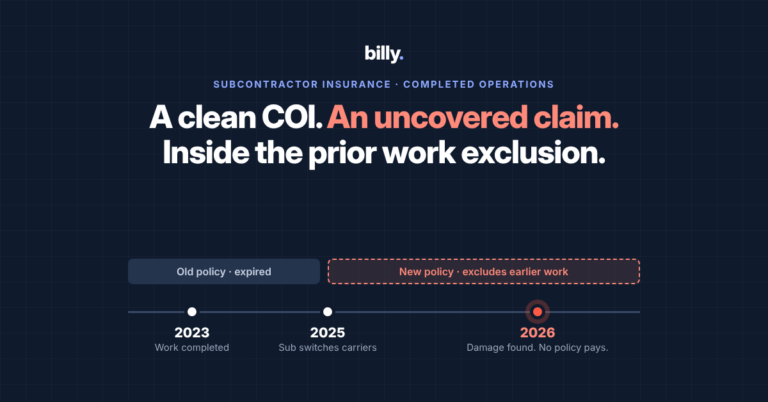
A continuous damage exclusion is a GL endorsement, common on E&S policies for contractors, that drops coverage for completed-work property damage once the claim has been presented to any earlier GL policy. When a subcontractor switches carriers, a slow-building defect claim can end up covered by neither policy. And it never appears on a certificate of insurance.
A compliant COI can still hide an uncovered claim
A certificate of insurance is evidence that a policy exists. It doesn’t tell you what the policy excludes. Here’s the same fire protection subcontractor, seen two ways:
Illustrative. Exclusions live in the policy’s forms and endorsements schedule, not on the ACORD 25.
What the exclusion actually says
This is the endorsement from a real fire protection contractor’s E&S general liability policy:
Endorsement No: 19
In consideration of the premium charged, it is hereby agreed that this policy shall not apply to any claim for “property damage” arising out of “your work” within the “products-completed operations hazard” if:
1. The “property damage” arises out of or is alleged to have arisen out of “your work” at a “single location” under a “single contract”, and
2. Such claim is at any time presented to a commercial general liability policy under which you are an insured that has an attachment date prior to the attachment date of this policy.
For purposes of this policy; A “single location” shall be defined to be the larger of the following: i. A single freestanding building; ii. A series of separate buildings on a single contiguous parcel of land that are under common ownership or control; or iii. A series of separate buildings or dwellings which are part of the same housing development.
Fire protection contractor · E&S general liability
Three phrases do the damage:
- “At any time presented to.” The prior policy doesn’t have to pay. It only has to be asked. Claimants’ lawyers routinely tender defect claims to every carrier on the timeline.
- “Under which you are an insured.” On its face, that isn’t limited to the sub’s own past policies. It could reach a GC’s policy where the sub was an additional insured, or a project wrap-up. How far it reaches is a question of interpretation, but it’s broad on paper.
- “The larger of.” A “single location” can be an entire housing development, so one defect can pull in every building on the job.
How a claim falls between two policies
Construction defect claims are slow. A leak starts small, gets found years later, and the damage has been spreading the whole time. Meanwhile, E&S contractors often change carriers every year or two.
The earlier carrier won’t always walk away. But the gap opens whenever it doesn’t fully respond: it disputes timing, its limits are already spent, it carries its own version of this exclusion, or it’s insolvent.
Your subs’ COIs say “compliant.” Do their endorsements? See how Billy checks submitted insurance documents against your project requirements.
See AI ReviewHow it compares to standard known-loss language
The standard ISO CGL coverage form already excludes damage the insured knew about before the policy started. That’s reasonable. The continuous damage exclusion goes much further.
| Standard ISO known-loss provision | Continuous damage exclusion | |
|---|---|---|
| Triggered by | What the insured knew before the policy began | The claim being presented to any earlier GL policy |
| Who controls it | The insured | Third parties: claimants, lawyers, other insureds |
| Hidden damage | Generally still covered | Can be excluded even if no one knew |
| Scope | The specific known damage | Everything at a “single location,” up to a whole development |
| On the COI? | Part of the base form | No |
What GCs should do about it
The trades with the longest tail are the ones to watch: fire protection, plumbing, roofing, waterproofing, HVAC and building envelope. Here’s how to close the gap in your subcontractor insurance requirements:
Prohibit it by name
List continuous, progressive and prior damage exclusions as prohibited endorsements in your subcontract. Use the sample language below as a starting point.
Collect the endorsement schedule with the COI
Make the GL forms and endorsements schedule a required document for high-risk trades, especially on E&S paper. Store it with the certificate so it’s reviewed at the same time.
Re-check at every renewal and carrier change
A sub that was clean at signing can pick this up when it moves carriers. A new carrier name on a renewal COI is your signal to pull the schedule again.
Require completed ops for years, not months
Require products-completed operations coverage and completed-ops additional insured status for a set period after the job closes.
Subcontractor’s commercial general liability insurance shall not contain any exclusion or limitation for continuous, progressive, or prior damage, including any exclusion that applies because a claim has been presented to, or made under, a policy with an earlier inception or attachment date (commonly titled “Continuous Damage Exclusion,” “Progressive Damage Exclusion,” or “Prior Work Exclusion”). Subcontractor shall provide Contractor with the schedule of forms and endorsements for such insurance upon execution of this Subcontract and at each renewal or change of carrier.
Starting point only. Have your counsel and broker adapt it to your contracts and jurisdiction.
Frequently asked questions
What is a continuous damage exclusion?
An endorsement, usually on E&S general liability policies for contractors, that removes coverage for completed-work property damage tied to an earlier policy period. Broad versions apply whenever the claim is presented to any earlier GL policy, even if nobody knew about the damage.
Does a certificate of insurance show it?
No. An ACORD 25 shows policy numbers, dates and limits, not exclusions. You need the policy’s forms and endorsements schedule.
Can a claim be uncovered by both the old and new policy?
Yes. If the new policy excludes it because it was presented to an earlier policy, and the earlier policy denies it, has exhausted limits, carries its own exclusion, or its carrier is insolvent, the contractor can be left without coverage.
How is it different from the standard known-loss provision?
The standard ISO form excludes only damage the insured knew about before the policy began. A continuous damage exclusion doesn’t depend on knowledge and can be triggered by someone else tendering the claim.
What should a subcontractor do before switching carriers?
Ask your broker to compare the endorsement schedules side by side. A cheaper premium may not be worth it if the new policy carries this exclusion.
This article is general information, not legal or insurance advice. Policy wording, court interpretations and state law vary. Review specific policies and contracts with your broker and counsel.