Construction Insurance Compliance
CG 20 10 Equivalents: Which Additional Insured Endorsements Actually Count?
When a general contractor asks a sub to name them as an additional insured, the CG 20 10 10 01 is the form everyone references. Here’s what it does, which forms the industry treats as equivalent, and what never qualifies.
If you collect and review certificates of insurance from subcontractors, you’ve seen the phrase “CG 20 10 or equivalent” written into countless contracts. But what actually counts as equivalent? Reviewers who approve the wrong endorsement expose their company to uncovered claims, and rejecting a perfectly valid carrier form slows projects down for no reason.
This guide breaks down the gold-standard form, the endorsements generally accepted in its place, and the documents that are never sufficient on their own. If your team is still checking this by hand, our AI Review Assistant reads endorsement language automatically and flags the gaps for you.
What is the CG 20 10 10 01, and why does it matter?
When a GC hires a subcontractor, the GC typically requires the sub to add them to the sub’s liability policy. That’s done through an endorsement — a document that modifies the policy to extend coverage to the GC.
The CG 20 10 10 01 is the most widely used standard form for this. It’s published by ISO (Insurance Services Office), which creates the baseline policy language most carriers build from. Because it’s a recognized industry standard, it’s the form most GC contracts reference by name.
The form does three key things:
- Adds the GC (or owner) to the sub’s policy as a covered party while work is ongoing
- Ties that coverage to a written contract between the parties
- Is recognized by claims professionals, risk managers, and attorneys across the industry
Form comparison at a glance
| Form / Type | What it covers | Industry status | Plain-language notes |
|---|---|---|---|
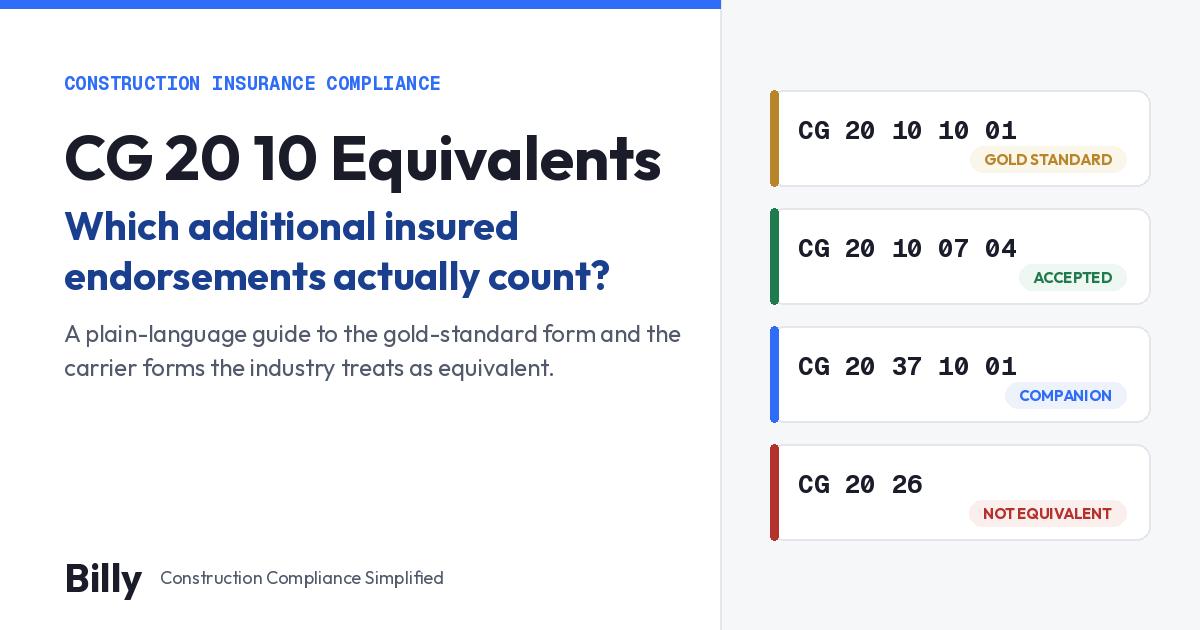
| CG 20 10 10 01 | Work in progress | Gold standard | The most widely recognized and requested form. Everything else is compared against this one. |
| CG 20 10 07 04 or 04 13 | Work in progress | Generally accepted | Slightly different wording in newer editions, but serves the same purpose. |
| CG 20 37 10 01 | After the job is done | Required separately | Companion form covering completed-operations claims. Often required alongside the CG 20 10. |
| Carrier blanket endorsement | Varies by form | Conditionally accepted | Many insurers use their own version. Reviewed case-by-case against the criteria below. |
| CG 20 26 | Named party only | Not equivalent | Adds an additional insured but isn’t tied to the work being performed. Different purpose. |
| Certificate language only | None | Never sufficient | A certificate is a summary document. It isn’t part of the policy and grants no coverage. |
| Contract language only | None | Never sufficient | A contract can’t change what a policy covers. The policy itself must be endorsed. |
When a carrier uses its own form instead of the ISO standard
Many carriers don’t use the ISO CG 20 10 word-for-word. Instead they publish their own version — often called a proprietary or manuscript endorsement. These are common and can be perfectly acceptable, but they aren’t automatically equivalent just because the title looks similar.
Industry practice is to read the actual wording, not the form number or title. These are the five things reviewers check:
- Triggered by a written contractThe endorsement should activate because of a written agreement — not just because someone asked. Vague language like “as required” with no reference to a written contract is a red flag.
- Covers work in progressIt needs to cover liability that arises while the sub is actively performing work. This is the core of what the CG 20 10 provides.
- Covers completed work (if required)If the contract requires completed-operations coverage, a separate endorsement equivalent to the CG 20 37 must be present.
- Pays before the other party’s insuranceThe sub’s policy should respond first, before any coverage the GC carries. This is “primary and non-contributory,” often a separate clause.
- Does not limit coverage to one-sided faultSome endorsements only respond if the sub was entirely at fault. The industry rejects these — additional insured coverage is meant to respond even when responsibility is shared.
Common carrier forms the industry recognizes
The carriers below issue their own additional insured endorsements that are broadly recognized in construction. Form numbers are common examples — always confirm the actual form on a given policy.
| Carrier | Common form numbers | Notes |
|---|---|---|
| Zurich | U-GL-1175-A CW, U-GL-2160-A | Blanket additional insured forms widely used in construction. |
| Travelers | CG D2 46 08 05, CG D3 82 | Separate forms for ongoing and completed operations. |
| Liberty Mutual | Varies by program | Blanket forms generally available; confirm the written-contract trigger. |
| CNA | Varies | Blanket forms generally available; watch for sole-negligence limitations. |
| The Hartford | HA 99 16 and others | Blanket form; often includes primary and non-contributory language in the same endorsement. |
| Chubb / ACE | Proprietary blanket forms | Generally strong language; confirm completed-operations coverage separately. |
What does not meet the standard
These are commonly submitted but are not sufficient on their own under general industry practice:
Quick reference summary
- The CG 20 10 covers the sub’s work while in progress. The CG 20 37 covers claims that come up after the work is done. Many contracts require both.
- Carrier proprietary forms can be acceptable if the language covers the same ground as the ISO standard.
- Read the actual endorsement text — don’t just check the form number or title.
- A certificate of insurance and contract language alone are never sufficient. The policy must be endorsed.
- Coverage that only responds when the sub is entirely at fault does not meet the industry standard.
Stop reading endorsements line by line
Billy’s AI Review Assistant checks endorsement language against your requirements automatically — flagging missing CG 20 37 coverage, sole-fault limitations, and weak contract triggers before they become uncovered claims.
See Billy in ActionGeneral industry reference information only. Not legal advice. The insured and their broker are responsible for determining whether specific endorsements satisfy their contract requirements. Last updated: June 2026.