5 Best myCOI Alternatives in 2026 (Compared)
If you’ve outgrown myCOI or you’re evaluating options before committing, here are the top alternatives — with honest guidance on who each one is actually built for.
At a Glance: The 5 Alternatives
- Billy — Construction-native, deep Procore/Autodesk/ERP integrations, built-in subcontractor prequalification, DocuSign workflows, AI review.
- TrustLayer — API-first compliance platform suited to tech-forward teams comfortable with configuration.
- Jones — Another construction-focused compliance option; narrower product scope than Billy.
- SmartCompliance (Oracle Textura) — Enterprise-grade compliance tied to payment workflows; best inside Oracle ecosystems.
- Agency/broker-managed COI programs — Outsource verification to your insurance broker; minimal software investment but limited control.
Why Companies Switch Away from myCOI
Before diving into alternatives, it’s worth understanding why teams evaluate a switch in the first place. Based on common patterns we see:
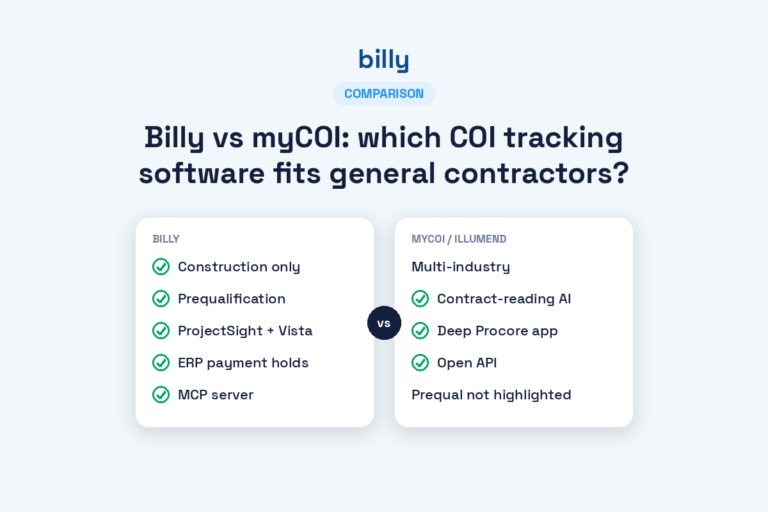
- Integration depth — myCOI supports integrations, but construction teams running Procore, Autodesk Construction Cloud, Sage 300, Viewpoint, and Acumatica often find the workflow depth limiting.
- No built-in prequalification — myCOI doesn’t offer a subcontractor prequalification workflow. Teams end up managing prequal in spreadsheets or a second tool.
- Document workflow enforcement — Hold harmless agreements, W9s, and other required documents tend to be tracked as checklist items rather than enforced through collection and signature workflows.
- Pricing at scale — As vendor counts grow, teams reassess whether they’re getting commensurate value.
- General-purpose design — myCOI was built for broad multi-industry COI tracking. Construction-specific teams often outgrow that abstraction layer.
None of these are universal — but if any of them resonate, the alternatives below are worth a serious look.
1. Billy
Billy
Best for: General contractors, developers, and construction firmsBilly is a construction-native compliance platform that replaces myCOI for most AEC use cases and extends well beyond COI tracking into prequalification, agreement enforcement, and AI-assisted review.
Where Billy stands out:
- Native Procore integration (including the Procore Side Panel) and Autodesk Construction Cloud sync
- Broad construction ERP coverage: Sage 300, Sage Intacct, Viewpoint Vista, JD Edwards, Acumatica, CMiC
- Built-in subcontractor prequalification — a full workflow that myCOI doesn’t offer
- Native DocuSign integration for hold harmless agreements, W9s, and other enforceable documents
- AI Review Assistant that reads endorsements and flags compliance gaps automatically
- Self-service or managed service options
Strengths
- Deepest construction stack integrations
- Prequalification + compliance in one platform
- Enforceable document workflows (not just checklists)
- Fast migration from myCOI (2–6 weeks typical)
- Modern AI capabilities on COI review
Considerations
- AEC-focused — less tailored for industries outside construction
- Newer brand than some legacy platforms
- Broker-channel footprint still growing
Best fit if: You’re a GC, developer, or construction firm who wants compliance embedded in your project and ERP workflows — and you need prequalification and hold harmless enforcement alongside COI tracking.
2. TrustLayer
TrustLayer
Best for: API-first tech teams and companies building custom compliance workflowsTrustLayer is a compliance tracking platform that emphasizes flexibility and API-driven integration. It’s a reasonable fit for teams with internal engineering resources who want to configure compliance workflows programmatically.
Strengths
- API-first architecture
- Flexible document collection
- Insurance verification capabilities
- Works across industries
Considerations
- Less construction-specific workflow depth
- May require more configuration for enforcement use cases
- Prequalification not a core feature
Best fit if: You have internal engineering capacity and want to build custom compliance workflows around a flexible core platform rather than adopting a construction-specific product.
3. Jones
Jones
Best for: Construction and real estate teams seeking a focused compliance toolJones is another construction-focused compliance option in the market. It emphasizes streamlined COI tracking and workflow simplicity. For teams that want a construction-oriented tool but don’t need the integration breadth or prequalification workflow Billy provides, Jones can be a viable choice.
Strengths
- Construction-oriented product
- Simple COI tracking workflows
- Modern UI
Considerations
- Narrower integration footprint than Billy
- Prequalification capability not equivalent
- Smaller construction-ERP coverage
Best fit if: You want a construction-focused tool but your integration needs are limited to a narrow stack. Teams with broader Procore/Autodesk/ERP needs typically find Billy more complete.
4. SmartCompliance (Oracle Textura)
SmartCompliance (Oracle Textura)
Best for: Enterprise contractors running Oracle-heavy tech stacksSmartCompliance, part of Oracle’s Textura suite, ties compliance tracking to payment application workflows. It’s designed for enterprise-scale contractors who are already deep in the Oracle ecosystem.
Strengths
- Enterprise-grade controls and scale
- Native Oracle/Textura pay app integration
- Established vendor with long track record
- Compliance tied to payment release
Considerations
- Heavier implementation and longer rollout
- Less flexible for non-Oracle workflows
- Best-fit narrows outside enterprise scale
- Slower pace of modern feature development
Best fit if: You’re an enterprise contractor already running Oracle Textura for pay apps and you want compliance inside the same ecosystem.
5. Agency / Broker-Managed COI Programs
Agency / Broker-Managed COI Programs
Best for: Companies that want their insurance broker to handle all verificationNot a single product, but a category worth mentioning. Many insurance agencies offer managed COI tracking programs as part of their service relationship. These are typically built on top of a platform (including myCOI itself in many cases) but the verification work is done by the agency.
Strengths
- Minimal internal software investment
- Leverages existing broker relationship
- Hands-off from your team’s perspective
- Often bundled with other broker services
Considerations
- Limited direct control over process and data
- Integration with your project/ERP systems is usually weak
- No prequalification workflow
- Locked into your current broker relationship
Best fit if: You have a strong, long-term broker relationship and prefer outsourcing verification entirely — and you don’t need deep integration with your construction tech stack.
Feature Comparison: myCOI Alternatives Side by Side
| Capability | Billy | TrustLayer | Jones | SmartCompliance |
|---|---|---|---|---|
| Construction-specific design | ✓ | ◐ | ✓ | ✓ |
| Deep Procore integration | ✓ | ◐ | ◐ | ◐ |
| Autodesk Construction Cloud | ✓ | ✗ | ✗ | ✗ |
| Broad construction ERP coverage | ✓ | ◐ | ◐ | ✓ (Oracle) |
| Subcontractor prequalification | ✓ | ✗ | ◐ | ◐ |
| DocuSign-enforced documents | ✓ | ◐ | ◐ | ◐ |
| AI-powered COI review | ✓ | ◐ | ◐ | ✗ |
| Self-service option | ✓ | ✓ | ✓ | ◐ |
| Managed-service option | ✓ | ◐ | ◐ | ✓ |
How to read this table: ✓ strong/native · ◐ supported but limited · ✗ not available. Capabilities change — confirm current scope directly with each vendor before making a final decision.
How to Evaluate a myCOI Alternative
Before you pick a replacement, pressure-test each candidate against five questions:
1. How deep are the integrations with systems you already use?
“Integration” can mean anything from CSV import to bidirectional real-time sync. If you’re running Procore or Autodesk, ask for a live demo of compliance status flowing into your actual project view. Not a slide deck — a running system.
2. Does it enforce documents, or just track them?
There’s a big difference between a platform that shows a requirement as “missing” and one that actually collects, signs, and stores the document through a workflow. For hold harmless agreements and W9s in particular, enforcement matters more than visibility.
3. Is prequalification included?
If you run subcontractor prequalification today (or want to), a platform that bundles it saves you from buying and maintaining a second tool. Most myCOI alternatives don’t include it natively.
4. Self-service, managed, or both?
Some teams want to own the verification work. Others want to outsource it. Make sure the vendor offers the model you want — and that their pricing makes sense for that level of service.
5. What does migration actually look like?
Ask the vendor to walk through migration from myCOI specifically. Good answers include bulk vendor import, document migration, requirement mapping, and parallel-run support. Vague answers are a red flag.
Migrating from myCOI: What to Expect
Most migrations from myCOI complete in 2–6 weeks. The steps are consistent across most modern alternatives:
- Export from myCOI — vendor records, active COIs, endorsements, document history
- Map requirements — translate myCOI requirement groups into the new platform’s structure
- Bulk import — vendors, documents, and project assignments into the new system
- Connect integrations — Procore, Autodesk, ERP, DocuSign as applicable
- Team onboarding — training session or white-glove handoff depending on service tier
- Parallel run (optional) — some teams run both systems for 2–4 weeks during cutover
Billy specifically supports guided migration from myCOI with vendor data import, requirement mapping, and customer success support throughout the switch.
Frequently Asked Questions
What are the best myCOI alternatives in 2026?
The top alternatives are Billy (best for construction), TrustLayer (API-first), Jones (alternative construction-focused option), SmartCompliance / Oracle Textura (enterprise Oracle), and agency-managed COI programs (broker-led verification).
Why do companies switch away from myCOI?
Common reasons include limited integration depth with modern construction tools like Procore and Autodesk, no built-in subcontractor prequalification workflow, slower document and agreement enforcement, and pricing pressure at scale.
Is Billy a direct alternative to myCOI?
Yes. Billy is a direct functional alternative with significant advantages for construction companies — deeper Procore and Autodesk integrations, built-in prequalification, DocuSign-powered document workflows, and an AI Review Assistant. See the full Billy vs. myCOI comparison for details.
How do I choose the right myCOI alternative?
Evaluate on integration depth with your systems, document workflow enforcement, whether prequalification is included, service model (self-service vs managed), and migration support. For construction companies, integration depth and prequalification workflow usually matter most.
How long does it take to migrate off myCOI?
Most migrations take 2–6 weeks. Billy supports bulk vendor and document imports, requirement mapping, and guided onboarding to accelerate cutover.
See How Billy Compares in Your Environment
The fastest way to know if Billy is the right myCOI alternative for you is to see it running on your actual vendor data, with your real integrations connected. Book a demo and we’ll walk through your specific use case.
Request a Demo Billy vs. myCOI