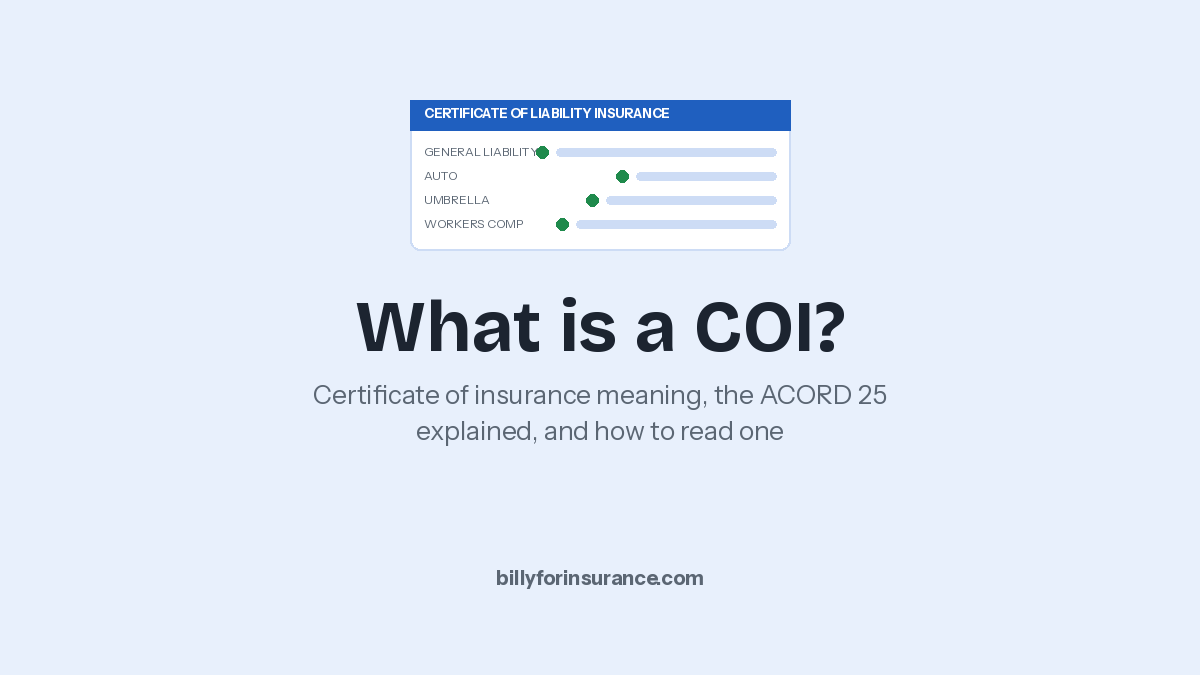
COI stands for certificate of insurance. It’s a one-page document, issued by an insurance agent or broker, that summarizes the insurance a business carries: which policies, which carriers, what limits, and when the coverage expires. In construction, property management, and vendor contracting, the COI is the standard proof that a contractor or vendor is insured before they set foot on your site.
The one-sentence version: a COI is a snapshot of someone’s insurance on the day it was issued. It doesn’t give you coverage, and it doesn’t change the underlying policy. It just tells you what exists.
What “COI” means in different contexts
In business and construction, COI almost always means certificate of insurance. You’ll occasionally see the same three letters used for “conflict of interest” (in governance and legal settings) or “cost of insurance” (in life insurance). If someone in construction, real estate, or procurement asks for your COI, they want proof of insurance.
Who issues a COI, and who asks for one
The insured party (a subcontractor, vendor, tenant, or consultant) asks their insurance agent or broker to issue a certificate. The broker fills out the standard form, usually an ACORD 25, and sends it to the certificate holder, the party that requested proof.
Common certificate holders:
- A general contractor hiring subcontractors
- A property owner or developer hiring a general contractor
- A landlord requiring proof from a commercial tenant
- A lender or equipment lessor protecting collateral
- A municipality issuing a permit
COIs are usually free. The broker issues them as part of the policy relationship, and most brokers can turn one around the same day or within a few business days.
How to read a certificate of insurance: the ACORD 25, section by section
Almost every COI you receive will be on the ACORD 25 form. Once you know the layout, you can review one in under a minute.
The disclaimer that matters: the top of every ACORD 25 says the certificate is issued as a matter of information only and confers no rights upon the certificate holder. That’s why a COI is evidence, not protection. The protection comes from the policy and its endorsements.
What to check when you receive a COI
- Named insured matches your contract. Same legal entity, same spelling.
- Every required policy line is present. If your contract requires umbrella coverage and the umbrella row is blank, the certificate is non-compliant.
- Limits meet or exceed your requirements. Compare per-occurrence and aggregate limits to the contract. Watch for a “per project” versus “per policy” aggregate.
- Dates cover the work period. A policy that expires mid-project needs a renewal certificate. Set a reminder 30 days before.
- Endorsements are attached, not just referenced. Additional insured, waiver of subrogation, and primary and non-contributory should come as actual endorsement forms, not just a checkbox.
- Description of operations names your project and your entity. Blanket endorsements can cover this, but confirm the wording.
- Certificate holder is correct. Your entity, your address.
Common COI endorsements in construction
A base policy rarely satisfies a construction contract on its own. General contractors typically require these endorsements, and they should show up as separate attached forms:
- Additional insured (ongoing operations), usually CG 20 10 or equivalent, which extends the sub’s liability coverage to the GC while work is in progress.
- Additional insured (completed operations), usually CG 20 37, which keeps that protection in place after the work is finished.
- Primary and non-contributory, usually CG 20 01, which makes the sub’s policy pay first before the GC’s policy responds.
- Waiver of subrogation, which stops the sub’s carrier from pursuing the GC to recover a claim payment.
Our guide to CG 20 10 and CG 20 37 covers the two additional insured forms in detail.
How long is a COI good for?
A certificate is valid until the earliest expiration date of the policies listed on it, most often 12 months from the policy’s effective date. It can become inaccurate sooner if the policy is cancelled, non-renewed, or changed, and the certificate holder won’t always be told. That’s the core reason organizations move from collecting COIs to actively tracking them.
Manual COI tracking vs. COI tracking software
Collecting one COI is simple. Collecting, reviewing, and renewing certificates for 50, 200, or 1,000 subcontractors and vendors across multiple projects is where spreadsheets break. Every certificate needs a review against a specific set of requirements, a follow-up when something’s missing, and a renewal request before it expires.
If you’re tracking fewer than a couple dozen vendors, a spreadsheet can work. We publish a free COI tracking template for Excel for exactly that. Past that point, COI tracking software automates the collection, review, expiration alerts, and in Billy’s case, the payment holds that keep non-compliant vendors from getting paid.
Frequently asked questions
What does COI stand for?
In business and construction, COI stands for certificate of insurance: a document that proves a company carries specific insurance coverage. In other contexts it can mean conflict of interest or cost of insurance.
Is a certificate of insurance the same as an insurance policy?
No. The certificate summarizes the policy; it isn’t a contract and doesn’t provide coverage. Your rights come from the policy and its endorsements, which is why you should request endorsement forms alongside the COI.
Does being listed as certificate holder make me an additional insured?
No. The certificate holder box only identifies who requested the certificate. Additional insured status requires an endorsement to the policy, which should be attached to the COI.
How long does it take to get a COI?
Most brokers issue a standard certificate the same day or within one to three business days. Certificates that require new endorsements or project-specific wording can take longer.
How much does a COI cost?
Usually nothing. Brokers issue certificates as part of servicing the policy. Adding endorsements like additional insured or waiver of subrogation may carry a premium charge.
What is a master COI?
A master or blanket certificate lists all of a company’s policies with blanket additional insured and waiver endorsements, so one certificate can be sent to many certificate holders. GCs still need to confirm the blanket wording actually covers their contract.
Stop reviewing COIs by hand
Billy collects certificates from your subs, checks them against your project requirements, and flags what’s missing before payment day.