5 Best TrustLayer Alternatives for Construction Compliance in 2026
If you’ve outgrown TrustLayer or you’re evaluating options before committing, here are the top alternatives — with honest guidance on who each one is actually built for.
The top TrustLayer alternatives in 2026 are Billy (best for construction GCs running on Procore, Autodesk, or a construction ERP), Jones (best for construction and real estate portfolios), myCOI (best for established multi-industry COI tracking), Certificial (best for broker-issued real-time verification), and agency-managed COI programs (best for companies that want their broker to handle verification). Construction GCs typically find Billy the closest functional replacement with significant added capability.
At a Glance: The 5 Alternatives
- Billy — Construction-native, deepest Procore + Autodesk + ERP integrations, built-in subcontractor prequalification, native DocuSign workflows, AI review.
- Jones — Construction + real estate focus with mature managed-service workflows.
- myCOI — Long-tenured multi-industry COI tracking with mature managed-service depth.
- Certificial — Real-time COI data network deployed through insurance agencies; broker-issued verification.
- Agency / broker-managed COI programs — Outsource verification to your insurance broker; minimal software investment but limited control.
Why Companies Switch Away from TrustLayer
Before diving into alternatives, it’s worth understanding why teams evaluate a switch in the first place. Based on common patterns we see when GCs come to Billy from TrustLayer:
- Horizontal platform, vertical problem. TrustLayer is built as a multi-industry compliance platform — it serves construction, transportation, property management, retail, and more. Construction GCs often find that this breadth comes at the cost of construction-specific workflow depth.
- API-first means engineering-required. TrustLayer markets its flexibility, but realizing that flexibility typically requires internal engineering capacity to configure custom workflows. GCs without dedicated dev resources often can’t unlock TrustLayer’s full value.
- No native Procore Side Panel. Both platforms integrate with Procore, but Billy’s Procore Side Panel puts compliance status inside Procore itself. TrustLayer requires switching applications to check vendor status.
- No built-in subcontractor prequalification. TrustLayer focuses on COI tracking and verification but doesn’t ship a full subcontractor prequalification workflow. Teams that want both end up running two tools.
- Subcontractor experience. TrustLayer’s subcontractor portal works, but isn’t differentiated. Billy’s free Insurance Wallet, free W9 generator, and lien waiver templates reduce friction for the subs you’re collecting from — which means faster, more complete responses.
- Managed-service flexibility. Some teams want to start self-service and grow into managed services as compliance volume scales. TrustLayer leans heavily self-service; not every team has the capacity to own all verification work in-house.
None of these are universal — but if any of them resonate, the alternatives below are worth a serious look.
Billy
Billy is a construction-native compliance platform built specifically for general contractors. It replaces TrustLayer for most AEC use cases and extends well beyond COI tracking into prequalification, hold harmless agreement enforcement, and AI-assisted endorsement review.
Where Billy stands out vs. TrustLayer:
- Native Procore integration including the Procore Side Panel — compliance status visible inside Procore itself, no application switching.
- Native Autodesk Construction Cloud sync — deeper than TrustLayer’s standard integration approach.
- Broader construction-ERP coverage: Sage 300, Sage Intacct, Viewpoint Vista, JD Edwards, CMiC, Acumatica.
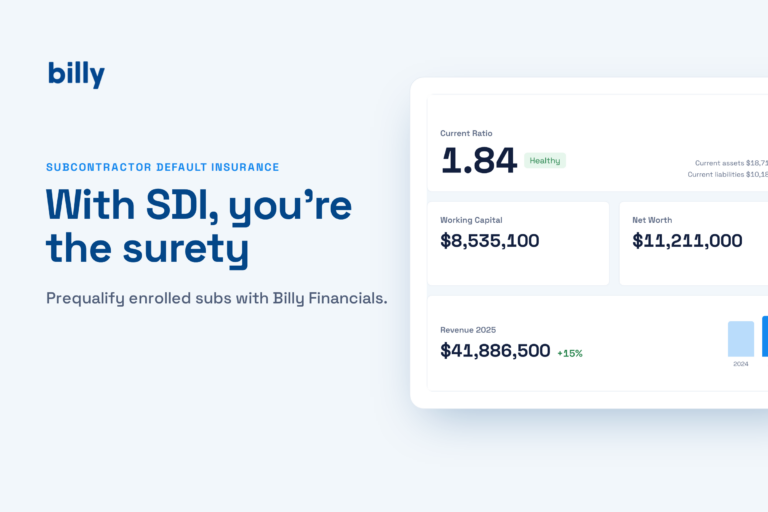
- Built-in subcontractor prequalification — a full workflow that TrustLayer doesn’t offer.
- Native DocuSign integration for hold harmless agreements, W9s, and other enforceable documents — not just checklist items.
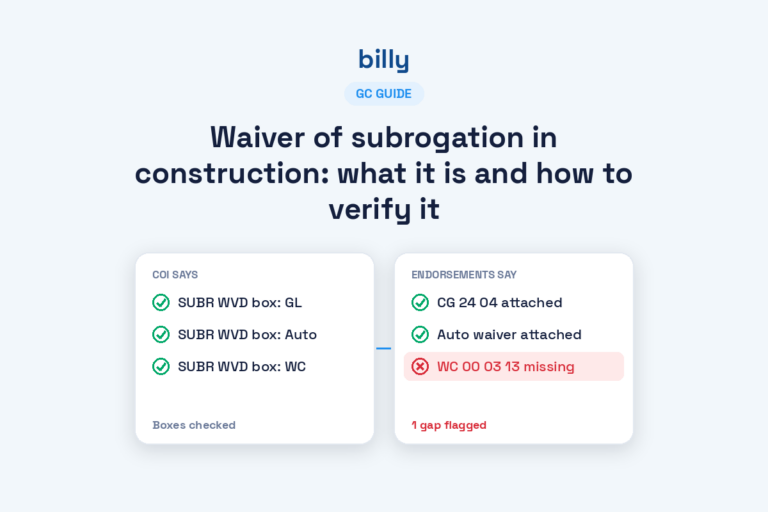
- AI Review Assistant reads endorsements (CG 20 10, CG 20 37, waiver of subrogation, primary & non-contributory) and flags compliance gaps automatically.
- Self-service or managed service options — pick the model that fits your team capacity, no engineering required.
- Free subcontractor tools (Insurance Wallet, W9 generator, lien waiver templates) reduce friction for the subs you’re collecting from.
- No code required — opinionated construction-specific defaults work day one.
Strengths
Considerations
Jones
Jones is a construction- and real-estate-focused compliance platform with mature managed-service workflows. For teams that want a vertical-specific tool but have narrower integration requirements than Billy, Jones is a solid alternative to TrustLayer’s horizontal approach.
Strengths
Considerations
myCOI
myCOI is one of the longer-tenured platforms in the COI tracking category. It serves multiple industries (construction, real estate, transportation, property management) and emphasizes its managed-service depth — experienced human reviewers backed by AI document extraction.
Strengths
Considerations
Certificial
Certificial takes a fundamentally different approach to compliance: rather than tracking COIs after they’re issued, Certificial deploys a real-time COI data network through insurance agencies. Brokers issue and update COIs directly inside Certificial, so verification happens at the source.
Strengths
Considerations
Agency / Broker-Managed COI Programs
Not a single product, but a category worth mentioning. Many insurance agencies offer managed COI tracking programs as part of their broader service relationship. These are typically built on top of a software platform — Jones, myCOI, TrustLayer, or Certificial in many cases — with the verification work performed by the agency’s compliance team.
Strengths
Considerations
Feature Comparison: TrustLayer Alternatives Side by Side
| Capability | Billy | TrustLayer | Jones | myCOI | Certificial |
|---|---|---|---|---|---|
| Construction-native design | ✓ | ● | ✓ | ● | ● |
| Procore Side Panel | ✓ | ✗ | ✗ | ✗ | ✗ |
| Procore (standard integration) | ✓ | ● | ✓ | ● | ✗ |
| Autodesk Construction Cloud | ✓ | ✗ | ✗ | ✗ | ✗ |
| Broad construction ERP coverage | ✓ | ● | ● | ● | ✗ |
| Subcontractor prequalification | ✓ | ✗ | ● | ✗ | ✗ |
| DocuSign-enforced documents | ✓ | ● | ● | ● | ✗ |
| AI-powered endorsement review | ✓ | ● | ✓ | ● | ✗ |
| Real-time broker network verification | ● | ● | ● | ● | ✓ |
| Self-service option | ✓ | ✓ | ● | ✓ | ● |
| Managed-service option | ✓ | ● | ✓ | ✓ | ● |
| Free tools for subcontractors | ✓ | ✗ | ✗ | ✗ | ✗ |
How to read this table: ✓ strong/native · ● supported but limited · ✗ not available. Capabilities change — confirm current scope directly with each vendor before making a final decision.
How to Evaluate a TrustLayer Alternative
Before you pick a replacement, pressure-test each candidate against five questions:
TrustLayer’s strength is multi-industry breadth. If your COI tracking needs span industries, that breadth is valuable. If you’re construction-only, a vertical tool like Billy or Jones with construction-specific defaults will move faster with less configuration.
TrustLayer’s flexibility requires configuration. If your team includes developers who can build custom workflows on top of an API, that flexibility unlocks. If not, an opinionated construction-specific platform with built-in defaults is usually faster to value.
If you run subcontractor prequalification today (or want to), a platform that bundles it saves you from buying and maintaining a second tool. TrustLayer focuses on COI tracking; prequalification isn’t a core feature.
There’s a big difference between a platform that shows a requirement as “missing” and one that actually collects, signs, and stores the document through a workflow. For hold harmless agreements and W9s in particular, enforcement matters more than visibility.
Ask the vendor to walk through migration from TrustLayer specifically. Good answers include bulk vendor import, document migration, requirement mapping, and parallel-run support during cutover. Vague answers are a red flag.
Migrating from TrustLayer: What to Expect
Most migrations from TrustLayer complete in 2–4 weeks. The steps are consistent across modern alternatives:
- Export from TrustLayer — vendor records, active COIs, endorsements, document history.
- Map requirements — translate TrustLayer requirement groups into the new platform’s structure.
- Bulk import — vendors, documents, and project assignments into the new system.
- Connect integrations — Procore, Autodesk, your ERP, DocuSign as applicable.
- Team onboarding — training session or white-glove handoff depending on service tier.
- Parallel run (optional) — some teams run both systems for 2–4 weeks during cutover for risk mitigation.
Billy specifically supports guided migration from TrustLayer with vendor data import, requirement mapping, parallel-run support, and customer success guidance throughout the switch. Most TrustLayer-to-Billy migrations complete inside 4 weeks.
Frequently Asked Questions
What are the best TrustLayer alternatives in 2026?
The top alternatives to TrustLayer in 2026 are Billy (best for construction GCs running on Procore, Autodesk, or a construction ERP), Jones (best for construction and real estate portfolios), myCOI (best for established multi-industry COI tracking), Certificial (best for broker-issued real-time verification), and agency-managed COI programs (best for companies that want their broker to handle verification).
Why do companies switch away from TrustLayer?
Common reasons include limited construction-specific workflow depth, the need for engineering resources to configure their API-first platform, no built-in subcontractor prequalification module, and the absence of a Procore Side Panel integration. Construction GCs often outgrow TrustLayer when they realize they need a vertical construction tool, not a horizontal compliance platform.
Is Billy a direct alternative to TrustLayer?
Yes. Billy is a direct functional alternative to TrustLayer with notable advantages for construction GCs: native Procore Side Panel integration, broader construction ERP coverage (Sage 300, Sage Intacct, Viewpoint Vista, JD Edwards, CMiC, Acumatica), built-in subcontractor prequalification, free tools for subcontractors, and an AI Review Assistant for endorsement-level review.
How does TrustLayer compare to Billy on Procore integration?
Both platforms support Procore, but the integration depth differs. Billy ships a native Procore Side Panel that lets project managers see compliance status inside Procore itself. TrustLayer’s Procore support is via standard integration without a side-panel surface, requiring users to switch between TrustLayer and Procore.
How long does it take to migrate from TrustLayer to Billy?
Most migrations from TrustLayer to Billy complete in 2–4 weeks. Billy supports bulk vendor and document import, requirement mapping, parallel-run support during cutover, and guided onboarding through customer success.
Is TrustLayer better than Billy for non-construction industries?
Possibly. TrustLayer is built as a horizontal compliance platform that works across multiple industries. If your COI tracking needs span industries beyond construction (transportation, property management, retail, healthcare), TrustLayer’s flexibility may serve you better. For construction-only use cases, Billy is purpose-built and typically a better fit.
How do I choose the right TrustLayer alternative?
Evaluate on five dimensions: depth of integration with your existing systems (Procore, Autodesk, ERP), whether subcontractor prequalification is included, document workflow enforcement (signed agreements vs. checklist tracking), service model (self-service vs. managed vs. both), and migration support. For construction GCs specifically, integration depth and prequalification typically matter most.
Related Reading
If you found this guide helpful, you’ll want these next:
See How Billy Compares in Your Environment
The fastest way to know if Billy is the right TrustLayer alternative for you is to see it running on your actual vendor data, with your real integrations connected. Book a demo and we’ll walk through your specific use case.
Request a Demo →