Industry Trends
Nuclear Verdicts Are Rewriting Construction Insurance Rules — Here’s What GCs Need to Change in 2026
10 min read · Industry Trends · Updated Feb 2026
|
$150M Texas, 2018 — highway project fatality |
$1.1B Florida, 2022 — commercial site wrongful death |
$78M California, 2024 — high-rise crane collapse |
These aren’t outliers anymore. They’re the new baseline.
The construction industry is in the middle of a fundamental shift in liability exposure, and most GCs haven’t updated their subcontractor insurance requirements to reflect it. If the last time you reviewed your standard insurance requirement template was before 2022, you’re almost certainly carrying more risk than you think — not because your subs are doing anything different, but because the consequences of a single incident have changed dramatically.
What’s Driving Nuclear Verdicts in Construction
The term “nuclear verdict” refers to a jury award exceeding $10 million — a threshold that, even a decade ago, was rare enough to make national headlines. Today, verdicts above $10M are common, and verdicts above $50M are no longer shocking. Here’s why construction is being hit particularly hard:
01 — Severe, Visible Injuries
Construction injuries — falls, crushing, electrocution, structural collapse — are catastrophic and immediate. Juries see X-rays, surgical photos, and video. The emotional impact drives larger awards.
02 — “Reptile Theory” Litigation
Plaintiff attorneys reframe workplace accidents as public safety failures. If a GC didn’t verify a sub’s safety program or insurance compliance, the GC becomes the story’s villain — not just a co-defendant.
03 — Social Inflation
Jurors today have different expectations about damage awards. High-profile verdicts in other industries have reset what jurors consider “reasonable.” A verdict that was $3M in 2015 is $15M in 2026.
04 — Third-Party Litigation Funding
Plaintiff firms access outside funding to take cases to trial instead of settling. Trial verdicts are almost always larger than settlements. When attorneys don’t face cash-flow pressure, they hold out for jury awards.
How It’s Changing the Insurance Market
| Market Shift | What It Means for GCs |
|---|---|
| Umbrella carriers pulling back | Several major carriers have reduced per-project capacity, stopped writing certain construction classes, or added nuclear verdict exclusions. GCs who easily obtained $25M umbrella coverage five years ago are struggling to build $10M towers. |
| Premium spikes on high-risk trades | Workers’ comp and CGL rates for structural steel, roofing, demolition, and crane operations have seen double-digit annual increases since 2022. Those costs flow through to sub bids and project budgets. |
| Carriers tightening policy terms | Watch for new exclusions: “assault and battery,” “communicable disease,” sublimits on “traumatic brain injury” claims. These are appearing on actual certificates right now. If your team isn’t reading beyond the limits, you won’t catch them until there’s a claim. |
| Excess follow-form becoming less reliable | Excess carriers increasingly write policies with their own terms and exclusions that differ from the underlying CGL. This creates coverage gaps invisible on a standard certificate. |
7 Things GCs Need to Change — Right Now
⚠️ Nuclear verdict risk doesn’t live in YOUR policy — it lives in your subcontractors’ policies. If a sub’s coverage is inadequate, the GC gets stuck with the exposure when the sub’s tower runs out.
Increase Your Standard Umbrella Requirements
| Risk Level | Trades | 2026 Umbrella Minimum |
|---|---|---|
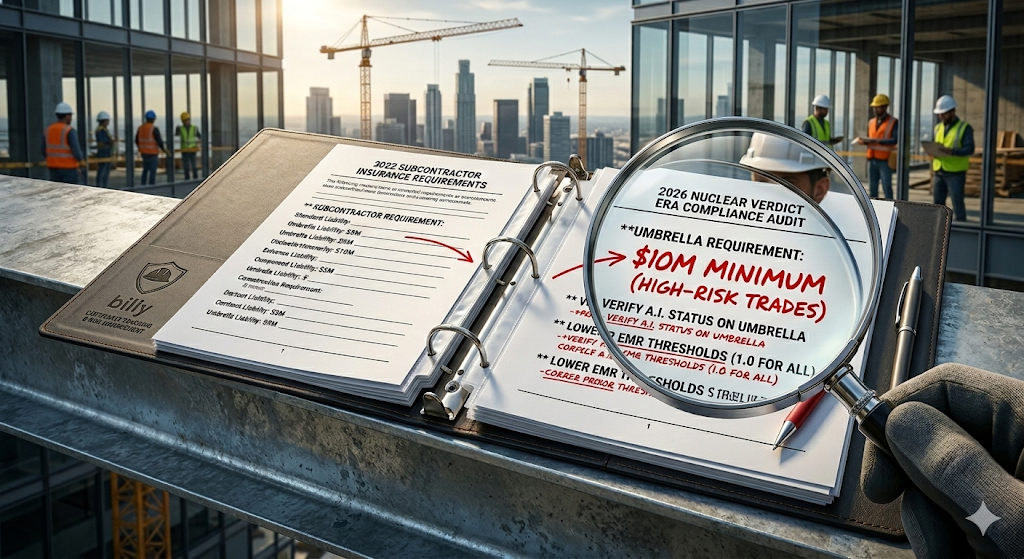
| High | Structural steel, demolition, crane ops, roofing | $10M minimum. $15M–$25M on projects >$50M. |
| Moderate | Concrete, excavation, mechanical, electrical, fire protection | $5M minimum. $10M on larger projects. |
| Lower | Drywall, painting, flooring, landscaping, low-voltage | $2M–$5M depending on project size. |
For a complete breakdown, see our Subcontractor Insurance Requirements by Trade checklist.
Verify the Umbrella Actually Follows Form
Requiring higher umbrella limits doesn’t help if the umbrella is full of holes. Your compliance team should verify that the umbrella follows form over all three underlying coverages — CGL, auto, and employer’s liability — and doesn’t contain exclusions broader than the underlying policies. This is one area where AI-only COI review falls short. Catching gaps between excess and underlying policies requires human expertise. Billy’s managed services team does exactly this kind of layered policy review for high-risk subs.
Require Additional Insured Coverage on the Umbrella
This is one of the most commonly missed requirements. Many GCs require additional insured endorsements on the CGL (CG 20 10 and CG 20 37) but don’t verify that additional insured status extends to the umbrella policy. If the GC is an AI on the sub’s $1M CGL but not on the sub’s $10M umbrella, the GC only has $1M of protection. Your standard requirements should explicitly state: “General Contractor shall be named as Additional Insured on both the CGL and the Umbrella/Excess Liability policy.”
Lower Your EMR Threshold
Consider lowering from the common 1.25 ceiling to 1.0 for all trades and 0.85 for high-risk trades. Nuclear verdicts don’t just happen on unsafe projects. They happen on projects where the plaintiff attorney can demonstrate the GC knew or should have known a sub’s safety record was below average and let them on the project anyway.
Review Your Additional Insured Endorsement Editions
The ISO CG 20 10 form was revised multiple times (2001, 2004, 2013), and each revision narrowed coverage. Make sure your contracts specify which edition you require. The 04/13 edition is most common but provides narrower coverage than the 07/04 edition. Our endorsement guide breaks down the differences. Also verify Primary & Noncontributory wording is in place — without it, the GC’s own policy responds first.
Add Contractual Defense Obligations
Your subcontract should include defense clauses triggered by a “claim” rather than a “finding of liability” — so the sub’s insurer pays for legal defense from day one, not after a trial that costs the GC millions in fees. Review with counsel.
Document Everything
In nuclear verdict cases, plaintiff attorneys routinely subpoena the GC’s subcontractor qualification files. They want to show the jury that the GC didn’t verify insurance compliance. Your defense is documentation: timestamped evidence that you verified every sub’s insurance, flagged non-compliance, and didn’t allow non-compliant subs to mobilize.
💡 Your audit trail is a defense asset
Billy maintains a complete, timestamped audit trail of every document received, every compliance check performed, every deficiency notice sent, and every resolution. A dedicated COI tracking system isn’t just administrative — in a nuclear verdict courtroom, it’s evidence that you did your job.
What’s Coming Next
| Trend to Watch | Impact on GCs |
|---|---|
| Tort reform efforts | Several states (Texas, Florida, Georgia) are considering caps on non-economic damages and litigation funding disclosure. May moderate verdicts locally but won’t eliminate the national trend. |
| “Nuclear verdict” endorsements | Expect carriers to offer endorsements with sublimits on non-economic damages, caps on defense costs, or modified occurrence definitions. Read these carefully before accepting on your subs’ policies. |
| Owners raising RFP requirements | Sophisticated owners are increasing insurance requirements in bid documents. If you can demonstrate airtight compliance, you’ll have a competitive advantage in risk-focused bid situations. |
| Insurance → Pre-qualification convergence | Insurance compliance is merging into pre-qualification workflows — insurance metrics weighted alongside financial qualifications and safety records. |
The Opportunity for GCs Who Act Now
Here’s the counterintuitive truth: GCs who respond proactively to nuclear verdicts don’t just reduce risk — they gain a competitive advantage.
When you can demonstrate to an owner that your subcontractor insurance compliance program is airtight — that every sub has been verified against trade-appropriate requirements, that your tracking system integrates with your project management platform, that you have a complete audit trail — you’re offering something most competitors can’t match.
Billy was built for this environment. Our platform combines AI-powered certificate review with expert human oversight, trade-specific compliance templates, real-time monitoring, and a complete audit trail that holds up under legal scrutiny. We integrate with Procore, Autodesk, CMiC, Sage, JD Edwards, and Viewpoint Vista.
🏗️ Built for the Nuclear Verdict Era
Trade-specific templates. AI + human review. Timestamped audit trails. Connected to your full construction stack.
Request a Free Demo →📚 Related Resources
|
Checklist |
Guide Insurance Endorsements: CG 20 10, CG 20 37 & Primary Noncontributory → |
|
Guide |
Compliance |
|
Workflow |
Free Tool |