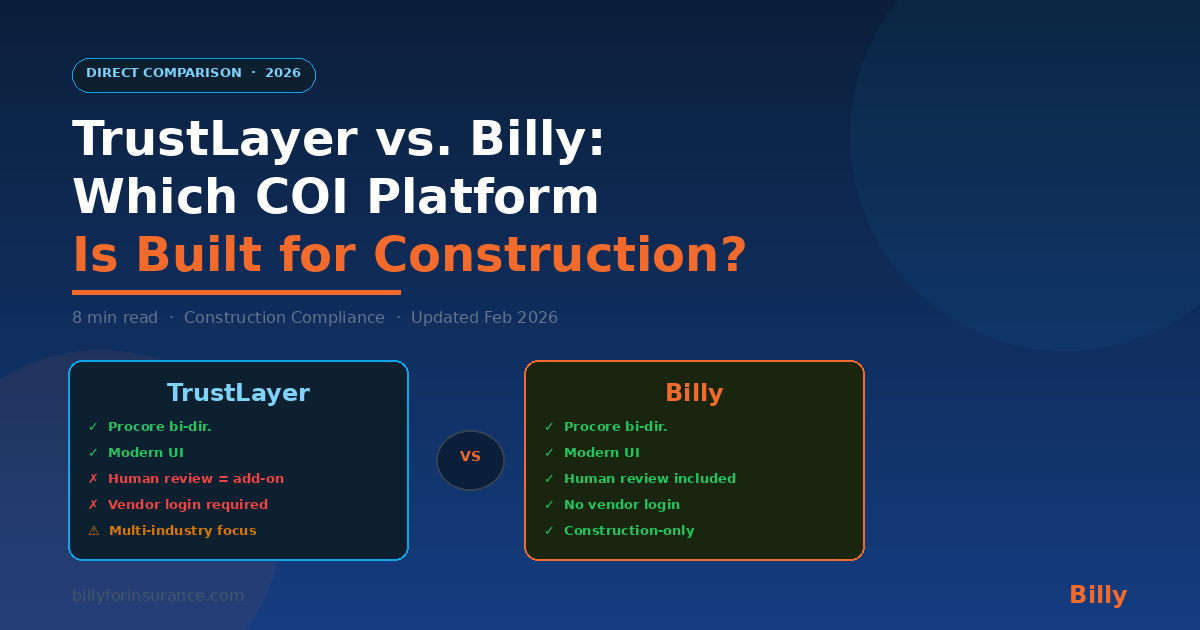
TrustLayer is running aggressive ad campaigns right now. If you’ve searched for COI tracking software recently, you’ve seen them. Their content is polished, their interface looks modern, and their pitch is compelling. But there’s a difference between a platform that looks built for construction and one that actually is. This comparison cuts through the marketing to show where TrustLayer and Billy genuinely differ — and when each one wins.
Quick disclosure: We’re Billy. So yes, we have a perspective. We’ve tried to be fair — including sections where TrustLayer has a real edge.
Where TrustLayer and Billy Are Actually Similar
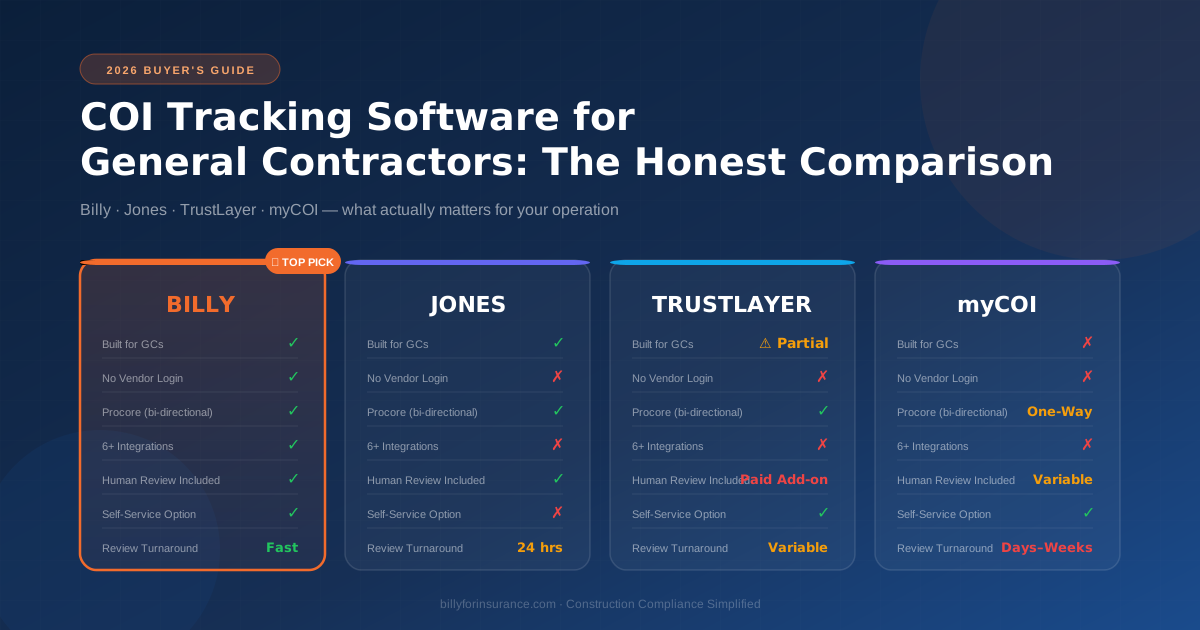
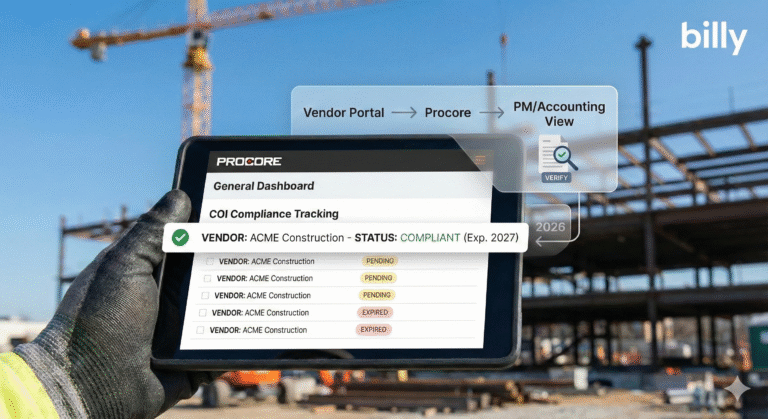
Before the differences, the honest overlap: both platforms handle automated COI collection, both offer vendor-facing submission workflows, and both integrate with Procore bi-directionally. If you’re coming from a spreadsheet or from myCOI, either platform will be a meaningful upgrade on turnaround time and workflow visibility.
The differences show up when you go deeper: how human review works, what construction-specific tooling looks like, what “integrations” actually means in practice, and what you pay for features that should be standard.
5 Differences That Actually Matter to GCs
TrustLayer vs. Billy: Full Feature Breakdown
| Feature | TrustLayer | Billy ★ |
|---|---|---|
| Built exclusively for construction | ⚠ Multi-industry | ✓ Construction-only |
| Human review included | ✗ Paid add-on | ✓ Every plan |
| No vendor login required | ✗ Login required | ✓ No login |
| Procore integration | ✓ Bi-directional | ✓ Bi-directional |
| Autodesk / Sage / CMiC | Limited | ✓ 6+ integrations |
| Self-service option | ✓ Available | ✓ Available |
| Modern UI | ✓ Strong | ✓ Strong |
| Volume minimum | Varies by plan | ✓ No minimum |
The Real Question: What Are You Actually Paying For?
TrustLayer’s pricing model separates human review from the base subscription. That means what looks like an apples-to-apples comparison often isn’t — you need to add the human review tier to get equivalent functionality to what Billy includes as standard.
For GCs evaluating both platforms, the right comparison isn’t just the headline price — it’s the price at the feature tier that actually covers your compliance requirements. When you factor in human review, ERP integrations, and managed services, Billy’s managed plan is typically competitive or less expensive for comparable coverage.
We recommend asking both platforms for a quote that includes: (1) human review on every COI, (2) bi-directional Procore sync, and (3) your ERP if you use one beyond Procore. The gap often becomes clear at that level.
Bottom Line: Which Platform Is Right for You?
|
Choose Billy if…
You’re a construction GC who wants human review included, no vendor login friction, bi-directional Procore sync, and ERP connectivity across your full stack — not just one system.
|
Choose TrustLayer if…
You operate across multiple industries beyond construction, have budget for the premium human review tier, and your vendor base is tech-comfortable with account creation across platforms.
|
📚 Related Resources
|
Comparison
Billy vs Jones vs TrustLayer vs myCOI →
How all four platforms stack up across every key feature.
|
Migration
Why GCs Are Switching from myCOI to Billy →
The four most common reasons GCs leave legacy platforms.
|
|
Product
Billy’s AI Review Assistant →
How AI + human review works together in Billy.
|
Integration
Billy + Procore: Bi-Directional Sync →
How the Procore integration actually works end-to-end.
|