Billy vs COMPASS by Bespoke Metrics: Which Prequalification Approach Fits Your Team?
If your COMPASS renewal is coming up and you’re weighing alternatives, this guide compares the two platforms honestly: standardized network prequalification versus prequalification built into your own compliance workflow.
Updated July 2026COMPASS by Bespoke Metrics is a standardized prequalification network: subcontractors complete one industry form (the 1Form) and receive a third-party risk score (the Q Score) that participating general contractors can reference. Billy is a vendor risk and compliance platform: general contractors run prequalification on their own custom forms and criteria, and the same platform tracks certificates of insurance and compliance through the life of every project, synced into Procore and your accounting system. Choose COMPASS if you want a standardized industry score. Choose Billy if you want prequalification connected to your own risk standards and your day-to-day compliance workflow.
What Is COMPASS by Bespoke Metrics?
COMPASS is a subcontractor prequalification and risk evaluation platform from Bespoke Metrics, a Toronto-based data analytics company. Its model is built on standardization: subcontractors complete the COMPASS 1Form, a common data collection form developed with a consortium of general contractors, insurers, and other stakeholders, and COMPASS produces a Q Score, an independent, model-driven assessment of subcontractor risk based on financials, business characteristics, and health and safety records. The platform is used by a large network of general contractors across North America and has partnerships with subcontractor default insurance providers.
For enterprise GCs that want a standardized, third-party benchmark applied uniformly across thousands of subs, that model has real strengths. But it also comes with trade-offs that matter to regional and mid-market builders, and those trade-offs are usually why teams start looking at alternatives around renewal time.
Where GCs Feel the Limits of a Standardized Network
1. Your risk standards aren’t standard
A standardized industry form is efficient for the network, but it means prequalification reflects the consortium’s questions, not necessarily yours. If your team has specific requirements around bonding thresholds, trade-specific safety criteria, contract limits, or exceptions (like qualifying a sub only up to a certain contract value), you want a prequalification process built on your form and your decisioning, not a one-size-fits-all profile.
2. A score isn’t a decision
A third-party score is an input. The actual decisions your team makes are more nuanced: qualified, qualified with an exception, approved but benched for the right project, or rejected. If your platform can’t capture those states and carry them into your project systems, your risk team ends up maintaining the real answer in a spreadsheet next to the score.
3. Prequalification that stops at prequalification
This is the biggest structural difference. Prequalification tells you a sub was healthy when they filled out the form. It doesn’t tell you whether their insurance certificate is valid on your project this month, whether their coverage meets the requirements in their contract, or whether they’re compliant the morning they mobilize. When prequalification lives in one platform and COI tracking lives somewhere else, there’s a handoff, and handoffs are where risk leaks in.
4. Another portal for your subs
Every platform you add is a platform your trade partners have to maintain. Regional subs who work with you repeatedly often resent maintaining a network profile for one GC relationship. With Billy, subcontractors complete your prequalification form for free, with no account or subscription required on their end, which keeps your best trade partners happy and your response rates high.
How Billy Approaches Vendor Risk
Billy treats prequalification as the first stage of a continuous compliance workflow, not a standalone event:
Prequalification on your form, your criteria
Send prequalification requests at scale using your own custom form covering financials, workforce capacity, safety records, bonding, and references. Your team reviews and decides: qualified, qualified with exceptions (like contract limits), unqualified but benched, or rejected. Requalification runs on a schedule so your data never goes stale.
Approved vendors flow into Procore automatically
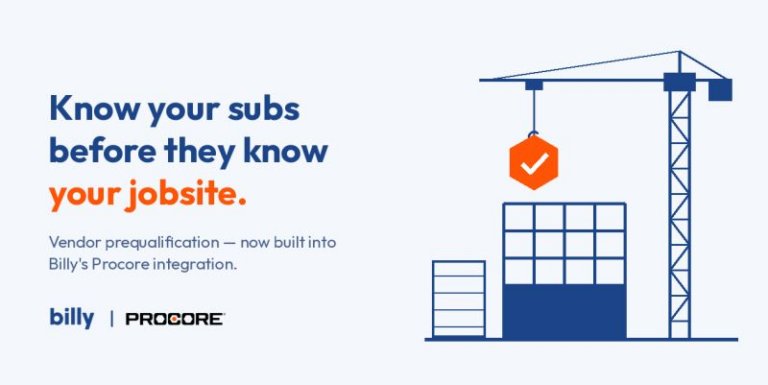
Approved vendors and their contacts sync into your Procore directory, where project teams can search prequalified subs, confirm status, and build bid lists without leaving Procore.
Compliance tracking starts the moment contracts are issued
When commitments go out, Billy begins tracking project-specific insurance requirements automatically: limits, endorsements, W9s, and certificates, with AI-assisted document review. One vendor record carries from prequalification through payment.
Compliance status where payment decisions happen
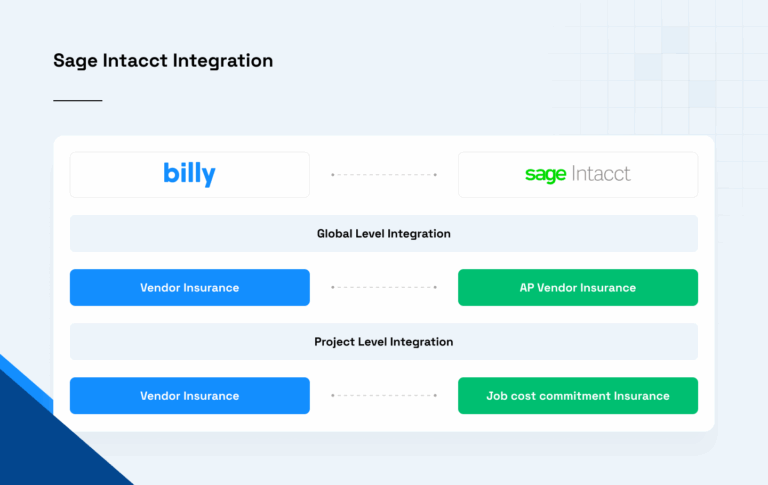
Billy syncs compliance status into accounting systems like Viewpoint Vista, Sage Intacct, and Sage 300, so a non-compliant sub is visible before the check run, not after the claim.
Billy vs COMPASS: Side-by-Side
| Dimension | Billy | COMPASS by Bespoke Metrics |
|---|---|---|
| Core model | Prequalification built into a full vendor compliance platform | Standardized prequalification network with third-party scoring |
| Prequal form | Your custom form and criteria | Standardized industry 1Form |
| Risk assessment | Your team’s decisioning, with statuses like qualified-with-exception and contract limits | Model-driven Q Score benchmark plus GC review |
| COI & compliance tracking | Built in: project-specific requirements, AI document review, ongoing monitoring | Focused on prequalification; compliance tracking typically handled in separate tools |
| Procore integration | Directory sync, bid-list discovery, and real-time compliance inside Procore | Integrations focused on prequalification data |
| Accounting integrations | Viewpoint Vista, Sage Intacct, Sage 300, CMiC, and more | ERP integrations available (e.g., CMiC prequalification module) |
| Subcontractor experience | Free for subs; complete your form with no account required | Subs maintain a COMPASS network profile |
| Best fit | Regional and mid-market GCs who want prequal connected to daily compliance | Enterprise GCs standardizing on an industry-wide benchmark |
To be fair to both sides: if your organization specifically wants an independent, standardized score applied across a very large subcontractor base, and your compliance tracking is already handled elsewhere, COMPASS’s network model is a reasonable choice. The question is whether you’re paying for a network when what you actually need is a workflow.
Questions to Ask Before You Renew
Whether you stay or switch, these five questions will tell you if your current prequalification platform is earning its renewal:
- Does prequalification connect to compliance? Or does “prequalified” live in one system while COIs and contract requirements live in another?
- Can we qualify on our own criteria? Including exceptions, contract limits, and trade-specific requirements?
- Do approved vendors flow into Procore automatically? Or is someone re-keying directory records?
- What does it cost our subs? In fees, time, or another portal to maintain?
- Can the field see compliance status in real time? Or does the jobsite find out about a lapsed certificate after mobilization?
If your current platform answers “no” to two or more of these, the renewal conversation is really a replacement conversation.
Switching Is Simpler Than You Think
The most common objection to leaving an incumbent prequalification platform is migration. In practice, switching to Billy means importing your vendor list, configuring your prequalification form and requirement groups, and connecting Procore and your accounting system. Because subs complete your form for free with nothing to install, re-collecting current prequalification data doubles as a natural requalification cycle: you come out the other side with fresher data than you had before. Most teams run their first prequalification campaign within weeks, not quarters.
Comparing more than one platform? See our full breakdown of Billy vs ISNetworld vs Avetta for subcontractor prequalification.
Frequently Asked Questions
What is the best alternative to COMPASS by Bespoke Metrics?
It depends on what you need prequalification to do. For general contractors who want prequalification connected to certificate of insurance tracking, Procore, and their accounting system in one workflow, Billy is the strongest alternative. For teams that only want standardized third-party scoring across a very large sub base, other network platforms like ISNetworld or Avetta are the closer comparison.
What is the difference between Billy and COMPASS?
COMPASS is a standardized prequalification network: subs complete the industry 1Form and receive a model-driven Q Score. Billy is a vendor compliance platform: GCs prequalify on their own custom forms and criteria, and the same platform tracks COIs and project compliance through payment, integrated with Procore and accounting systems like Viewpoint Vista, Sage Intacct, and Sage 300.
Does Billy charge subcontractors for prequalification?
No. Subcontractors complete your prequalification form in Billy for free, with no account, subscription, or portal to maintain.
Can Billy replace both our prequalification platform and our COI tracking tool?
Yes. That consolidation is the core of Billy’s model: prequalification, insurance compliance tracking, and vendor monitoring run on one vendor record in one platform, so there is no handoff between “prequalified” and “compliant.”
How hard is it to switch from COMPASS to Billy?
Migration involves importing your vendor list, setting up your prequalification form and requirement groups, and connecting your integrations. Because re-collecting prequalification data acts as a requalification cycle, most teams finish the switch with more current vendor data than they started with.
Coming Up on a Prequal Renewal?
See how prequalification looks when it’s connected to your compliance workflow, your Procore projects, and your accounting system, on your forms and your criteria.
Book a demo Explore Billy Prequalification