Here’s something we hear on nearly every discovery call: a general contractor tells us they looked at one of the big prequalification platforms, got a demo, saw the price tag, and quietly closed the tab. Not because they don’t care about vetting their subs. They do. They just don’t need a platform built for ExxonMobil to prequalify roofers in Charlotte.
Keith, a preconstruction director at a well-known regional GC, put it plainly during a recent conversation: “We don’t need the national litmus test. We need to know if a sub has the right insurance, a clean safety record, and enough bandwidth to finish the job.”
That observation keeps coming up because it captures something the enterprise platforms miss. The majority of general contractors in the United States are regional firms doing $20M to $250M in annual revenue. They’re not managing 90,000 vendor networks across six countries. They’re managing 150 to 400 trade partners across a few states, and they need tools that match that reality.
65% of construction businesses fail within 5 years
Construction is the riskiest industry to partner with. Your prequalification process is the frontline of defense. But the tool you use to run it shouldn’t cost more than the risk it’s mitigating.

What’s Inside
The “Overbuilt for Somebody Else” Problem
The dominant prequalification platforms, ISNetworld, Avetta, Veriforce, were born in oil and gas and heavy industrial. Their DNA is built around managing contractor safety in environments where a single incident can mean an explosion, an environmental disaster, or a regulatory shutdown. That’s a legitimate use case, and those industries need that level of rigor.
But when a commercial GC building multifamily housing in Denver or a school renovation in Phoenix gets funneled into the same platform, they inherit complexity that doesn’t map to their world. Suddenly they’re navigating RAVS verification programs, sustainability questionnaires, cybersecurity assessments, and HSE program audits designed for petrochemical facilities.
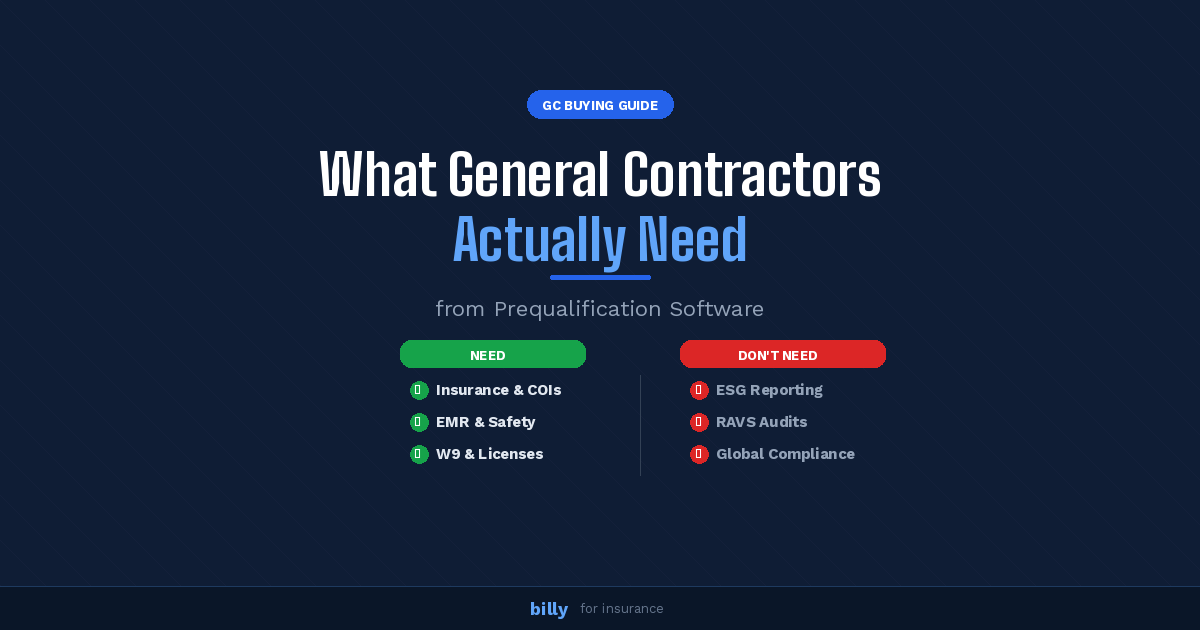
Enterprise Platforms Ask For
Sustainability & ESG reporting
Cybersecurity program documentation
Multi-country regulatory compliance
Pandemic preparedness protocols
Employee-level training verification
Financial audits and credit scoring
Regional GCs Actually Need
Valid insurance certificates
EMR and safety track record
Business licenses and W9s
Project references and trade scope
Bonding capacity verification
Diversity and workforce certifications
There’s a real cost to this mismatch, and it’s not just the subscription price. When you force subcontractors through a process that doesn’t match the scope or complexity of your projects, you create friction in your bidder pool. Subs who are perfectly qualified to frame a four-story building shouldn’t need to document their cybersecurity protocols to win the work.
The 6 Things General Contractors Actually Need from Prequalification Software
After hundreds of conversations with GCs ranging from $15M firms to ENR Top 100 builders, a clear pattern emerges. The features that actually move the needle fall into six categories, and none of them require enterprise-level complexity.
✓ Essential
1. Customizable Forms That Match Your Actual Requirements
Every GC has a slightly different list of what matters. Some care deeply about bonding capacity. Others prioritize EMR thresholds. Your prequalification form should reflect your company’s risk criteria, not a generic industry standard designed for the lowest common denominator across all sectors. Look for software that lets you configure your own form fields, set your own approval thresholds, and update requirements without calling a support line.
✓ Essential
2. Automated Document Collection with Renewal Tracking
The real time sink in prequalification isn’t the initial review. It’s the ongoing chase: expired COIs, lapsed business licenses, outdated W9s. Good prequalification software should automatically request documents, send reminders before expiration dates, and flag gaps so your team can focus on evaluating risk instead of sending follow-up emails.
✓ Essential
3. Integration with Procore, Autodesk, or Your Existing PM Stack
Prequalification data is only useful if it connects to where your project teams actually work. If your preconstruction team approves a vendor in one system but your project managers can’t see that status in Procore or Autodesk, you’ve just created another silo. Native integration means vendor data, compliance status, and prequalification documents live alongside project data, not in a separate tab no one checks.
✓ Essential
4. Approval Workflows That Include the Right People
Prequalification decisions typically involve preconstruction, risk management, safety, and sometimes executive leadership. You need a system that routes submissions through the right reviewers based on your internal process, captures their feedback in one place, and creates an audit trail for every approval or rejection. No more passing paper folders between desks or forwarding email chains.
✓ Essential
5. A Subcontractor Experience That Doesn’t Create Friction
This is the feature most platforms get wrong. If your prequalification tool requires subcontractors to create accounts, pay registration fees, or navigate a complex portal just to submit their qualifications, you’re shrinking your bidder pool. The best subs have options, and they’ll choose the GC whose onboarding process respects their time. A good platform lets subs submit through a simple form or link with no account required and no fees attached.
✓ Essential
6. Clear Compliance Dashboards (Not a PhD in Data Analytics)
You shouldn’t need training to understand whether your vendors are compliant. A red/yellow/green status view, a “needs attention” queue, and the ability to filter by project, trade, or compliance status covers 90% of what GC teams need on a daily basis. Save the advanced analytics and ISN-style benchmarking for the firms managing global supply chains.

What You’re Paying For (But Probably Don’t Need)
This isn’t about bashing enterprise platforms. They serve a purpose. But if you’re a regional GC evaluating prequalification software, it helps to know which features you can safely ignore so you’re not paying for capabilities that sit unused.
Global Multi-Region Compliance
If all your projects are in a handful of U.S. states, you don’t need a platform that supports compliance tracking across 170 countries. ISNetworld’s pricing model, for example, includes per-country setup fees for international operations. That’s a cost center you’ll never activate.
RAVS-Level Document Auditing
ISNetworld’s RAVS (Review and Verification Services) team performs detailed line-by-line reviews of safety programs against regulatory requirements. For oil and gas operators managing high-hazard work, that depth makes sense. For a GC building a medical office park, it’s overkill. You need to verify that a safety program exists and covers the basics, not audit whether it cites the correct OSHA sub-paragraph.
Sustainability and ESG Reporting
Both Avetta and ISNetworld include sustainability and corporate social responsibility modules. These matter for publicly traded companies with ESG reporting obligations. If you’re a private GC, your prequalification tool shouldn’t be charging you for ESG questionnaire management.
Network Marketplace / Vendor Discovery
Platforms like ISNetworld market their network of 90,000+ contractors as a sourcing advantage for hiring clients. Regional GCs already know their trade partners. You don’t need to “discover” subs through a prequalification platform. You need to efficiently vet the ones who are already in your bid invitations. Paying for a vendor marketplace you’ll never browse is a feature tax.
“We don’t need a national litmus test. We need to know if a sub has the right insurance, a clean safety record, and enough bandwidth to finish the job.”
Preconstruction Director, Regional GC (Mid-Atlantic)
Why the Subcontractor Experience Matters More Than You Think
Here’s the part that often gets left out of the prequalification software conversation: what happens on the other side of the form?
When you choose a platform that charges subcontractors $800 to $1,500 per year just to register, you’re introducing a filter that has nothing to do with quality. Small, highly capable trade contractors, especially MBE/WBE/DBE firms that you may need on your projects for diversity requirements, may not have the budget to maintain annual subscriptions across multiple prequalification platforms. They skip the registration, you never see their bid, and your project loses access to qualified capacity.
The Hidden Cost of Charging Subcontractors
When subs pay annual fees to prequalification platforms, those costs don’t disappear. They get baked into bids as overhead. A sub paying $1,500/year to ISNetworld and another $800 to Avetta adds $2,300 in annual platform costs alone. Multiply that across every GC relationship they maintain, and those fees start showing up in the numbers you see at bid day.
The alternative is simple: the GC pays for the tool. The subcontractor fills out a form. No accounts. No registration fees. No login portals they’ll forget the password to in three weeks. That’s how you get higher completion rates, faster turnaround, and a wider bidder pool.

How to Right-Size Your Prequalification Stack
If you’re evaluating prequalification software right now, here are the questions that will save you from overspending on features you won’t use:
Five Questions Before You Buy
Question 1:
How many active trade partners do you manage across all projects? If the answer is under 500, you almost certainly don’t need an enterprise platform.
Question 2:
Do your projects require global or multi-country compliance? If you operate in the U.S. only, cross that feature off the list.
Question 3:
Does the platform integrate with your current project management software (Procore, Autodesk, Sage, CMiC)? If prequalification data lives in isolation, your teams won’t use it.
Question 4:
What does the subcontractor experience look like? Ask for a demo from the sub’s perspective, not just the admin view. If they need to create an account or pay to participate, that’s a red flag for completion rates.
Question 5:
Can you customize the form, or are you stuck with a one-size-fits-all questionnaire? Your risk criteria are yours. The tool should adapt to your process, not the other way around.
Billy’s Approach: Built for the GCs That Actually Build
Billy was designed specifically for general contractors in commercial construction. Not for oil and gas hiring clients. Not for global supply chain managers. For GCs who need to vet trade partners, collect compliance documents, track COIs, and push vendor data into Procore or Autodesk without paying enterprise prices or forcing their subs through a registration gauntlet.
Custom Prequalification Forms
Build your own form with the fields that matter to your firm. Embed it directly on your website or send a branded link.
Zero Cost to Subcontractors
No sub accounts. No registration fees. No login required. Subs fill out a form and upload documents. Done.
Procore + Autodesk Integration
Vendor data, compliance status, and documents sync directly. No duplicate entry. No disconnected tools.
Automated COI + Document Tracking
Renewal reminders, expiration alerts, and a “Needs Attention” dashboard your whole team can access.
If you’re ready to stop paying for features designed for someone else’s problems, explore Billy’s prequalification module or schedule a demo to see how it works with your actual workflows.
Ready to right-size your prequalification process?
See how Billy gives you everything you need and nothing you don’t.
Schedule a Demo