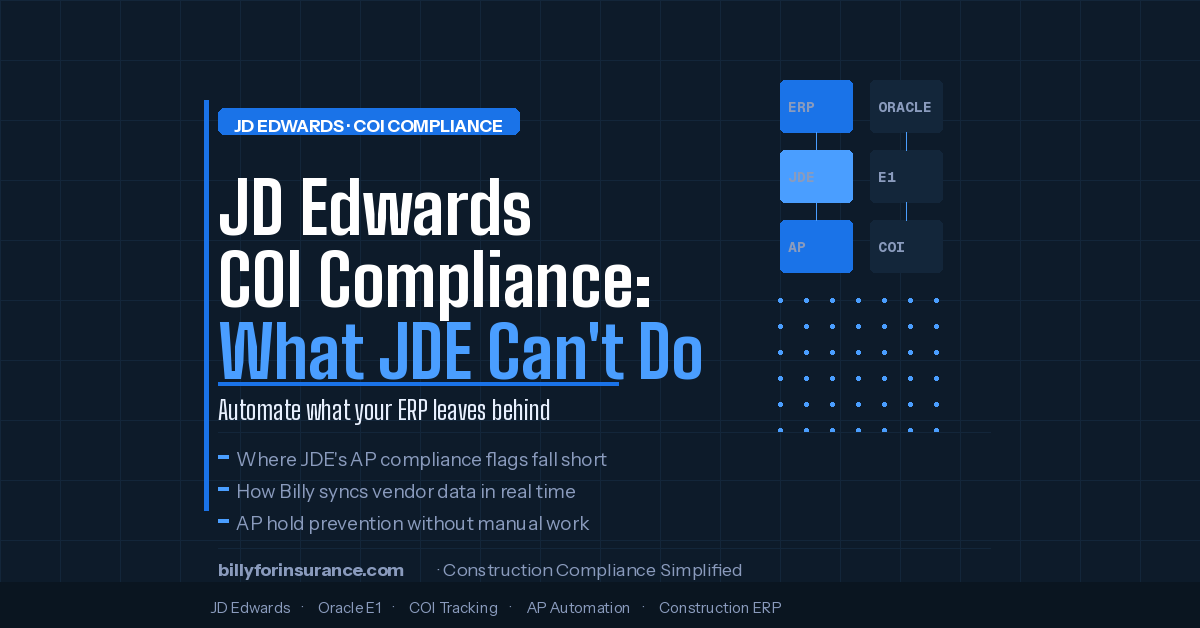
JD Edwards tracks subcontract commitments and manages AP — but it was never built to collect insurance documents, review endorsement language, or stop compliance gaps before they become claim exposure. Here’s where JDE ends and where the real risk begins.
If your company runs on JD Edwards EnterpriseOne, you already know the platform is capable. Oracle’s JDE handles subcontract management, procurement workflows, AP vouchers, and commitment tracking across complex construction and manufacturing operations. The system is mature, deeply integrated, and trusted by mid-market and enterprise organizations across every vertical.
But ask any compliance coordinator at a JDE shop about managing certificates of insurance and you’ll hear the same answer: “We do it manually.”
That’s not a configuration problem. It’s a product scope problem. JDE was built for financial operations — not insurance compliance tracking. And the gap between those two things is where your exposure lives.
What JD Edwards Actually Does for Compliance
To be fair to JDE, the platform has some native compliance infrastructure worth understanding before you extend it.
JD Edwards EnterpriseOne’s Procurement and Subcontracts Management module allows GCs and project owners to track subcontractor commitments, manage payment applications, and generate lien waiver forms alongside AP check runs. Within the AP module, JDE can be configured to flag vendors with missing or expired compliance items — similar to how Viewpoint Vista handles compliance codes.
In practical terms, JDE can:
- Store vendor compliance record fields (insurance policy dates, coverage amounts)
- Display warnings during invoice posting when compliance items expire
- Block or warn AP payments based on configured compliance settings
- Track subcontract log items, submittals, and transmittal status
- Run AIA application reports tied to pay requests
This is the same limitation that exists in Sage 300 and other construction ERPs. The ERP can enforce payment holds — it just can’t prevent the lapse that triggers the hold in the first place.
The 4 Compliance Gaps JDE Leaves Open
Can’t collect COIs automatically
No outbound request, no vendor portal, no email automation. Every COI is chased manually.
Can’t review endorsements
JDE tracks dates and limits — not whether your Additional Insured endorsements are actually correct.
No pre-expiration outreach
The AP hold fires after the lapse — not before. JDE has no mechanism to prevent the gap.
No full document set
W9s, MSAs, lien waivers, business licenses — JDE has no native workflow for tracking these alongside COIs.
Gap 1 — JDE can’t collect COIs from subcontractors
When a new subcontractor is added to your vendor master in JDE, nothing automatically reaches out to them for a certificate of insurance. Your compliance coordinator manually contacts the sub or their broker, requests the COI, receives it via email, reviews it, and then manually enters the policy data into JDE. At 5 vendors this is workable. At 100 active vendors across 12 projects, it becomes a full-time job.
Gap 2 — JDE can’t review endorsements, only dates
Even if your team manually enters COI data into JDE, the system can only track what you tell it to track: coverage amounts and expiration dates. It cannot review whether the subcontractor’s endorsements are correct.
Most construction insurance claims that harm GCs don’t come from expired policies — they come from missing or incorrect endorsements. A COI can show $2M general liability and still fail to provide Additional Insured status.
Billy Compliance TeamGap 3 — JDE can’t prevent AP holds, only trigger them
Policies expire. When a subcontractor’s general liability policy renews on July 1st, JDE will flag the payment hold — but it won’t have done anything to prevent it. There’s no automated outreach 30 days in advance. The lapse happens first, then the hold fires, then your AP team scrambles.
Gap 4 — JDE can’t handle the full compliance document set
Modern construction compliance goes beyond COIs. General contractors now routinely require W9 forms, business licenses, Master Service Agreements, lien waivers, warranty letters, and safety agreements — in addition to certificates of insurance. JDE has no native workflow for collecting and tracking this document set as a unified vendor compliance record.
How Billy Fills Every Gap
Billy connects directly to your JD Edwards vendor and project data, then automates the parts of compliance that JDE was never designed to handle.
| Compliance task | JDE alone | Billy + JDE |
|---|---|---|
| Store vendor master data | ✓ Native | ✓ Synced from JDE |
| Block payment on expired COI | ⚠ Manual entry required | ✓ Automated via Billy sync |
| Collect COI from sub / broker | ✗ Manual email | ✓ Automated request + portal |
| Review endorsement language | ✗ Not possible | ✓ AI Review Assistant |
| Pre-expiration renewal reminders | ✗ No outbound automation | ✓ 30-day automated outreach |
| Track W9, license, MSA, lien waiver | ✗ Not in scope | ✓ Full document set |
| Sub uploads without login | ✗ Not possible | ✓ Via Insurance Wallet |
| Real-time compliance dashboard | ⚠ AP flags only | ✓ Vendor-level visibility |
The JDE ↔ Billy sync in practice
When Billy connects to your JD Edwards environment, vendor records from your JDE supplier ledger flow automatically into Billy. When a new vendor is added in JDE, Billy initiates a COI request automatically — no manual step, no email, no spreadsheet entry.
- Vendor added in JDE — Billy detects the new supplier record and auto-initiates a compliance request.
- Sub or broker receives request — Billy sends a branded email with a one-click upload link. No sub login required.
- AI Review Assistant reviews the COI — Checks coverage limits, endorsement types, Additional Insured status, and expiration against your contract requirements.
- Compliance status syncs back to JDE — AP hold status updates automatically. No manual data entry.
- Renewal outreach fires 30 days early — Billy contacts the sub and their broker before the policy expires, preventing holds before they happen.
What the AI Review Assistant Does
What the AI checks on every submitted COI
- CG 20 10 and CG 20 37 Additional Insured endorsements
- Primary and Non-Contributory (PNC) language
- Waiver of Subrogation status
- Coverage limits against per-project requirements
- Carrier AM Best rating thresholds
- Named insured accuracy against the legal entity on file
Billy’s AI Review Assistant reads submitted COIs and endorsements against your specific contract requirements — not just generic coverage minimums. For JDE users running Billy Managed Services, licensed insurance professionals review flagged certificates alongside the AI — bringing human expertise to edge cases that require judgment rather than pattern matching.
JDE + Billy Alongside Your Other Systems
If you run JDE alongside Procore or another project management system, Billy connects to both — eliminating the common problem of compliance data living in two separate systems that never talk to each other. Billy currently integrates with:
Oracle JD Edwards
Vendor master sync, AP hold automation, full compliance lifecycle.
Viewpoint Vista
Compliance code sync, BILLY code, AP Verify flag integration.
Procore + Side Panel
Native embedded side panel — compliance visible without leaving Procore.
Sage 300 CRE
Vendor compliance sync direct to Sage AP and financial modules.
Is This Right for Your JDE Environment?
If you’re managing a smaller vendor set, Billy’s self-service plan provides the automation layer without enterprise pricing. If you’re managing high volume across multiple projects simultaneously, Managed Services puts licensed insurance professionals on your compliance operation alongside the software.
See Billy + JD Edwards in Action
We’ll walk through how the sync works, what the AI review catches, and what your compliance workflow looks like after implementation.
Book a Free Demo →Frequently Asked Questions
Does Billy replace JD Edwards?
No. Billy runs alongside JDE, not instead of it. Your ERP handles what it was built for — financial operations, subcontract management, AP processing. Billy handles what JDE was never built for — COI collection, endorsement review, and compliance lifecycle automation. The two systems stay in sync through Billy’s JDE integration.
How long does the JDE integration take to set up?
Most JDE integrations go live within a few weeks. Billy’s implementation team handles the connector configuration, and your team doesn’t need to write custom code.
What if our subcontractors don’t want to use a portal?
Billy’s Insurance Wallet doesn’t require your subcontractors to create accounts or log in. They receive a branded email, click a link, and upload their COI directly. Their broker can also submit on their behalf.
Can Billy handle more than just COIs?
Yes. Billy collects and tracks the full compliance document set — COIs, W9 forms, business licenses, Master Service Agreements, warranty letters, lien waivers, safety agreements, and custom documents your contracts require.