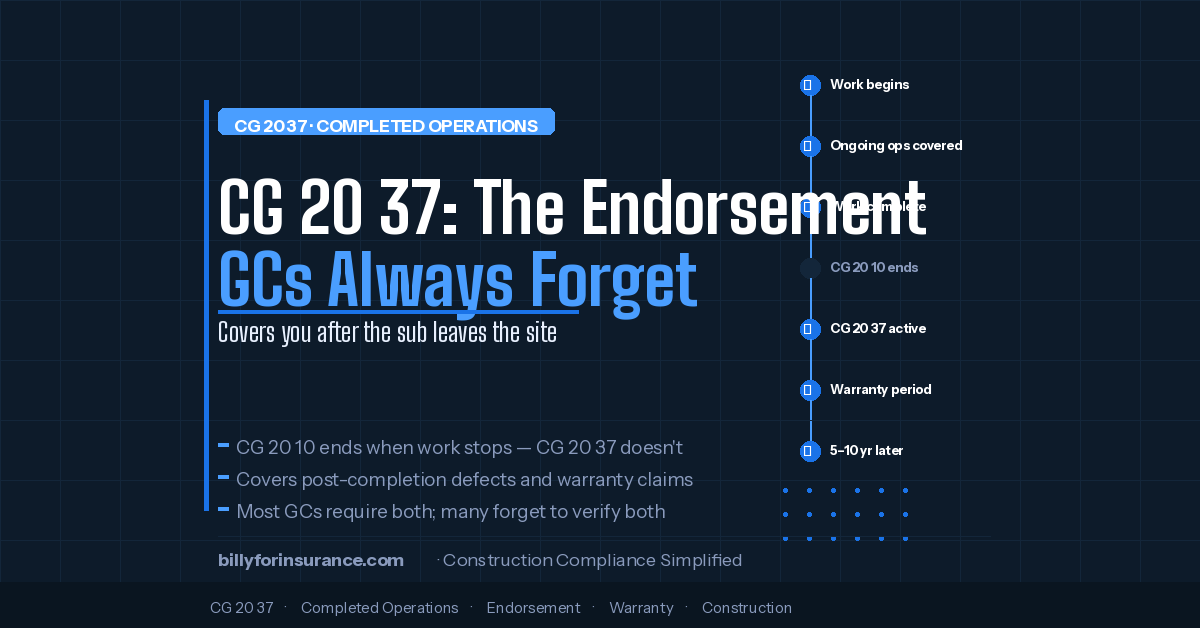
CG 20 10 is the endorsement everyone knows to ask for. CG 20 37 is the one they forget — and it’s the one that covers you after the subcontractor leaves the site. If your contracts don’t require both, your post-completion liability exposure is real.
Here’s a scenario that happens to GCs more often than anyone publishes: A subcontractor finishes their scope of work on a commercial project, their insurance looks compliant on the day of closeout, and everyone moves on. Eight months later, a defect surfaces — a waterproofing failure, a structural issue, a MEP problem — and a claim arises.
Your GC contract requires you to indemnify the property owner. You tender the claim to the subcontractor’s insurer under their CG 20 10 Additional Insured endorsement. The carrier denies coverage. Why? Because CG 20 10 only covers ongoing operations — and the sub’s work was completed months ago. You needed CG 20 37, and your contract never required it.
What Is CG 20 37?
CG 20 37 is an ISO endorsement form officially titled “Additional Insured – Owners, Lessees or Contractors – Completed Operations.” Like CG 20 10, it attaches to a subcontractor’s Commercial General Liability policy and adds the general contractor (or owner/developer) as an Additional Insured — but specifically for claims arising after the sub’s work is complete.
The two endorsements are designed to work together. CG 20 10 covers you while work is happening. CG 20 37 covers you after work is done. Together, they provide continuous Additional Insured protection across the full project lifecycle.
CG 20 10 vs. CG 20 37: Exactly What Each Covers
| Coverage dimension | CG 20 10 | CG 20 37 |
|---|---|---|
| Coverage period | During ongoing operations only | After operations are complete |
| Triggers when… | Sub is actively working on the project | Work is finished and sub has left the site |
| Terminates when… | Sub’s work on that project is complete | Policy expires (or as stated in endorsement) |
| Primary use case | On-site incidents, bodily injury, property damage during construction | Post-completion defects, latent defects, warranty claims |
| Needed together? | Yes — CG 20 37 fills CG 20 10’s gap | Yes — CG 20 10 fills CG 20 37’s gap |
| Covers sub’s sole negligence? | No | No |
Why You Need Both — Not One or the Other
The gap between CG 20 10 and CG 20 37 is the gap between “while the crew is on-site” and “for as long as your warranty runs.” For most commercial construction projects, that gap is 5 to 10 years.
What “completed operations” means in practice
A completed operation is a claim that arises from the subcontractor’s finished work — after they’ve left the site and been paid. Common examples include:
- Waterproofing failure discovered during the first heavy rain post-occupancy
- Electrical fault causing a fire six months after project completion
- Structural cracking attributed to a concrete contractor’s work two years later
- Plumbing leak from improper installation discovered during interior finishing by the next trade
- HVAC system failure due to installation defect during commissioning
Every one of these claims would fall under completed operations — and without CG 20 37, you’re holding the liability yourself.
Completed Operations and Warranty-Period Compliance
Most GC contracts include warranty obligations that run 1 to 10 years after substantial completion — sometimes longer for specialty scopes. During the entire warranty period, every subcontractor’s completed operations coverage needs to remain active and compliant.
This creates a compliance challenge that most COI tracking platforms don’t address: projects close out, vendor records go dormant, and nobody is monitoring whether the subs’ policies — and their CG 20 37 coverage — remain in force for the full warranty window.
How to Verify Your Subs Have CG 20 37
- Update your contract language — Require “Additional Insured status for both ongoing and completed operations via CG 20 10 and CG 20 37 or equivalent.” Don’t assume CG 20 10 implies CG 20 37.
- Request both endorsements at onboarding — Your prequalification form and COI request should explicitly require both endorsement forms.
- Read the endorsement, not just the COI — A COI that says “Additional Insured” does not confirm which ISO forms are attached. Request the actual endorsement pages.
- Confirm the completed operations policy period — Some subs carry completed operations on a “tail” policy with a limited term. Confirm the policy period covers your warranty obligations.
- Track it past project closeout — Set your compliance monitoring to continue tracking completed operations coverage for the full warranty period, not just until substantial completion.
Verify CG 20 10 and CG 20 37 on Every Submitted COI — Automatically
Billy’s AI Review Assistant confirms both endorsements are present, checks edition dates, and flags whether you have ongoing and completed operations coverage — in seconds, on every document.
See How It Works →Frequently Asked Questions
Is CG 20 37 always separate from CG 20 10?
Yes. They are separate ISO forms that cover separate time periods. Some carriers issue them together on one endorsement page; others issue them as separate documents. Regardless of format, both must be present for continuous AI coverage across the project lifecycle.
How long should completed operations coverage run?
At minimum, through your warranty period — typically 1 to 3 years for most commercial construction. For projects with longer statutory warranty periods or owner-required warranties, require completed operations coverage through the full term. Work with your broker to confirm your subcontract language addresses the specific warranty period for each project.
What if a sub can’t get CG 20 37?
Some specialty subcontractors or smaller subs with limited policy options may have difficulty obtaining CG 20 37 from their carrier. This should be flagged and addressed before work begins — not discovered post-completion. If a sub can’t provide completed operations AI coverage, assess the risk carefully and document your decision.