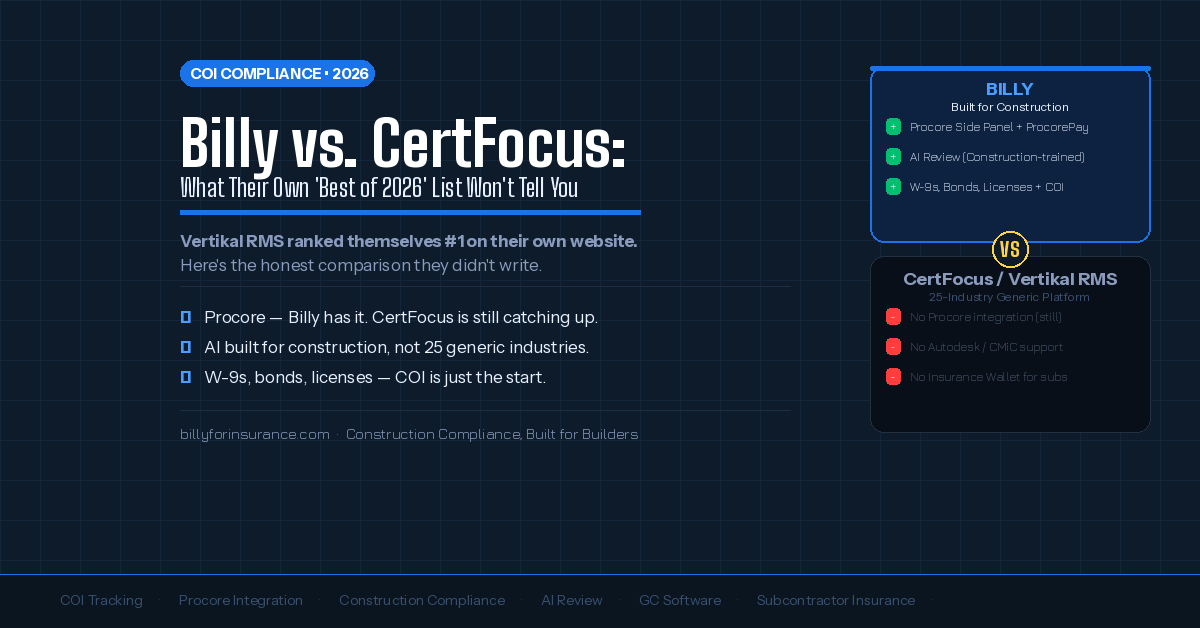
Earlier this year, Vertikal RMS published a “Best COI Tracking Software 2026” list on their own website — and ranked their own product, CertFocus, at #1. They gave themselves glowing praise, labeled competitors’ strengths as weaknesses, and tucked Billy in at #5 with a handful of carefully worded cons.
We’re not upset about it. We’re flattered we made the list at all.
But if you’re a General Contractor evaluating COI compliance software in 2026, you deserve an honest comparison — not one written by a vendor promoting their own product. So let’s do this properly.
How Much Is Manual COI Tracking Costing You?
Adjust the sliders to reflect your operation. See your annual savings potential with Billy.
These are estimates based on industry benchmarks. Your actual savings depend on your workflows.
Get a custom quote from Billy →
First: Let’s Acknowledge the Obvious Conflict of Interest
The Vertikal RMS article reads like an independent editorial. It uses language like “we tested these platforms” and claims to evaluate tools “based on what matters in real operations.” But it’s published on vertikalrms.com, the website of CertFocus’s parent company. Vertikal writes the content, ranks the platforms, and scores every category.
Spoiler: they win every category.
This is a common content marketing tactic — and it’s effective because it ranks in search results alongside genuinely independent reviews. But before you make a six-figure compliance decision based on it, you should know who wrote the piece you’re reading.
This article is written by Billy. We’ll be transparent about that too. Check third-party review sites like Capterra, Software Advice, and GetApp to form your own view.
The Core Difference: General-Purpose vs. Built for Construction
CertFocus by Vertikal RMS serves 25 different industry verticals — from retail chains to healthcare systems to NASCAR. That breadth is their selling point to enterprise risk managers who oversee sprawling vendor networks across multiple business lines.
Billy was built for one industry: construction. Every feature, every workflow, every integration decision was made with General Contractors, Home Builders, and owner-developers in mind. That focus isn’t a limitation — it’s why ENR’s top 20 General Contractors trust Billy to manage their compliance.
When Vertikal’s article lists “limited to the construction industry” as a con for Billy, they’re framing a feature as a flaw. For a GC managing subcontractor compliance across 50 active job sites, a platform that thinks in projects, trades, and payment approvals — not in retail franchise locations — isn’t a compromise. It’s the right tool.
Where Billy Wins: A Feature-by-Feature Look
1. Procore Integration — No Contest
The Vertikal article buries a remarkable admission in its FAQ section: CertFocus “will integrate with Procore by the end of 2025.” It’s March 2026.
Billy has had a native, two-way Procore integration for years — including a dedicated Procore Side Panel that lets your project managers check COI compliance without ever leaving Procore. Sub compliance data syncs in real time. Alerts live inside the workflows your team already uses.
Billy also integrates with ProcorePay, embedding compliance checks directly into payment approval workflows. Non-compliant subs don’t get paid. It’s automatic, and it removes the manual step of cross-referencing compliance before releasing funds. If your business runs on Procore, this alone is the deciding factor.
2. Billy’s AI Review Assistant — Not “Basic AI”
The Vertikal article describes Billy’s AI capabilities as “basic AI for automated compliance gap identification and alerts.” That’s inaccurate.
Billy’s AI Review Assistant is trained specifically on construction insurance requirements. It reads COI documents, cross-references coverage limits against your project-specific insurance requirements, and flags gaps — including missing endorsements, inadequate limits, and wrong additional insured language — automatically.
The difference between Billy’s AI and a generic AI layer is the same as the difference between a construction attorney and a general practice lawyer. Both are lawyers. Only one knows what an additional insured endorsement on a CGL policy should look like for a subcontract in New York.
3. Construction-Specific Integrations
Billy connects natively with the systems construction teams actually use:
- Procore (including Side Panel and ProcorePay)
- Autodesk Construction Cloud
- CMiC
- Sage 300 CRE
- Sage Intacct
- Oracle JD Edwards
- Viewpoint Vista
- DocuSign
CertFocus connects to “ERP systems via open API” — but generic API connections require custom development and ongoing maintenance. Billy’s integrations are pre-built, tested with construction workflows, and maintained by a team that understands how project data flows in a GC environment.
4. The Insurance Wallet — A Unique Advantage for Your Supply Chain
One feature the Vertikal article doesn’t mention at all: Billy’s Insurance Wallet for subcontractors.
Subs on Billy-managed projects get their own compliant document repository. They can store and share their COIs, track their own coverage status, and respond to compliance requests from multiple GCs in one place — without creating new logins or managing separate portals for every job. This reduces friction on their end, which means faster submissions and higher compliance rates on yours.
5. Document Scope: More Than Just COIs
Billy tracks the full document stack that GCs actually need: Certificates of Insurance, W-9 tax forms, business licenses, surety bonds, warranty forms, and lien waivers. CertFocus focuses primarily on COIs. If you’re managing compliance holistically — which the best risk managers do — having all of this in one platform, integrated with your project management system, is a material advantage.
Where CertFocus by Vertikal RMS Has Legitimate Strengths
Honest comparisons go both ways. Here’s where CertFocus genuinely has an edge:
Multi-industry breadth. If you’re managing compliance for a Fortune 500 company with vendor relationships in retail, food service, healthcare, and construction simultaneously, CertFocus’s 25-industry coverage may be a better fit than a construction-specific platform.
Vendor-pay pricing model. CertFocus offers a model where the compliance cost is passed to suppliers ($85–$150/vendor/year). For certain enterprise procurement operations, shifting the cost to vendors makes sense.
Established enterprise relationships. CertFocus has been in the market since the early 2000s. For large organizations that require extensive security reviews, compliance audits, and procurement committee approvals before onboarding new software, legacy market presence can matter.
The Cons Vertikal Listed for Billy — Fact-Checked
The article listed four cons for Billy. Let’s look at each one:
“Limited to the construction industry, lacking versatility for other business sectors.”
True, and intentional. If you’re a GC, this is a feature. If you manage compliance for a hotel chain, Billy isn’t your tool. Know your use case.
“May require initial setup time for full integration with existing construction management systems.”
Every enterprise software integration requires setup time. CertFocus itself lists implementation as requiring 1–2 weeks. Billy’s onboarding team is construction-specific and has run hundreds of implementations across GCs of all sizes.
“Newer platform with less established market presence compared to legacy COI tracking providers.”
Billy is trusted by ENR’s top 20 General Contractors. “Less established” is doing a lot of work in that sentence. The construction industry’s leading firms chose Billy specifically because legacy tools weren’t meeting their needs.
“Customization options may be limited compared to more generalized compliance platforms.”
In practice, Billy’s insurance requirement templates are fully customizable by project, trade type, contract value, and location. If there are specific customizations you need, ask us — we’ll tell you honestly whether we support them.
Head-to-Head Summary
| Feature | Billy | CertFocus / Vertikal RMS |
|---|---|---|
| Built for construction | ✅ Purpose-built | ❌ 25-industry generic platform |
| Procore integration | ✅ Native, Side Panel, ProcorePay | ⚠️ Announced for “end of 2025” — not live |
| Autodesk integration | ✅ Yes | ❌ Not listed |
| CMiC integration | ✅ Yes | ❌ Not listed |
| AI COI review | ✅ Construction-trained AI | ✅ Hawk-I AI (multi-industry) |
| Full-service option | ✅ Yes | ✅ Yes |
| Self-service option | ✅ Yes | ✅ Yes |
| W-9, license & bond tracking | ✅ Yes — full doc stack | ❌ COI-focused |
| Sub-facing Insurance Wallet | ✅ Yes | ❌ Not available |
| ENR Top 20 GC clients | ✅ Yes | ❌ Not construction-focused |
| Wrote their own “Best of 2026” list | 🏗️ Built for the job | 🥇 Ranked #1… by themselves |
Bottom Line
CertFocus by Vertikal RMS is a real product with a real customer base. For enterprise risk managers overseeing multi-industry vendor compliance, it may genuinely be worth evaluating.
But their “Best of 2026” list is marketing content, not an independent editorial. It was written to rank in search results and funnel leads to CertFocus. The fact that Billy made the list at #5 — despite the obvious incentive to exclude or bury us — is actually a signal that the platform is hard to ignore.
If you’re a General Contractor, the question isn’t which platform won a self-published ranking. The question is which platform was built for how you work.
We think the answer is obvious. But we’re biased, and we told you so upfront.
See Billy in action — request a demo →
Also worth reading: Billy vs. TrustLayer | PINS Advantage Alternatives (2026)
Billy is a trademark of BuildAP, Inc. All third-party product names mentioned are the property of their respective owners. This article reflects Billy’s perspective as a competitor in the COI tracking market.