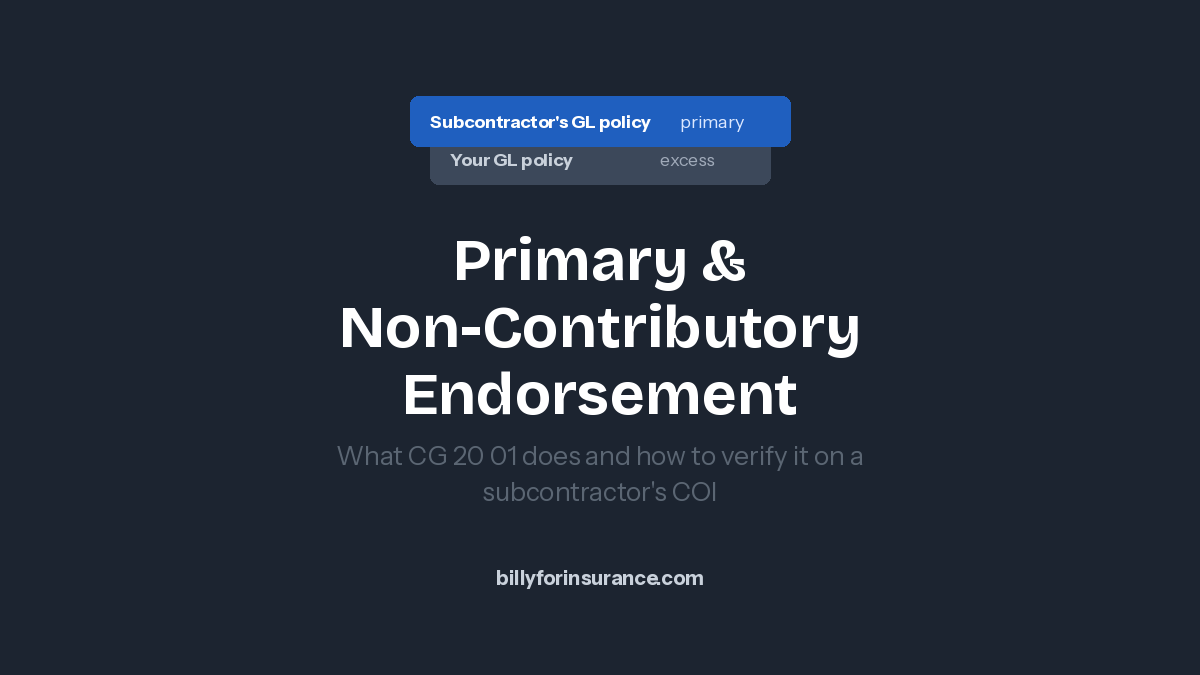
Being named an additional insured on a subcontractor’s policy is only half the protection most general contractors think it is. Without primary and non-contributory wording, the sub’s carrier can argue that your own general liability policy should share the loss, and you end up paying part of a claim that was supposed to be theirs. That’s the gap the primary and non-contributory endorsement closes.
In one sentence: a primary and non-contributory endorsement makes the subcontractor’s liability policy pay first, and in full up to its limits, before your policy is asked to contribute anything.
Why “other insurance” clauses create the problem
Almost every commercial general liability policy contains an “other insurance” condition. When two policies cover the same loss, this clause decides how they share it. The default in the standard ISO CG 00 01 form is that primary policies share on an equal shares or pro rata basis.
So picture a jobsite injury caused by an electrical sub’s work. You’re an additional insured on the sub’s policy. But you also have your own GL policy. Under the default rules, both policies are primary for you, and both carriers contribute. Your claim history takes the hit, your deductible or SIR may apply, and your renewal premium reflects a loss that was caused by someone else.
The primary and non-contributory endorsement overrides that default. It says two things:
- Primary: the sub’s policy responds first to a covered claim against you as additional insured.
- Non-contributory: the sub’s carrier won’t seek contribution from your policy. Your insurance sits in excess and only responds once the sub’s limits are exhausted.
The endorsement form: ISO CG 20 01
The standard ISO form is CG 20 01, “Primary and Noncontributory – Other Insurance Condition.” The current edition is 04 13 (April 2013). It modifies the “other insurance” condition so that coverage for an additional insured is primary and non-contributory when two conditions are met:
- The additional insured is a named insured under another policy (that’s you, on your own GL), and
- A written contract or agreement requires the insurance to be primary and non-contributory.
That second condition is why your subcontract language matters. If your contract doesn’t say “primary and non-contributory,” the endorsement may not trigger even if it’s on the policy.
Carrier-specific forms. Many insurers use their own manuscript endorsements instead of CG 20 01, and some fold primary and non-contributory wording into a broad “blanket additional insured” endorsement. The form number varies; the operative language should still say the coverage is primary and that the insurer will not seek contribution from your insurance. Read the text, not just the title.
Primary and non-contributory vs. additional insured vs. waiver of subrogation
These three endorsements travel together on nearly every construction contract, and they do different jobs. Requiring one doesn’t get you the others.
| Endorsement | Common form | What it does | What it doesn’t do |
|---|---|---|---|
| Additional insured (ongoing) | CG 20 10 | Extends the sub’s GL coverage to you for claims arising from their ongoing work | Doesn’t say which policy pays first |
| Additional insured (completed ops) | CG 20 37 | Keeps that protection after the work is done | Same |
| Primary and non-contributory | CG 20 01 | Makes the sub’s coverage for you primary; stops their carrier from asking yours to share | Doesn’t grant additional insured status by itself |
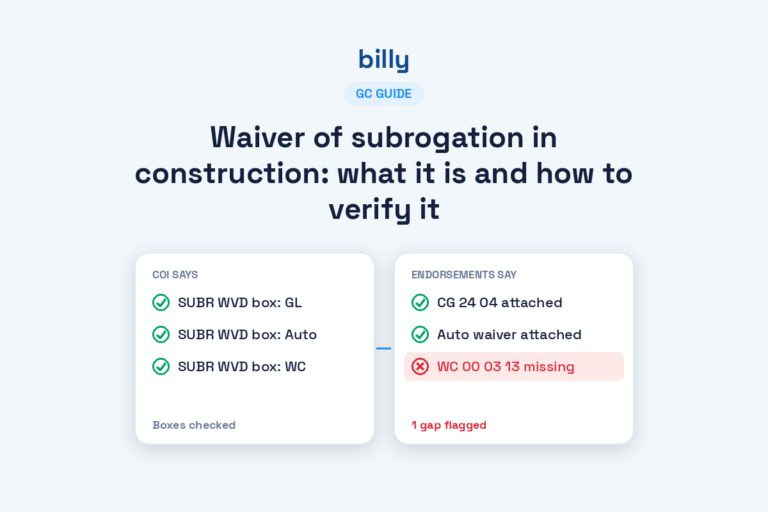
| Waiver of subrogation | CG 24 04 (GL), WC 00 03 13 (workers’ comp) | Stops the sub’s carrier from suing you to recover what it paid | Doesn’t affect which policy pays first |
See our guide to CG 20 10 and CG 20 37 for the two additional insured forms.
How primary and non-contributory shows up on a COI
This is where most compliance reviews go wrong. The ACORD 25 certificate has no checkbox for primary and non-contributory. It has “ADDL INSD” and “SUBR WVD” columns, and that’s it. Primary and non-contributory status, if it’s mentioned at all, appears only in the Description of Operations box as free text.
Typical wording you’ll see:
Three problems with relying on this:
- The broker typed it. It’s a statement about the policy, not the policy.
- The certificate disclaims itself: it confers no rights on the certificate holder.
- If the description references a form that isn’t attached, you can’t confirm the wording or the edition date.
How to verify it
- Require it in the subcontract. Spell out “primary and non-contributory” in the insurance exhibit. CG 20 01 only triggers when a written contract requires it.
- Ask for the endorsement form, not just the certificate. CG 20 01 or the carrier’s equivalent, with the edition date visible.
- Read the operative language. Look for “primary” and “will not seek contribution” or equivalent. A blanket AI endorsement that’s silent on contribution doesn’t satisfy the requirement.
- Check the umbrella too. If your contract requires primary and non-contributory on excess or umbrella coverage, the umbrella policy needs its own wording. Many don’t follow form automatically.
- Log it as a separate requirement. In your tracking system, primary and non-contributory should be its own line item with its own compliant/non-compliant status, not a note buried in the AI requirement.
What happens without it
The practical consequences of a missing primary and non-contributory endorsement show up only after a claim:
- Your carrier is pulled into a claim caused by a sub’s work, and your deductible or self-insured retention applies.
- The loss appears on your loss runs, and your experience mod or GL premium moves at renewal.
- Coverage counsel spends months arguing over “other insurance” clauses between two carriers, with you in the middle.
Owners know this, which is why most owner-GC agreements flow the requirement down: the owner requires primary and non-contributory from the GC, and the GC has to require it from every sub.
Tracking primary and non-contributory across a subcontractor roster
On a single project this is manageable. Across a hundred subs on a dozen projects, with different owner requirements on each, it’s the kind of detail that gets skipped when the reviewer is under time pressure, because it lives in a free-text box rather than a checkbox.
Billy treats primary and non-contributory as its own requirement in each project’s requirement group. The AI Review Assistant reads the description of operations and attached endorsements, flags when the wording is missing or references an unattached form, and marks the vendor non-compliant until it’s fixed. If you’ve connected Procore Pay or your accounting system, that status holds payment until the sub’s broker sends the right form.
Frequently asked questions
What does primary and non-contributory mean?
It means the subcontractor’s liability policy responds first to a covered claim against the additional insured, and the sub’s carrier won’t ask the additional insured’s own policy to share the loss. The GC’s policy sits in excess.
What is the CG 20 01 endorsement?
CG 20 01 is the ISO form titled “Primary and Noncontributory – Other Insurance Condition.” It modifies the policy’s other-insurance clause so coverage for an additional insured is primary and non-contributory when a written contract requires it.
Is primary and non-contributory the same as additional insured?
No. Additional insured status extends coverage to you. Primary and non-contributory determines which policy pays first. You need both, and they come from different endorsements.
Where does primary and non-contributory appear on a certificate of insurance?
Only in the Description of Operations box as free text. The ACORD 25 has no dedicated checkbox for it, so always request the endorsement form itself.
Does primary and non-contributory apply to workers’ compensation?
No. It’s a general liability (and sometimes auto and umbrella) concept. For workers’ compensation, the relevant endorsement is the waiver of subrogation, WC 00 03 13.
Catch missing P&NC wording automatically
Billy’s AI Review Assistant reads the description of operations and attached endorsements on every certificate and flags what’s missing against your project requirements.